Think of your company’s benefits program—health plans, retirement accounts, vision insurance, and all the rest. Managing it all can feel like trying to wrangle dozens of different moving parts. Benefits administration software is the tool that brings everything together, transforming what is often a chaotic, paper-heavy process into a smooth, organized digital experience.
What is Benefits Administration Software?

At its core, benefits administration is the entire process of creating, managing, and updating your employee benefits package. It’s a critical HR function that touches everything from tracking eligibility and educating employees to ensuring every detail is compliant with a complex web of regulations.
When done manually with spreadsheets and stacks of forms, it’s a recipe for administrative overload and costly mistakes. This is where benefits administration software comes in. It’s a centralized platform designed to automate and simplify these exact tasks. It takes the guesswork and tedious data entry off your HR team’s plate.
Freeing Your HR Team from Administrative Gridlock
The real value of this software is that it frees your HR team from getting bogged down in administrative tasks. Instead of spending hours chasing down enrollment forms or manually updating payroll deductions, they can focus on the strategic work that actually supports your employees.
During open enrollment, for instance, employees can use a self-service portal to compare their plan options and make elections on their own time. The software automatically checks eligibility, sends the enrollment data to the right insurance carriers, and updates payroll—a process that used to take weeks of painstaking manual work.
This automation has a direct impact on your business’s efficiency and accuracy. By moving the process online, the software minimizes the human errors that often lead to payroll mistakes or compliance violations. A single data entry error can cause an employee’s 401(k) contribution to be miscalculated or their health coverage to lapse. Good software prevents these issues by creating a single, reliable source for all benefits data.
Key Tasks Managed by Benefits Software
At its heart, this software automates the most time-consuming parts of managing employee perks. It acts as the central hub for a variety of critical functions, including:
- Open Enrollment: Guiding employees through plan selection with intuitive, step-by-step digital workflows.
- Eligibility Tracking: Automatically determining which employees qualify for specific benefits based on their employment status, hours worked, and applicable waiting periods.
- Life Event Changes: Allowing employees to easily update their coverage after major life events, like a marriage or the birth of a child, without needing HR to do it for them.
- Compliance and Reporting: Generating necessary reports and managing requirements for regulations like the ACA and COBRA, which have specific rules that can vary based on company size and state law.
Ultimately, benefits administration software provides the modern, user-friendly experience today’s workforce has come to expect. It helps businesses of all sizes manage complexity, reduce expensive errors, and deliver a benefits program that attracts and retains top talent.
Essential Features of Top Tier Software
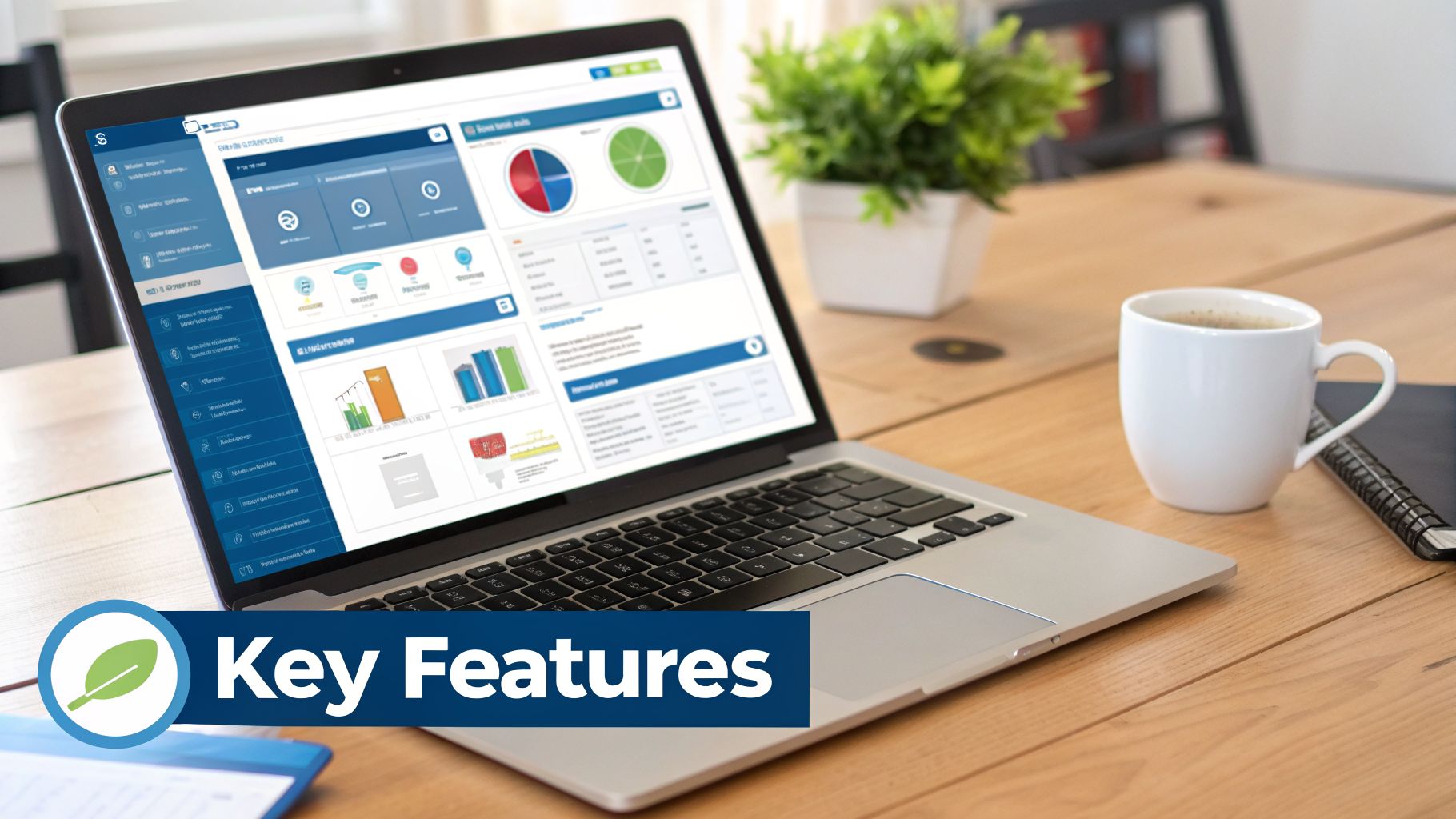
Not all benefits administration software is created equal. While plenty of platforms can move your enrollment forms online, the best ones do so much more. They offer a connected set of features designed to lighten your administrative load, keep you compliant, and give your employees real control.
Choosing the right tool starts with understanding what these core capabilities look like in action. A top-tier platform isn’t just a digital filing cabinet; it should feel like an intelligent partner for your HR team, automating tedious work and delivering strategic insights.
Employee Self-Service Portal
The heart of any modern benefits software is an intuitive employee self-service portal. This is more than a simple website—it’s a central hub where your team can manage their own benefits, 24/7. Think of it as giving every employee their own personal benefits expert they can consult at any time.
This kind of self-service access dramatically cuts down on the routine questions your HR team has to field. Instead of asking for plan details or enrollment forms, employees can log in to compare health plans side-by-side, add a new baby to their coverage, and pull up their information whenever they need it.
A great portal should deliver:
- Guided Enrollment: A step-by-step process that walks employees through open enrollment, making their options and costs crystal clear.
- Life Event Management: Simple tools for employees to report events like a marriage or the birth of a child and update their benefits accordingly within the required timeframes.
- Document Access: A secure place to find plan summaries, ID cards, and other important documents.
- Decision Support Tools: Features that help employees estimate their potential out-of-pocket costs or see which doctors are in-network.
By empowering your people, a self-service portal doesn’t just improve their experience—it frees up your HR team to focus on strategic work that actually supports the business.
Automated Compliance Dashboards
Navigating the web of benefits regulations is one of the biggest challenges for any employer. The legal landscape is a patchwork of federal, state, and even local laws where one small misstep can lead to significant penalties. That’s why automated compliance management is an absolute must-have.
The penalties for non-compliance are serious. For 2026, the Affordable Care Act (ACA) penalties for applicable large employers (ALEs) can exceed $3,000 per full-time employee for failing to offer minimum essential coverage. Penalties are indexed for inflation annually, so staying current is critical.
The best benefits software acts as a digital watchdog, automating compliance tracking and reporting for major regulations and protecting your business from costly mistakes. This is crucial for managing:
- Affordable Care Act (ACA): It should automatically generate and file forms 1094-C and 1095-C, track employee eligibility throughout the year, and run affordability tests to ensure your plans meet federal rules.
- COBRA: For employers with 20 or more employees, the system should trigger and document continuation of coverage notifications when employees leave—a process that is notoriously time-sensitive and easy to mess up when done by hand. Note that many states have “mini-COBRA” laws that apply to smaller employers.
- HIPAA: It must ensure all protected health information (PHI) is handled securely through strong platform security, data encryption, and role-based access controls.
Look for a centralized dashboard that tracks deadlines, flags potential issues before they become problems, and keeps a clear audit trail. This is especially important if you have employees in multiple states, where rules for paid leave, retirement plans, and other benefits can vary significantly.
Robust Reporting and Analytics
The most powerful benefits software doesn’t just hold your data—it helps you make sense of it. Strong reporting and analytics tools turn raw information into clear insights about your workforce and your benefits spend. This is what allows you to make decisions based on data, not just guesswork.
Imagine being able to see instantly which health plans are most popular or how your benefits costs are trending over the last three years. Those insights are invaluable when you’re trying to design a benefits package that’s both competitive and affordable.
A good analytics dashboard should let you:
- Analyze Enrollment Trends: See which benefits your employees value most and spot any gaps in your offerings.
- Track Program Costs: Monitor your spending on premiums and contributions so you can forecast budgets with confidence.
- Identify Strategic Opportunities: Use data to explore cost-saving ideas, like introducing a wellness program or offering different plan designs, without hurting employee satisfaction.
When your software turns benefits data into actionable intelligence, it becomes a true strategic asset. It helps you get the most out of every dollar you spend on benefits and ensures your program is working to attract and keep the talent you need.
Why Software Integration Is Non-Negotiable
A benefits platform that doesn’t play well with your other HR software can create more problems than it solves. Think about it: when an employee changes their benefits selection, that information needs to flow everywhere else automatically. If your systems are disconnected, your team is stuck being the bridge, manually plugging the same data into multiple platforms.
This isn’t just tedious work; it’s a huge source of risk. Every time someone re-types information, there’s a chance for error. When you’re dealing with sensitive payroll and benefits details, even a tiny mistake can snowball into a major headache, leading to payroll errors and compliance issues.
Eliminating Dangerous Manual Data Entry
There’s a reason seamless integration between your benefits administration software and other core platforms—like payroll and your HRIS (Human Resource Information System)—is the gold standard. When these systems talk to each other, data is shared instantly and accurately. No more double-entry.
This connected setup means that when an employee enrolls in a new health plan, the correct deduction amount is automatically sent to payroll. Your HR team doesn’t have to touch a calculator or manually key in a single number, which dramatically cuts down on costly payroll mistakes.
A fully integrated system helps ensure:
- Benefit deductions are calculated and applied to payroll with perfect accuracy.
- New hires are enrolled in benefits and set up in payroll without delays or missing info.
- Employee records, like name changes or address updates, stay consistent across all systems.
A study by the American Payroll Association found that the gross error rate for payroll processing can be as high as 8%, with manual data entry being a major contributor. For a company with 100 employees, that could mean thousands of dollars in payroll errors and countless hours spent on corrections each year.
The Power of a Unified HR Ecosystem
A truly integrated system goes beyond just sharing data. It creates a single, unified experience for both your HR team and your employees. When an employee updates their address in the HRIS, for instance, that change instantly populates in the benefits and payroll systems without anyone lifting a finger. This prevents critical communications from ending up in the wrong mailbox.
Integration also powers more effective time and attendance management. To get the most out of your benefits platform, a practical guide to integrating software systems can be a lifesaver. For example, data from your time tracking system can inform benefits eligibility, making sure employees who hit certain hour thresholds are correctly offered coverage as required by regulations like the ACA. You can see more on how technology helps with these rules in our article on time and attendance software.
At the end of the day, a benefits tool that isn’t integrated is just a digital version of an old paper form—it holds information, but it doesn’t actively help you manage it. Investing in software that connects seamlessly with your other HR tools is non-negotiable for any business that values efficiency, accuracy, and compliance.
Security and Compliance: Protecting Your Business and Your People

When you manage employee benefits, you’re handling your team’s most sensitive information. We’re talking about Social Security numbers, health histories, and other personal details that demand the highest level of care. A single slip-up isn’t just a breach of trust; it can expose your business to serious legal and financial trouble.
That’s why the security and compliance tools within benefits administration software aren’t just extra features—they’re essential. A modern platform is built from the ground up to protect this data, because the days of managing this on spreadsheets or in unlocked filing cabinets are long gone. The stakes are simply too high.
Keeping Your Data Secure
First and foremost, you need powerful security. Your benefits platform holds a ton of confidential information, making it an obvious target for cyberattacks. Any software vendor you consider must prove they can protect this data from anyone who shouldn’t see it.
Think of it like a digital bank vault. It’s not enough to have a strong lock on the front door; you need multiple layers of protection inside.
Here are the non-negotiable security measures to look for:
- Data Encryption: All sensitive data must be encrypted, both when it’s stored (at rest) and when it’s being transmitted (in transit). This scrambles the information, making it completely unreadable to anyone without the right key.
- Secure Access Controls: The system should let you control exactly who sees what based on their role (role-based access control). Employees and admins should only have access to the minimum information necessary to do their jobs.
- Regular Security Audits: Reputable vendors bring in independent third-party experts to test their systems for weaknesses. Always ask a potential provider for their latest security reports, like a SOC 2 Type II report, to prove they take this seriously.
Without these foundational security features, you are leaving your company and your employees at risk.
Making Sense of Complex Regulations
Beyond security is the tangled world of compliance. A dizzying number of federal and state laws govern employee benefits, and claiming ignorance won’t protect you from penalties. The right benefits administration software is designed to act as a guardrail, helping you stay on the right side of these regulations.
This automation is a huge relief for HR teams. In fact, the market for this technology continues to grow, largely because it makes complicated rules manageable. For instance, platforms have been shown to drastically cut the manual labor needed for ACA compliance, which reduces the risk of fines from errors.
At its core, compliance isn’t just about avoiding penalties. It’s about fulfilling your legal and ethical responsibility to your employees. Having an expert partner or a reliable system is key to navigating rules that often change and can differ significantly from state to state.
This is where a deep understanding of employment law becomes critical. Learning more about regulations like HIPAA compliance for small business is a great starting point for ensuring you’re protecting employee data correctly.
Key federal regulations the software helps you manage:
- ERISA (Employee Retirement Income Security Act): This law sets the standards for most private-sector retirement and health plans. The software helps you provide required documents (like Summary Plan Descriptions) to employees and keep accurate records.
- HIPAA (Health Insurance Portability and Accountability Act): Sets the national standard for protecting sensitive patient health information. A compliant platform ensures this data is handled with the highest level of security.
- ACA (Affordable Care Act): This act brings complex reporting and coverage rules for employers. The software automates eligibility tracking and generates the required 1094-C and 1095-C forms—a task that is incredibly difficult to get right on your own.
Staying on top of these risks requires a proactive approach. Understanding what HR compliance entails is the first step toward building a benefits program that protects both your business and your people.
Calculating the True Return on Investment
It’s easy to get hung up on the price tag when you’re looking at new software. But with a benefits administration platform, the subscription fee is only one small part of the story. To understand the real financial picture, you have to look beyond the initial cost and see the full return on your investment (ROI).
Thinking this way helps you see the software for what it is: a tool that can save you money and time, not just another expense. It’s about calculating both the direct, hard-dollar savings and the less obvious “soft” returns that come from a happier, more stable workforce.
Calculating the Total Cost of Ownership
Before you can measure your return, you need a clear picture of what you’re actually spending. The Total Cost of Ownership (TCO) covers every expense that comes with buying and running the software, not just the monthly bill.
A complete TCO calculation should include:
- Subscription or Licensing Fees: This is the most obvious cost, often billed per employee per month (PEPM).
- Implementation and Setup Costs: One-time fees for getting the system configured, migrating your data, and setting up carrier connections.
- Training Expenses: The time and resources it takes to get your HR team and employees up to speed on the new platform.
- Ongoing Maintenance or Support Fees: Some vendors might charge extra for premium customer support or future system updates.
Adding all these up gives you a realistic number for what the software will truly cost your business over its lifetime.
Quantifying the Hard ROI
This is where you start to see the software pay for itself. “Hard ROI” refers to the direct, measurable cost savings your business gets from automating manual work and cutting out costly mistakes.
You can start calculating savings in a few key areas:
-
Reduced Administrative Hours: Think about how much time your HR team currently spends answering the same benefits questions, fixing enrollment forms, and manually processing life event changes. A self-service portal automates most of this. For example, cutting back administrative work by just 15 hours per month at an HR manager’s fully-loaded rate can save your business thousands of dollars a year.
-
Elimination of Costly Errors: Manually entering payroll deductions and reconciling carrier bills is a recipe for errors. A single typo can lead to overpayments or underpayments that take hours of frustrating work to fix. An integrated system that syncs benefits information directly with payroll makes sure deductions are right every time.
-
Avoidance of Compliance Fines: Staying compliant with regulations like the ACA is non-negotiable, and the penalties for getting it wrong can be huge. As noted, fines for failing to offer affordable coverage can exceed $3,000 per worker annually. These tools are critical investments in risk mitigation.
The global benefits administration software market is projected to reach over $14.5 billion by 2030, growing at a CAGR of more than 12%. This growth is heavily driven by regulatory pressures and the need to avoid costly compliance missteps, with cloud-based solutions dominating the market. You can explore more data on these market trends at Data Insights Market.
The Invaluable Soft ROI
Beyond the spreadsheets, benefits administration software delivers “soft” returns that have a huge impact on your company’s culture and long-term health. These are the benefits tied to morale, engagement, and retention. A better benefits experience simply makes your company a better place to work.
Key soft returns often include:
- Improved Employee Satisfaction: A modern, easy-to-use self-service portal puts employees in the driver’s seat, giving them clarity and control over their benefits. That positive experience makes them feel valued and respected.
- Increased Retention: A great benefits experience is a powerful reason for an employee to stay. When people feel supported and can easily manage their health and financial wellness, they’re far less likely to start looking for another job. This directly reduces your costs for recruiting, hiring, and training new staff.
Standalone Software vs. An Integrated PEO
Once you decide to modernize your benefits administration, you’ll come to a fork in the road. You can buy a standalone benefits administration software platform, or you can partner with an all-in-one Professional Employer Organization (PEO). Making the right call depends entirely on your company’s resources, goals, and how much of the administrative burden you want to carry yourself.
It helps to think of it like a home renovation. Buying software is like buying a professional-grade power tool—it’s powerful and can do a specific job very well, but you’re the one who has to learn how to use it, maintain it, and ultimately do all the work. Partnering with a PEO is like hiring a full-service general contractor who brings their own top-tier tools and the expert crew to manage the entire project for you.
The Case for Standalone Software
Standalone benefits software puts the control directly in your hands. Your internal team is responsible for setting up the platform, managing open enrollment, and handling all the day-to-day administration.
This approach can work well for businesses that already have a fully staffed, experienced HR department. If your team has the time and in-house expertise to manage benefits, navigate compliance, and troubleshoot issues, a standalone tool can be a good fit. You own the process from start to finish, but that also means you own all the responsibility.
The Strategic Advantage of a PEO
A PEO like Helpside offers something fundamentally different. Instead of just selling you a piece of technology, a PEO delivers a fully integrated service that pairs powerful software with genuine human expertise. This model is a game-changer for small and midsize businesses that don’t have a large HR team.
With a PEO, the benefits administration software is just one part of a complete solution. Here’s where the partnership really shines:
- Integrated Human Expertise: You don’t just get a login; you get a dedicated team of HR, payroll, and benefits specialists. When a complex compliance question comes up or an employee has a tricky claim issue, you have a real person to call—not a support ticket.
- Access to Large-Group Benefits: PEOs bring their clients together to negotiate for Fortune 500-level benefits. This gives smaller companies access to better, more affordable medical, dental, and vision plans than they could ever secure on their own.
- Shared Liability and Compliance Management: This is a huge differentiator. A PEO becomes a co-employer, sharing certain employer-related liabilities. They manage the heavy lifting of compliance—from ACA reporting to multi-state payroll taxes—dramatically reducing your company’s risk.
For a closer look at how this model works, you can learn more about what a professional employer organization is and the value it brings to growing companies.
Standalone Software vs. Integrated PEO Partnership
Deciding between a tool and a team comes down to your company’s specific needs. The table below offers a clear, side-by-side comparison to help you see which path makes the most sense for your business.
| Consideration | Standalone Benefits Software | Integrated PEO Solution |
|---|---|---|
| Core Offering | A software tool for your internal team to manage benefits. | A comprehensive service combining technology with human experts. |
| Benefits Access | You negotiate and manage your own plans with brokers/carriers. | Access to large-group, Fortune 500-level benefit plans. |
| Compliance Risk | Your company retains 100% of the administrative and legal liability. | Certain employer liabilities are shared, with the PEO managing compliance and risk. |
| HR Support | Limited to technical support for the software. | Dedicated HR specialists provide strategic guidance and support. |
| Best For | Companies with a large, expert HR team and simple benefits needs. | Businesses seeking to reduce risk, access better benefits, and offload HR complexity. |
Ultimately, a standalone tool gives you autonomy, while a PEO partnership gives you expertise, better benefits access, and peace of mind. The best choice is the one that frees you up to focus on what you do best: running your business.
Common Questions About Benefits Technology
When you’re looking at benefits technology, a few key questions almost always come up. Getting good answers is the first step to making a decision that supports your business and your people.
How Long Does Implementation Take?
The timeline for getting new benefits technology up and running can vary quite a bit. If you choose a standalone benefits administration software, you can generally expect the process to take between four and ten weeks. This route often requires a heavy lift from your own HR team to handle data migration and connect with your insurance carriers.
Onboarding with a PEO, on the other hand, is usually a more guided experience. A dedicated implementation team works with you to sync the new system with your payroll schedule, which helps ensure a much smoother transition for all your HR functions, not just benefits.
A common misconception is that software is a “plug-and-play” solution. In reality, a successful rollout always needs a clear project plan, data cleanup, and thorough employee training to get the full value from the investment.
When Is a PEO More Valuable Than Software?
While there isn’t a single magic number, businesses with 10 to 150 employees often hit a sweet spot where the value of a PEO becomes exceptionally clear. As a company grows, so does its complexity—especially when it comes to multi-state payroll, staying compliant across different jurisdictions, and needing to offer more competitive benefits plans to attract top talent.
At that stage, the all-in-one service, shared risk management, and expert support you get from a PEO often deliver far more value than a standalone software tool ever could.
Can I Keep My Insurance Broker with a PEO?
This is a really important question, and the answer comes down to the PEO’s business model. Some PEOs require you to leave your current broker behind and use only their in-house plans and advisors.
However, a broker-friendly PEO is built to work alongside your existing broker. This model lets you keep that trusted relationship while still getting access to the PEO’s powerful technology, administrative help, and large-group benefits.
Call today for a Free, 15-Minute benefits audit: 1-800-748-5102
Further Readings:
Unlock Affordable Health Benefits for Small Businesses in 2026
How Helpside Works with Health Insurance Brokers to Elevate Client Success
Unlock Growth with Outsourced HR Services Small Business
If you’re looking for a partner that combines powerful technology with human expertise to handle your benefits, payroll, and HR, Helpside is here to help. Discover how our people-first PEO services can support your growing business.