
A manager gets a message before 8 a.m. An employee’s parent died overnight. The employee doesn’t know when the service will be, doesn’t know how much time they’ll need, and definitely isn’t thinking about handbook language. But the business still has payroll to run, customers to serve, and a team that needs direction.
That’s the moment when employers start asking the core question behind bereavement leave how many days. What’s required, what’s normal, and what’s wise?
For most U.S. employers, there isn’t one simple federal answer. Bereavement leave often sits at the intersection of three issues that small businesses feel immediately: legal risk, employee wellbeing, and business continuity. If your policy is too thin, managers improvise. If managers improvise, employees get inconsistent treatment. If treatment feels inconsistent, a hard situation can become an HR problem fast.
A workable policy does more than assign a number of days. It gives managers a script, gives employees clarity, and gives owners a defensible process when emotions are high and facts are still coming in.
Responding to Grief in the Workplace
Most bereavement situations don’t arrive neatly. An employee may ask for time to travel, manage family obligations, attend services, or to function. Another may be able to work part of the week but not at full capacity. The mistake many employers make is treating grief like a scheduling issue first and a human issue second.
Grief rarely follows a clean timeline. If your managers need a plain-language refresher on what employees may be experiencing emotionally, Grief Stages Explained is a useful resource to read before these conversations happen. It helps managers respond with context instead of assumptions.
What employers need in the first conversation
The first response should be simple and steady. A manager doesn’t need to solve everything in one call. They need to acknowledge the loss, pause operational questions until necessary, and route the situation into the company’s leave process.
A good first response sounds like this: “I’m sorry for your loss. Take care of what you need to take care of today. We’ll walk through the leave details with you and make a plan.”
That approach protects the employee and the business. It prevents careless comments, reduces confusion, and creates a record that the company handled the request thoughtfully.
The three pressures you’re balancing
Small business owners usually feel all three of these at once:
- Compliance pressure: You need to know whether state law applies and whether your handbook language still matches current rules.
- Team pressure: Someone else may need to absorb deadlines, client calls, or coverage.
- Human pressure: A grieving employee may not know what they need yet, and that’s normal.
If your current policy is vague, it helps to review a practical HR overview like this guide to understanding bereavement leave and providing employee support. Clear policy language matters most when nobody is in the right frame of mind to interpret vague wording.
The Legal Landscape of Bereavement Leave
A bereavement policy can look fine in your handbook and still create risk the first time a manager applies it across different states. That is the primary compliance problem for small and mid-sized employers. The question is rarely whether you want to offer leave. It is whether your written policy, manager guidance, and state rules still line up.
Private employers generally are not required by federal law to offer bereavement leave. In practice, that does not give employers much room to be casual. Once a policy exists, inconsistent decisions can create employee relations problems and, in some states, legal exposure.
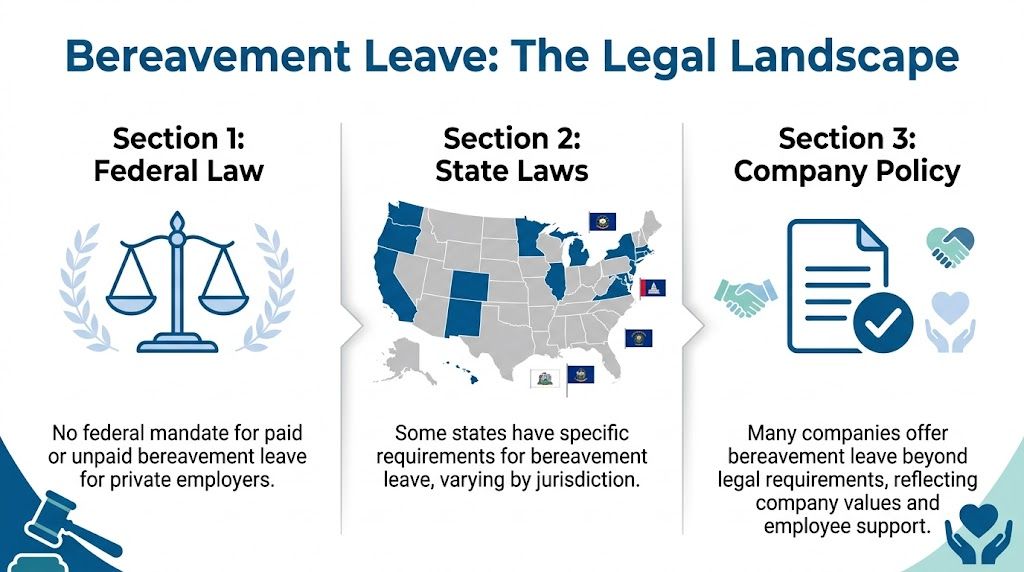
Federal law leaves room for employer policy, but state law can narrow that room
For many employers, bereavement leave starts as a handbook benefit. Then a state rule changes the terms. A manager approves one request under the old rule, denies another under the new one, and now the company has a consistency problem.
That is why multi-state employers should review bereavement leave the same way they review wage and hour rules, final pay timing, or paid sick leave. A current state-by-state employee leave law reference helps you check whether a local requirement affects eligibility, timing, documentation, or job protection.
California is the clearest example
California requires covered employers to provide bereavement leave under AB 1949. For employers with California employees, this is no longer just a policy choice. It is a compliance item that should be reflected in the handbook, manager training, and leave administration process.
Under California’s AB 1949, effective January 1, 2023, employers with 5+ employees must provide up to 5 days unpaid bereavement leave. Eligible employees need 30+ days tenure, can take the leave non-consecutively within 3 months, and can choose to use accrued paid leave.
Older handbook language often conflicts with those rules. I commonly see policies that require leave to be taken immediately after the death, limit time off to funeral attendance, or define family too narrowly. Those are the kinds of gaps that create trouble during an already sensitive situation.
California employers should check these points closely:
- Covered relationships: spouse, child, parent, sibling, grandparent, grandchild, domestic partner, and parent-in-law
- Timing: leave may be taken within a three-month period and does not have to be consecutive
- Pay status: the statutory leave can be unpaid, but employees may use accrued paid leave if they choose
- Documentation: employers may request reasonable documentation, but they should use one consistent standard
For a small business, the trade-off is simple. A tighter policy may feel easier to control, but if it conflicts with state law or forces managers to improvise exceptions, it usually creates more work, not less.
Other states can affect your policy too
California gets the most attention, but it is not the only state employers need to review. Several states have bereavement-related protections for certain employees or under specific leave frameworks. If you operate in more than one state, a single national paragraph in the handbook may not be enough.
The practical decision is whether to maintain state-specific addenda or adopt a company standard that meets or exceeds the strictest rule that applies to your workforce. Small employers often prefer one broader standard because it reduces manager guesswork. Multi-state employers with more complex leave programs may need a base policy plus state supplements.
This is one of the areas where a PEO or experienced HR partner can save time and reduce avoidable mistakes. The value is not just policy drafting. It is keeping the handbook, leave process, and manager instructions aligned as state rules change.
What a Typical Bereavement Leave Policy Includes
A business owner usually asks one practical question first: what do we put in the handbook so managers stop improvising during a difficult moment?
The answer is not just a day count. A usable bereavement policy sets the baseline, defines who is covered, explains how time can be taken, and gives managers a controlled way to approve exceptions. For small businesses, that structure limits inconsistent decisions. For multi-state employers, it also reduces the chance that one location handles requests more generously or more restrictively than another.
Many employers use a tiered approach. In plain terms, they provide more leave for the death of an immediate family member and less for extended family. A common setup is 3 to 5 paid days for immediate family and 1 to 3 days for extended family, with extra time handled through PTO, unpaid leave, or HR review.

Why employers use tiers
Tiering is an administrative choice as much as a compassionate one. The death of a spouse, child, parent, or sibling often creates immediate responsibilities such as travel, funeral planning, childcare changes, and estate tasks. Extended family losses can still be personal, but employers often set a shorter default to keep the policy easier to apply across the workforce.
A simple version looks like this:
| Relationship group | Common practice |
|---|---|
| Immediate family | 3 to 5 paid days |
| Extended family | 1 to 3 days |
| More distant relationships | Often handled through manager discretion or PTO |
This format works because managers can use it quickly. It also gives HR a starting point for exceptions.
What the written policy should actually cover
The strongest policies answer the questions managers get on day one, not just the questions HR thinks of during drafting. At minimum, include:
- Covered relationships: Define immediate family and extended family clearly. Include domestic partners, in-laws, grandparents, grandchildren, and room for HR review of comparable family relationships.
- Amount of leave: State the standard number of paid or unpaid days for each category.
- Pay rules: Clarify whether bereavement leave is paid, unpaid, or partially paid, and whether employees may use PTO for additional time.
- Timing: Explain whether leave must be taken right after the death or can be used later for services, travel, or estate matters.
- Approval process: Tell employees whether they notify a direct manager, HR, or both.
- Documentation: State whether you may request an obituary, funeral notice, or another reasonable form of documentation, and apply that standard consistently.
- Flexibility: Reserve discretion for unusual situations, but route exceptions through HR or a designated decision-maker rather than leaving them entirely to frontline managers.
If you need a starting point for drafting, a practical bereavement leave policy template resource can help you turn these points into handbook language.
What works and what creates problems
The trade-off is straightforward. A narrow policy looks easier to control, but it often creates more exceptions, more manager discomfort, and more employee relations risk.
What usually works:
- A clear baseline: Employees and managers know the default rule.
- A defined exception path: HR can approve added time for travel, caregiving responsibilities, or nontraditional family situations.
- A modern family definition: The policy reflects how employees live.
What tends to create problems:
- Funeral-only wording: Employees may need time before or after a service.
- No written policy at all: Every request turns into a custom decision.
- Manager-only discretion: Similar cases get treated differently across teams or states.
I advise small and multi-state employers to write bereavement leave like an operational policy, not a values statement. The supportive message matters, but primary protection comes from clear rules, manager instructions, and a process that stays consistent across locations. A PEO or experienced HR partner can help keep those pieces aligned as your workforce and state obligations get more complex.
How to Design Your Bereavement Leave Policy
A strong bereavement policy should be short enough for managers to use and specific enough for HR to enforce consistently. The biggest mistake is writing a sentimental paragraph instead of an operational policy. Compassion matters. So do definitions, timing rules, and documentation standards.
If you’re drafting or revising language, a practical bereavement leave policy template resource can speed up the process and reduce ambiguity.
Start with the core policy choices
Before you write a single sentence, decide these points internally:
-
Eligibility
Will all employees receive bereavement leave, or only full-time employees? If you use different eligibility rules, make sure they’re intentional and consistently applied.
-
Covered relationships
Define immediate family and extended family clearly. If you want fewer exceptions later, include domestic partners, in-laws, grandparents, grandchildren, and language that allows HR review for comparable family relationships.
-
Paid, unpaid, or mixed
Many employers provide a paid baseline and then allow employees to supplement with PTO or unpaid leave if more time is needed.
-
Timing of use
Decide whether leave must be used immediately, can be split, or may be used within a set period after the loss. If you operate in a regulated state, your timing rule must align with that state.
Sample handbook language you can adapt
Here is a practical starting point:
Employees may take bereavement leave following the death of a covered family member. The company provides up to five workdays for the death of an immediate family member and up to three workdays for the death of an extended family member, subject to applicable state law.
That sentence handles the baseline. It does not handle real-life administration yet.
Add a family definition:
Immediate family includes spouse, domestic partner, child, parent, sibling, grandparent, grandchild, parent-in-law, and any other individual whose relationship to the employee is equivalent to a family relationship, as approved by HR.
That final clause matters. It gives you room to handle modern family structures without rewriting the handbook every time a difficult case appears.
Decide how much proof is reasonable
Documentation is one of the fastest ways to damage trust if handled poorly. Employers are allowed to verify leave in some settings, but managers shouldn’t demand proof in the first conversation unless law or policy clearly requires it.
Use language like this:
The company may request reasonable documentation when appropriate, such as an obituary, memorial notice, or other confirming record. Requests for documentation will be made with discretion and applied consistently.
That wording does two useful things. It preserves your right to verify while discouraging reflexive overreach.
Clarify how the leave is taken
One of the biggest operational gaps is whether bereavement leave must be consecutive. The answer depends on your policy and, in some states, the law. If your business wants flexibility, say so directly.
Bereavement leave may be taken consecutively or, with manager and HR approval, in separate increments related to travel, services, estate matters, or other needs associated with the loss, unless a different rule applies under state law.
Build in PTO coordination
A good policy should also explain what happens when the standard allotment isn’t enough.
- Allow supplementation: Employees may use available PTO if they need additional time.
- Reserve discretion carefully: HR can approve extra unpaid time when circumstances justify it.
- Separate legal leave from company leave: If state law creates additional rights, your policy should say the company will comply with applicable law.
For employers in the Intermountain West and nearby states, one option is to use a PEO or HR partner that can maintain handbook language, leave workflows, and state-specific updates in one place. Helpside is one example of a platform and service model that supports payroll, HR administration, and multi-state compliance for small and midsize employers.
A Manager’s Guide to Handling Leave Requests
Managers rarely need more empathy. They usually need better wording. In bereavement situations, the wrong sentence can stay with an employee for years.
A strong response is calm, brief, and practical. A weak response is either cold or overly personal.
What to say first
A manager can use this:
“I’m sorry for your loss. Please take the time you need today, and we’ll work with HR on next steps and coverage.”
That response works because it does three things at once. It acknowledges the loss, removes immediate pressure, and sets a process.
What not to say:
- “I know exactly how you feel.” Grief isn’t interchangeable.
- “When will you be back?” That can be necessary later, but it shouldn’t be the first question.
- “Can you still join the client call?” Unless there is a true emergency, this lands badly.
How to handle team communication
Managers also need to know what to tell coworkers. Share only what the employee is comfortable sharing. In many cases, the best team message is short and respectful.
For example:
- Internal note: “Jordan is out on bereavement leave. Please route urgent project questions to Sam through Friday.”
- Client-facing note: “Jordan is out of office. Sam will be your contact this week.”
No speculation. No details. No casual commentary.
Preparing for the return to work
The return date isn’t the end of the issue. Some employees come back ready for routine. Others can complete basic tasks but aren’t operating at their usual level.
Managers should plan for:
-
A check-in on workload
Ask what absolutely must happen first and what can wait.
-
A temporary reset of expectations
If possible, reduce nonessential meetings or low-value work for a short period.
-
A private follow-up
Don’t make the employee explain the situation publicly to the team.
A respectful return sounds like this: “We’re glad you’re back. Let’s look at this week together and decide what needs your attention first.”
That’s practical support. It’s also good management.
Best Practices for Small and Multi-State Businesses
A five-person company in one state can often handle bereavement leave informally. A 40-person company with staff in three or four states usually cannot. One manager says yes, another asks for documentation, payroll codes the time three different ways, and the problem becomes both a people issue and a compliance issue.
Small employers also feel the operational hit faster than large companies. One absence can disrupt client deadlines, billing, shift coverage, and manager capacity in the same week. That reality leads some owners to keep the policy tight. In practice, a policy that is too narrow often creates more exceptions, more manager improvisation, and more employee relations risk.
A workable policy reduces confusion.
For employers still benchmarking bereavement leave how many days, the useful question is not just how many days peers offer. The better question is whether your policy can be applied consistently across locations, pay types, and managers without forcing HR to make judgment calls every time someone experiences a loss.

One broad policy or state-by-state rules
Multi-state employers usually choose between two setups.
Option one is a single company-wide policy that meets the highest standard among the states where you operate. This is easier to train, easier to explain, and less likely to produce uneven decisions.
Option two is a core policy plus state addenda. This gives you more specific alignment by jurisdiction, but it also requires tighter tracking, better documentation, and managers who know when state rules override the general policy.
Here is the trade-off:
| Approach | Advantage | Risk |
|---|---|---|
| Single broad policy | Simpler administration | May provide more leave than legally required in some states |
| State-specific addenda | More specific by jurisdiction | Higher risk of inconsistent manager application |
For many SMBs, the first option is worth the extra cost. You may give a few more paid days than strictly required in some states, but you cut down on training errors and one-off exceptions. For employers growing quickly or hiring remote workers across state lines, that simplicity has real value.
If you use the second option, treat it like a compliance system, not a handbook footnote. HRIS settings, payroll codes, manager guides, and leave request forms all need to match.
What works well for SMBs
These practices hold up under real use:
- Build for common complications: Include travel, delayed memorial services, estate tasks, and caregiving responsibilities.
- Create one intake process: Employees should know who receives the request, who approves it, and how the time is recorded.
- Review requirements before entering a new state: Do this during hiring setup, not after the first leave request lands on a supervisor’s desk.
- Give managers a short script and escalation rule: If the request falls outside the standard policy, managers should know when to stop and hand it to HR.
- Use outside support if your internal team is thin: A PEO or experienced HR partner can help small employers keep state rules, handbook language, payroll practices, and manager training aligned.
The companies that handle bereavement leave best are not always the ones with the longest leave allotment. They are the ones with clear rules, a small amount of defined flexibility, and managers who do not have to guess.
Frequently Asked Questions About Bereavement Leave
Does bereavement leave have to cover pregnancy loss or miscarriage
Sometimes yes, and the answer can change by state. For a multi-state employer, this is one of the easiest places to make a costly mistake because managers often treat it as a judgment call instead of a policy issue.
If your policy does not address pregnancy loss, miscarriage, or related circumstances, fix that before the next request comes in. Define what events are covered, who reviews exceptions, and whether any state-specific rule changes the outcome. Small businesses rarely have time to sort this out case by case while an employee is waiting for an answer.
Can we cover a close friend or chosen family member
Yes, if you choose to. Many small employers do better with a policy that names immediate family members, then gives HR or a designated decision-maker authority to approve comparable relationships.
That approach gives employees some flexibility without turning every request into a manager-by-manager interpretation problem.
Can bereavement leave be taken intermittently
Yes, if your policy allows it and state requirements do not say otherwise. Intermittent use often comes up in real situations, especially when an employee needs time for travel, a delayed service, religious observances, or estate responsibilities that happen over more than one day.
Write the rule down. State whether the leave must be taken consecutively, within a set window, or in partial-day increments. If you leave that open, supervisors will apply different standards, and payroll errors usually follow.
What’s the best benchmark if I’m still asking bereavement leave how many days
Start with common practice, then adjust for your workforce and compliance burden. This overview of bereavement leave how many days is a useful benchmark, but it should not be your final policy.
For SMBs, the better question is whether your policy is easy to apply across every location, manager, and payroll process you already run. A slightly more generous policy that is clear and consistently administered is often safer than a narrower policy full of exceptions. If your team is growing and your leave policies are starting to vary by state, manager, or handbook version, Helpside can help you standardize the process, update policies, and manage HR and payroll administration with less manual guesswork.
Call Helpside today for your Free 15-Minute Benefits Audit: 1-800-748-5102
Further Readings:
How to do payroll: A Complete 2026 Guide for Small Businesses