
You hired an independent contractor to handle a project, fill a skill gap, or move faster than your internal team could. Now the relationship isn’t working, or the work is ending, and you need to close it out without creating a bigger problem than the one you’re trying to solve.
That’s where many small businesses get exposed.
A contractor termination letter looks simple on the surface. In practice, it sits at the intersection of contract law, documentation, payment obligations, access control, and, for multi-state employers, classification risk. A vague template pulled from the internet can miss the exact contract clause, skip state-specific notice issues, or use language that sounds more like an employee discipline letter than a contractor notice.
For owners and operators across Utah, Idaho, Arizona, and Wyoming, that distinction matters. A sloppy termination can trigger disputes over unpaid work, confidentiality, intellectual property, or whether the person was really an independent contractor in the first place.
Before You Write the Letter Critical First Steps
The letter comes late in the process. Effective risk management starts before you draft a single sentence.

Start with the contract, not the frustration
Most termination mistakes happen because the business acts from irritation instead of from the written agreement.
Pull the signed contractor agreement and read the sections on termination, notice, payment, deliverables, confidentiality, intellectual property, and dispute resolution. If the relationship has changed over time, gather amendments, statements of work, email approvals, and any later scope documents too.
A contract may allow termination for cause when the contractor breaches a defined obligation. It may also allow termination for convenience, which means ending the relationship without alleging fault, usually with whatever notice the agreement requires.
That distinction is strategic, not semantic. According to contract lifecycle management data summarized by Paradigmie, for convenience terminations succeed in 85% of cases without disputes, while for cause terminations succeed in 65% because they require proof. The same source notes that missing clause citations lead to 35% of employer liability reversals.
If you have the right to terminate for convenience and your main goal is a clean exit, that may be the lower-risk path. If you need to terminate for cause because of a material breach, late-stage payment dispute, or repeated nonperformance, your documentation needs to be much tighter.
Classify the situation correctly
Use the facts, not your gut reaction.
| Criteria | Termination for Cause | Termination for Convenience |
|---|---|---|
| Primary trigger | A specific contractual breach | A business decision to end the relationship without alleging fault |
| Proof required | Yes. You need records tied to the agreement | Less proof of wrongdoing, but you still need proof you followed the contract |
| Tone of letter | Factual and evidence-based | Neutral and concise |
| Common risk | Weak or vague allegations | Failing to cite the clause or notice period |
| Best use case | Missed deliverables, failure to meet specs, nonpayment issues, confidentiality breaches | Budget changes, shifting priorities, role redesign, project completion, vendor consolidation |
Build your file before you draft
If this is a for-cause termination, you need a paper trail that shows a pattern or a defined breach.
That usually includes:
- The governing agreement: The signed contract and the exact section you’re relying on.
- Performance records: Missed deadlines, rejected deliverables, quality issues, or payment discrepancies.
- Prior notices: Emails, warning letters, meeting notes, or cure notices.
- Objective evidence: Attachments, redlines, acceptance criteria, or statements of work showing what was required and what was missed.
- Administrative records: Invoice status, expense submissions, and any company property or system access assigned to the contractor.
Practical rule: If you can’t point to the clause, the date, and the supporting record, you’re not ready to send the letter.
This is also the stage to pressure-test classification. If the contractor has been managed like an employee, used like an employee, and terminated like an employee, your documentation problem may be bigger than the letter itself. If you need a refresher on where businesses get this wrong, review this guide on independent contractor vs employee classification for small businesses.
Decide who needs to approve the message
In a small business, termination decisions often move fast. The owner is frustrated, the project is behind, and someone wants the relationship ended by the afternoon.
Slow that down just enough to protect the company.
For a higher-risk termination, review the draft with the person who owns the contract, the finance lead handling final payment, and legal counsel if the facts are disputed. If the contractor worked across multiple states or had access to customer data, intellectual property, or regulated information, add the right internal stakeholders before the notice goes out.
A contractor termination letter works best when it reflects one consistent position. Not a legal theory from one person, a payment promise from another, and a different story in Slack.
Drafting the Contractor Termination Letter Clause by Clause
A strong letter isn’t long. It’s exact.
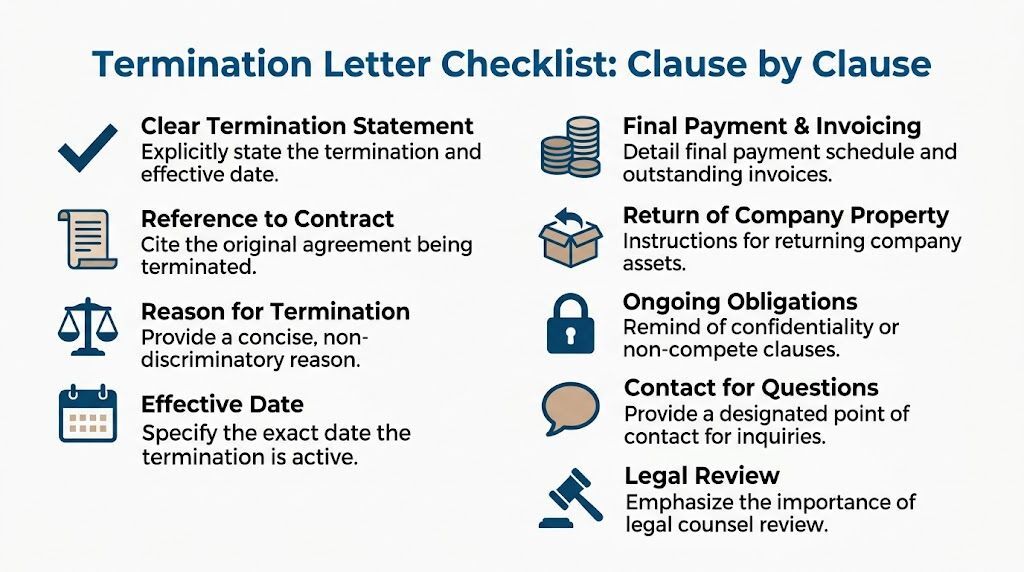
The job of the letter is to create a clean written record. It should tell the contractor what is ending, why it is ending if cause applies, when it ends, what happens to payment, and what obligations continue after the relationship is over.
A global review reported that performance shortcomings (47%) and financial issues (32%) are the leading causes of contractor termination, and it stressed that defensible letters use objective reasons with evidence and avoid emotional language, as noted by Hire in South’s guidance on effective independent contractor termination.
Open with a direct termination statement
The first paragraph should say exactly what the letter does.
Good opening language is simple:
- This letter serves as formal notice that Company is terminating the Independent Contractor Agreement dated [DATE].
- This letter serves as formal notice of termination pursuant to Section [X] of the agreement dated [DATE].
Avoid long windups, apologies, or commentary about how difficult the decision was. They don’t add legal value, and they can create ambiguity.
If it’s a for-cause termination, say that plainly. If it’s for convenience, say that too. Don’t mix the two.
Cite the agreement and the clause
This is one of the most important lines in the entire document.
State the exact contract title, effective date, and relevant clause. If the agreement includes a notice provision, follow it in the letter and in delivery. If there’s a separate statement of work being terminated, identify that separately.
A contractor should be able to read the notice and know which legal instrument governs the separation.
If your agreement language is weak or outdated, this is usually the point where businesses realize the problem started upstream. A stronger independent contractor agreement makes terminations much easier to execute cleanly.
State the effective date without room for debate
Use an exact calendar date.
If the contract requires notice, count it carefully. If termination is immediate under a for-cause clause, say “effective immediately” only if the agreement supports that result and your facts justify it.
Don’t say “as soon as possible,” “at the end of the month,” or “after transition.” Those phrases invite dispute.
The effective date is where legal drafting meets operations. Payroll, accounts payable, system access, handoff, and final invoice review all depend on it.
Give the reason only to the level the contract and facts support
A common mistake is overexplaining.
For a convenience termination, keep it short. You usually don’t need a narrative. The point is not to create a record of fault where none is necessary.
For a for-cause termination, include only factual, supportable statements tied to the contract. Example structure:
- Pursuant to Section 4.1, Company is terminating the agreement for cause.
- Deliverables submitted on October 15, 2026 failed to meet the specifications in Exhibit A.
- Company previously notified Contractor of these deficiencies in writing on October 5, 2026.
That approach is much safer than broad accusations like “poor quality,” “unprofessional conduct,” or “failure to perform adequately.”
Here’s a quick visual summary before you finalize the draft.
Cover final payment and invoice procedure
Many disputes that look legal are really accounting problems.
Your letter should state:
- What will be paid: Approved work through the effective date, if owed under the contract.
- What must be submitted: Any final invoice, expense documentation, or supporting materials.
- When payment will be processed: Use the timeline required by the agreement or your normal accounts payable process if consistent with the contract.
- What is excluded: Unapproved future work, disputed deliverables, or costs not allowed under the agreement.
Be clear, but don’t promise more than the contract requires.
Add closeout obligations that protect the business
A contractor termination letter should also address the practical fallout.
Include instructions for:
- Return of company property: Laptops, keys, badges, files, prototypes, or paper records.
- Access termination: Company systems, shared drives, messaging platforms, project tools, and client-facing accounts.
- Confidentiality and IP: Remind the contractor that confidentiality, non-disclosure, and intellectual property assignment terms remain in effect if the agreement says they survive termination.
- Records handoff: Project files, passwords held in escrow, status notes, and customer communications if required.
End professionally
Close with a designated contact for logistics, invoicing, or document return.
Then stop.
Don’t add softening phrases that imply the relationship may continue informally. Don’t promise references. Don’t suggest future work unless the business has intentionally decided to preserve that option and the legal wording supports it.
A contractor termination letter should close the relationship, not reopen it by accident.
Sample Termination Letters for Common Scenarios
Templates are useful when they show judgment, not just format.
The two samples below are intentionally plain. That’s the point. A contractor termination letter should read like a business record, not a dramatic speech.
Sample for-cause termination letter
[Company Letterhead]
Date: [Insert Date]
To: [Contractor Name]Address: [Contractor Address]
Re: Termination of Independent Contractor Agreement
Dear [Contractor Name],
This letter serves as formal notice that [Company Name] is terminating the Independent Contractor Agreement dated [Agreement Date] pursuant to Section [4.1] of that agreement.
The basis for termination is Contractor’s failure to satisfy contractual performance requirements. Specifically, the deliverables submitted on October 15, 2026 did not meet the specifications required under Exhibit A. Company previously notified Contractor of these deficiencies in writing on October 5, 2026 and provided an opportunity to cure.
The termination is effective [immediately / on Insert Date], in accordance with the agreement.
Contractor must cease performing services as of the effective date and deliver to Company all work in progress, project files, credentials, and any Company property in Contractor’s possession no later than [Date]. Any final invoice for approved services rendered through the effective date must be submitted by [Date], with supporting documentation.
All confidentiality, non-disclosure, intellectual property, and other surviving obligations under the agreement remain in full force.
Please direct questions regarding payment or closeout logistics to [Name, Title, Contact Information].
Sincerely,
[Name][Title][Company]
Why this works
The letter cites the agreement, names the clause, identifies the factual breach, references the prior written notice, and gives a defined closeout path.
That matters because CobbleStone Software’s contract termination guidance notes that vague reasons like “poor quality” invite countersuits in 60% of cases, while specific, documented breach language materially reduces litigation risk.
If your facts are messy, your letter should get shorter, not longer. Long letters often reveal uncertainty.
Sample for-convenience termination letter
[Company Letterhead]
Date: [Insert Date]
To: [Contractor Name]Address: [Contractor Address]
Re: Notice of Termination
Dear [Contractor Name],
This letter serves as formal notice that [Company Name] is terminating the Independent Contractor Agreement dated [Agreement Date] pursuant to Section [8.2] of the agreement.
This termination is for convenience and will be effective on [Insert Date], consistent with the notice period required by the agreement.
Please complete any approved transition items identified by Company before the effective date and provide all final project materials, status documentation, and any Company property by [Date]. Please submit any final invoice for approved services and reimbursable expenses, if permitted under the agreement, by [Date].
Company appreciates the services provided during the engagement and wishes you the best in your future work.
Please send any questions regarding offboarding or payment to [Name, Title, Contact Information].
Sincerely,
[Name][Title][Company]
Why this works
This version stays neutral. It doesn’t drift into criticism, and it doesn’t create a record of fault where none is needed.
If you want a simple formatting reference you can print and mark up during review, this Printable Termination Letter can be a useful working aid before legal or HR finalizes the actual notice.
What both letters avoid
Neither sample includes emotion, personal judgments, or improvised legal language.
That’s deliberate. The safest contractor termination letter usually sounds a little boring. Boring is good.
Navigating Delivery and Post-Termination Logistics
A strong letter can still fail if you deliver it poorly.

Delivery matters because disputes often turn on timeline. When was notice sent. When was it received. Was work still performed after notice. Did anyone keep assigning tasks anyway.
In federal contracting, formal written delivery by methods such as certified mail or confirmed email is required, and upon receipt the contractor must halt work immediately and notify subcontractors, according to this review of FAR termination procedures. Even outside government contracting, that’s a smart standard for private businesses because it creates a documented timeline.
Use a delivery method you can prove
For most small businesses, the best practice is straightforward:
- Send the notice in writing: Use email and a tracked physical method if the contract allows or requires both.
- Confirm receipt: Ask for acknowledgment if your contract requires confirmation or if the matter is likely to become contentious.
- Save the record: Preserve the sent email, attachment, mailing receipt, and any acknowledgment.
- Match the agreement: If the notice clause says certified mail, overnight courier, or a specific address, follow it exactly.
Don’t rely on a text message, Slack message, or verbal call as your primary notice.
Shut down work cleanly
Once the effective date hits, the contractor shouldn’t keep producing work, accessing systems, or speaking for the company unless the notice expressly allows a narrow transition task.
Create a same-day checklist:
| Closeout item | Why it matters |
|---|---|
| Disable system access | Prevents data loss, unauthorized activity, and confusion about authority |
| Recover company property | Protects devices, files, badges, and physical security |
| Collect deliverables and records | Preserves work product, client history, and project continuity |
| Notify internal stakeholders | Stops accidental assignments or payments after termination |
| Confirm payment process | Reduces invoice disputes and repetitive follow-up |
Handle the conversation like an operator
If you’re delivering the decision live, keep the conversation brief and controlled.
State that the company is ending the engagement, that written notice is being provided, what the effective date is, and who will handle logistics. Don’t debate the merits in real time. Don’t improvise promises.
A termination meeting is not a negotiation session unless you intentionally structured it that way in advance.
In some situations, owners ask whether a delayed departure model makes sense. That can be useful in employee settings, and if you’re comparing approaches, this explainer on understanding garden leave policies provides context. For independent contractors, though, you need to be careful. Extending pay while restricting work can create classification and control questions if it isn’t grounded in the contract and handled properly.
Document the offboarding process
The notice is one record. The offboarding file is another.
Keep a file that shows:
- date and method of notice
- acknowledgment of receipt, if any
- date access was removed
- date property was returned
- status of final invoice review
- internal communications telling managers not to assign new work
If your company doesn’t have a consistent workflow for this, build one and use it every time. A formal termination procedure reduces avoidable mistakes, especially when different managers work with different contractors.
Multi-State Compliance and Reducing Legal Risk
Generic templates break down fastest when your business operates across state lines.
A contractor who supports clients in Utah, works remotely from Arizona, signs an agreement tied to Idaho operations, and handles a project touching Wyoming can turn a simple exit into a multi-layer compliance problem. The contract still matters. So do the facts of the relationship. But state-specific rules and interpretations can change how much risk the business carries after termination.
The letter can affect classification risk
This is the issue many owners miss.
A bad contractor termination letter doesn’t just create a contract dispute. It can also help a claimant argue that the person functioned like an employee. If the letter reads like employee discipline, references handbook policies that don’t apply to contractors, or shows the company controlled the person like staff, it may undercut your classification position.
That’s especially important for smaller multi-state employers. According to Penbrothers’ analysis of termination-letter compliance issues, 72% of misclassified contractor disputes arise from inadequate termination documentation. The same source notes that for businesses with 20 to 150 employees operating across states such as Utah, Idaho, Arizona, and Wyoming, multi-state compliance is a major risk area.
State nuance changes the practical answer
One state may be more flexible about contract ending mechanics. Another may put more weight on good-faith conduct, notice handling, or post-termination restrictions.
You don’t need to become a fifty-state expert to handle this well. You do need to stop assuming one online template covers every situation.
A few practical examples:
- Notice periods can differ in effect: Your agreement may say one thing, but state-specific rules or the facts around prior warnings can shape how defensible your process looks.
- Post-termination restrictions can vary: Confidentiality, IP assignment, and non-compete language may not be interpreted the same way everywhere.
- The worker’s location matters: A contractor based in one state and serving your business in another can create overlapping legal questions.
- Classification facts matter more than labels: Calling someone an independent contractor in the agreement won’t save you if the actual relationship looked like employment.
Wyoming is a good example of why templates fail
Penbrothers notes a specific 2025 Wyoming issue: if prior warnings are undocumented, for-cause terminations require 30-day notice, and 90% of online templates miss that nuance.
That is exactly how owners get into trouble.
They use a broad internet template, assume immediate termination is fine, and send a letter that doesn’t match the contract, the documentation file, or the state-specific rule set. At that point, the legal problem isn’t just the separation. It’s whether the business can still defend the process at all.
Multi-state contractor terminations fail when businesses treat them like admin tasks. They’re legal-operational events.
What lowers risk in practice
For a growing business, the best protection usually comes from disciplined process, not complicated prose.
Use this checklist before sending any contractor termination letter involving cross-state operations:
- Identify the contractor’s working state or states. Don’t assume the company headquarters state controls everything.
- Review the agreement and any state-specific addenda. Especially notice, governing law, confidentiality, IP, and dispute provisions.
- Check whether the relationship was managed like a contractor or like an employee. This goes to classification risk.
- Match the tone and content of the letter to contractor status. Avoid employee-policy language unless it directly belongs under the contract.
- Align payment, offboarding, and access removal. Inconsistency creates facts that claimants use later.
- Escalate edge cases early. If the person handled core business functions, worked full time for you, or had long-term exclusivity, get legal review.
The practical takeaway is simple. The contractor termination letter is not an isolated document. It is evidence. In a multi-state environment, it becomes evidence about the contract, the relationship, and the classification decision all at once.
Frequently Asked Questions About Contractor Terminations
Can I just stop assigning work instead of sending a contractor termination letter
Sometimes owners assume silence is safer than a formal notice. It usually isn’t.
If the agreement has a notice requirement, you should follow it. If you stop sending work, you can create disputes over whether the contract is still active, whether notice was effective, and whether ongoing obligations were ever triggered.
What if the contractor refuses to return company property
Treat that as a contract enforcement and security issue, not a personal conflict.
Document the missing property, send a follow-up demand tied to the agreement, disable access immediately, and preserve records of what was issued and what was requested back. If the property includes sensitive data or credentials, involve counsel and your IT lead quickly.
Is terminating a contractor legally different from terminating an employee
Yes. The legal framework is different because the relationship is different.
A contractor termination usually turns first on the written agreement and the facts of the business relationship. An employee termination raises a separate set of employment law questions. Mixing those frameworks in your letter can make your position worse, especially if classification is already questionable.
What if the contractor threatens legal action
Don’t argue by email.
Acknowledge receipt, preserve all records, stop informal commentary inside the company, and route the issue through the person handling legal or HR risk. If your letter was factual, clause-based, and supported by documentation, you’ll be in a much better position than if you sent an emotional or improvised notice.
Should I explain every detail in the letter to make my case stronger
Usually no.
For-cause letters need enough detail to tie the decision to the contract and the facts. They do not need every grievance the business has accumulated. Overloading the letter can create inconsistencies, invite side arguments, and expose weak points you didn’t need to raise.
Do I need a lawyer to review every contractor termination letter
Not every time. But some situations deserve review.
Get help when the facts are disputed, the contractor operates across states, the person had access to sensitive information, the agreement is poorly drafted, or the relationship may look like employment in practice.
Don’t let a simple termination turn into a legal problem.
If you want a second set of eyes on your contractor agreements, termination process, or classification risk, Helpside can help you get it right before issues escalate.
Call today for a Free, 15-Minute benefits audit: 1-800-748-5102
Further Readings:
Unlock Affordable Health Benefits for Small Businesses in 2026
What Is a PEO—and Is It Worth It? Insights from Lever1’s Erica Brune & Chad Braymer
Unlock Growth with Outsourced HR Services Small Business
Growing businesses usually don’t struggle because they lack a template. They struggle because contractor terminations touch contracts, pay, access, classification, and multi-state compliance at the same time. If you want an experienced partner to help reduce HR and compliance risk while your team scales, Helpside supports small and midsize employers across the Intermountain West with payroll, HR, benefits, and practical risk management.