
An employee handbook often feels like a formal, “big company” document, but for a growing business, it’s one of the most important tools you can have. A good employee handbook template is your starting point for creating a single source of truth—the go-to guide for setting clear expectations, building a consistent culture, and protecting your business legally.
This guide will walk you through how to take a template and make it your own.
Why Your Business Needs a Handbook Now More Than Ever

If you think an employee handbook is just for corporate giants, it’s time to reconsider. As your business grows, the unwritten rules and informal ways of doing things start to create confusion, inconsistency, and real risk. A thoughtfully prepared handbook is your best defense against costly misunderstandings and helps you foster a much more productive work environment.
For any company navigating the complex web of employment laws—whether in one state or several—this document is non-negotiable. It formalizes clear, legally sound policies that protect your business while ensuring every team member is treated fairly and consistently.
To illustrate, here’s a quick look at the core benefits a handbook provides.
At-a-Glance Benefits of an Employee Handbook
| Benefit Area | Impact for Your Business |
|---|---|
| Clear Expectations | Reduces confusion and questions by clearly defining policies on PTO, conduct, and performance. |
| Legal Compliance | Documents adherence to federal, state, and local laws, serving as a first line of defense against disputes. |
| Consistent Management | Ensures all managers apply company policies uniformly, reducing claims of favoritism or discrimination. |
| Culture Building | Communicates your company’s mission, values, and what it’s like to work on your team. |
| Onboarding Efficiency | Gives new hires a comprehensive resource to understand company procedures from day one. |
Ultimately, a handbook is an investment in stability and clarity as your company scales.
Create a Single Source of Truth
Without a handbook, employees are left guessing about everything from how to request time off to what’s considered appropriate workplace conduct. That ambiguity quickly leads to managers applying rules differently, which can sink morale and open the door to claims of unfair treatment.
A handbook serves as the official reference for your entire team. Much like a modern employee self-service portal, it empowers your staff to find answers on their own. This saves your managers valuable time and reinforces a culture of accountability.
A well-maintained handbook is much more than a dry policy document. It’s a strategic tool that defines your culture, clarifies expectations, and becomes your first line of defense in any legal dispute.
Reduce Legal Risks and Ensure Compliance
The legal landscape for employers is always changing. A handbook is your formal method for communicating and documenting compliance with federal, state, and local laws. This includes absolutely critical policies such as:
- Equal Employment Opportunity (EEO) statements
- Anti-harassment and anti-discrimination procedures
- Family and Medical Leave Act (FMLA) guidelines (for eligible employers)
- At-will employment disclaimers, which are crucial in many states
Having these policies in writing—and getting employees to acknowledge they’ve received them—is a powerful way to demonstrate due diligence and reduce legal risk. It is a fundamental best practice for businesses of all sizes to maintain a handbook to mitigate disputes and foster clarity in the workplace.
Crafting Your Handbook’s Legal Foundation
While your handbook is a great place to share your company culture and operational details, its most critical job is to protect your business. The legal policies are the non-negotiable foundation of the entire document.
Think of these policies as the core legal framework for your company. They aren’t just formalities; they are what turn your handbook from a simple guide into a crucial tool for minimizing risk.
The At-Will Employment Disclaimer
One of the single most important statements you will include is your At-Will Employment disclaimer. This clause clarifies that, unless a specific, written contract says otherwise, either the employer or the employee can end the employment relationship at any time, for any lawful reason, with or without notice.
This is the default employment relationship in every state except Montana. However, it is a critical best practice to include this disclaimer. Without it, statements about performance reviews or disciplinary processes could be misinterpreted as an implied contract, seriously undermining the at-will relationship and opening you up to legal challenges.
Example Language for Your Handbook
“Employment with [Company Name] is on an ‘at-will’ basis. This means that either you or [Company Name] may terminate the employment relationship at any time, for any reason or for no reason, with or without cause or notice, as long as the reason is not unlawful. This handbook is not a contract of employment, and no statement within it should be interpreted as such.”
Make sure this language is prominent and clear. It’s a simple statement, but it’s powerful protection against potential wrongful termination claims.
Equal Employment Opportunity and Anti-Harassment
Your commitment to a fair and respectful workplace needs to be spelled out clearly. Federal laws like Title VII of the Civil Rights Act and the Americans with Disabilities Act (ADA) require employers to prevent discrimination and harassment based on protected characteristics.
Your Equal Employment Opportunity (EEO) policy should state this commitment directly. It’s more than a legal box to check—it sets the tone for your entire workplace culture.
- List Protected Classes: Your policy must name all federally protected classes: race, color, religion, sex (including pregnancy, sexual orientation, and gender identity), national origin, age (40 or older), disability, and genetic information.
- Add Local Protections: Many states and cities have their own protected categories, such as marital status, veteran status, or lawful off-duty conduct. Your policy must reflect the laws for every location where you have employees.
- Outline a Clear Reporting Process: The policy must explain exactly how an employee can report discrimination or harassment, identify multiple people to report to (in case one is the alleged harasser), and include an assurance that there will be no retaliation for making a good-faith complaint.
A strong EEO and anti-harassment policy is your best defense. It helps prevent issues from happening in the first place and shows you’ve made a good-faith effort to comply with the law if a complaint ever arises.
Understanding FLSA and FMLA Requirements
For many businesses, figuring out the Fair Labor Standards Act (FLSA) and the Family and Medical Leave Act (FMLA) can be a real headache. Your handbook is the perfect place to clarify these complex rules for your managers and employees.
The FLSA covers things like minimum wage, overtime pay, and recordkeeping. A key piece of this is defining employee classifications in your handbook. You need to clearly explain the difference between:
- Exempt Employees: Salaried employees who aren’t eligible for overtime because their specific job duties and salary level meet strict legal requirements.
- Non-Exempt Employees: Employees (often paid hourly, but not always) who must receive overtime pay—at 1.5 times their regular rate of pay—for any hours worked over 40 in a workweek.
As for FMLA, this federal law applies to private employers with 50 or more employees within a 75-mile radius. If you meet this threshold, your handbook must have a policy that details employee eligibility and rights for up to 12 weeks of unpaid, job-protected leave for certain family and medical reasons. Many states also have their own family and medical leave laws that may apply to smaller employers.
Getting these classifications and policies right is absolutely essential for avoiding costly wage and hour disputes. If you’re not sure which laws apply based on your company’s size and location, there are resources to help you figure it out. For a deeper dive, our guide on which federal employment laws apply to your company is an excellent starting point.
Defining Your Culture with Essential Company Policies

If the legal disclaimers are the foundation of your handbook, then your company policies are the walls and windows—they’re where your culture really takes shape. This is your chance to go beyond legal jargon and show employees how your team actually works together day-to-day.
These policies turn your handbook from a document people sign once into a practical guide they can actually use. They answer the questions employees will have, like “How do I request a day off?” or “What’s expected of me if I’m working from home?”
Getting these sections right creates a framework that not only reflects your values but also sets clear, consistent expectations that help everyone do their best work.
Remote and Hybrid Work Policies
The modern workplace has changed, and your handbook needs to keep up. A clear remote or hybrid work policy isn’t a perk anymore; for many businesses, it’s a core operational necessity. Without one, you’re just inviting confusion and inconsistency.
Your policy needs to spell out the specifics:
- Eligibility: Which roles can be remote or hybrid? Is it based on performance or tenure?
- Expectations: Are there core working hours? How will productivity be measured?
- Communication: What is the standard for responding to emails or instant messages?
- Equipment and Security: Who provides the computer and other gear? What are the rules for keeping company data safe on a home network and for reimbursing business expenses?
When remote work norms are left undefined, it can lead to miscommunication, frustration, and decreased morale. A well-defined policy sets clear expectations from day one, which is key for both onboarding and retention.
Social Media and Confidentiality
In a world where everyone is connected, the line between an employee’s personal and professional life can get blurry. A social media policy isn’t about controlling what your team posts on their own time—it’s about setting reasonable guidelines for how their online behavior can reflect on the company.
The policy should encourage good judgment. Advise employees to avoid sharing confidential information, speaking for the company without permission, or engaging in conduct that could damage the business’s reputation. It’s also critical that your policy does not illegally restrict an employee’s right to discuss wages, hours, and working conditions under the National Labor Relations Act (NLRA).
Your social media policy should act as a guardrail, not a gag order. The goal is to protect the company’s reputation and confidential information while respecting employees’ rights under the law.
A strong confidentiality policy is just as important. It needs to clearly define what “confidential information” means—it could be anything from client lists and financial data to internal processes. It also has to outline every employee’s duty to protect that information, both during and after their time with the company. This policy is a cornerstone of trust, both inside your team and with your customers.
Time Off and Leave Policies
Few policies have a bigger impact on morale than the ones covering time off. This is a section of your employee handbook template that requires careful thought to match your company’s culture and operational needs. The two main approaches are traditional accrual and flexible PTO.
- Traditional Accrual: Employees earn a set amount of time off for each pay period. This system is predictable and straightforward. Be aware that many states have rules about whether accrued, unused vacation time must be paid out upon termination.
- Flexible (or “Unlimited”) PTO: Employees take time off as they need it without a set bank of days. This can foster a culture of trust, but it needs clear guidelines to prevent misuse and to ensure people take enough time off to recharge. This approach can also create complexities with state leave laws.
No matter which system you land on, your policy must be explicit. And beyond the policy itself, a good guide to employee time off tracking is essential for managing requests and staying compliant.
Your handbook also needs to cover other types of leave, like sick time, holidays, bereavement, and jury duty. For businesses in states like Arizona that mandate paid sick leave, your policy has to meet or exceed those legal requirements. The key is to leave no room for ambiguity, because these policies are often where your policies reflect your company culture the most.
Navigating State-Specific Laws in UT, AZ, WY, and ID
Once you’ve locked down your core company policies, it’s tempting to think you’re done. But this is where many businesses, especially those in the Intermountain West, run into trouble. Relying on a one-size-fits-all employee handbook template can create serious compliance gaps if you have employees in Utah, Arizona, Wyoming, or Idaho.
While federal law provides a baseline, state and even local laws often add their own rules, which are typically more favorable to the employee. Ignoring these local differences isn’t just a misstep—it can lead to costly legal disputes.
Key State Law Variations You Cannot Ignore
We often see employers get tripped up by a few key areas where state laws diverge. The most common are final paycheck rules, meal and rest break requirements, and paid leave laws.
For instance, a business with teams in both Utah and Arizona has to navigate two different sets of rules for final pay. One state has different deadlines depending on whether the employee resigned or was terminated, while the other sets different timeframes. Getting this wrong can lead to significant penalties.
- Final Pay: Each state has its own timeline for when a departing employee must be paid.
- Meal and Rest Breaks: Federal law doesn’t require breaks for adults, but some states do. It’s crucial to know if you’re required to offer paid rest periods or unpaid meal breaks.
- Paid Sick Leave: This is a major variable. Arizona’s mandatory paid sick leave law is a frequent point of confusion for employers expanding from states like Utah, Wyoming, or Idaho, where no statewide requirement exists.
To help you see the differences at a glance, we’ve put together a direct comparison of these key regulations.
State-Specific Employment Law Comparison: UT vs. AZ vs. WY vs. ID
The table below highlights just how much employment laws can vary from one state to the next, even when they’re neighbors. Note: This information is for educational purposes and is subject to change. Always consult with legal counsel for your specific situation.
| Policy Area | Utah | Arizona | Wyoming | Idaho |
|---|---|---|---|---|
| State Minimum Wage (as of early 2024) | $7.25/hr | $14.35/hr | $7.25/hr (Employers subject to FLSA must pay $7.25) | $7.25/hr |
| State-Mandated Paid Sick Leave | Not Required | Required; 1 hr per 30 hrs worked (accrual cap varies by employer size). | Not Required | Not Required |
| Meal/Rest Breaks | Not Required for adults | Not Required for adults | Not Required for adults | Not Required for adults |
| Final Paycheck Due | Terminated: Within 24 hrs. Resigned: By next regular payday. | Terminated: Within 7 working days or next regular payday, whichever is sooner. Resigned: By next regular payday. | By next regular payday. | Terminated: Earlier of next payday or 10 days. Resigned: Next payday or upon request within 10 days. |
As you can see, a generic policy just won’t cut it. An employer in Arizona absolutely must have a compliant paid sick leave policy, but that same policy isn’t required for a business operating solely in Wyoming.
How to Manage Multi-State Compliance
Don’t panic—managing different state rules doesn’t mean you need four separate handbooks. The most practical and effective strategy is to build a core handbook with all your federal and universal company policies. From there, you can create state-specific addenda.
An addendum is simply a short supplement that modifies or adds policies for employees in a particular state or city. This approach keeps your main handbook clean and universal while ensuring you’re fully compliant everywhere you operate.
Pro-Tip: Include a savings clause in your handbook stating that if any company policy conflicts with a federal, state, or local law, the law will take precedence. This is a great safety net for staying compliant.
This challenge isn’t new; it mirrors what global companies have faced for years. As experts at Littler note when discussing international handbook challenges, rolling out a single document without local adjustments is a recipe for non-compliance. The same principle applies right here in the U.S.
Using a core handbook with state-specific addenda is a scalable solution that makes life much easier. When a law changes in Idaho, you only have to update the Idaho addendum, not your entire employee handbook. For a deeper dive into these complexities, our multi-state employment compliance guide is a great resource.
Successfully Rolling Out and Maintaining Your Handbook
You’ve finally finished your employee handbook. That’s a huge milestone, but the work isn’t quite done. A handbook is only valuable if your team actually receives, understands, and acknowledges it.
How you introduce this document is just as important as the policies inside. A thoughtful rollout turns your handbook from a static file into a practical, living guide that protects your business and supports your employees.
The Initial Rollout and Distribution Strategy
The goal here is simple: make sure every single employee receives, reads, and understands the new handbook. Just emailing it out and hoping for the best often leads to low engagement and can create legal headaches later.
We always recommend planning a more intentional launch. Consider a short all-hands meeting (virtual is fine) to introduce the new handbook. Frame it as a positive step—a resource designed to clarify expectations, ensure fairness, and support everyone. It’s also the perfect chance to highlight any major policy changes.
When it comes to distribution, you have a few solid options:
- Digital Delivery: Sending the handbook as a PDF via email is the standard, especially for remote or multi-location teams. It’s efficient and easy.
- HRIS/PEO Portal: If you partner with a PEO like Helpside, you can host the handbook on your company’s HR portal. This creates a single, permanent, and easily accessible spot for all employees to find it.
- Trackable Links: Some services let you see who has opened the document link, giving you a quick read on engagement before you even ask for signatures.
The key is to make it incredibly simple for everyone on your team to access, no matter their role or location.
Securing and Tracking Employee Acknowledgment
This is the single most important step of the rollout. An employee’s signature confirms they received the handbook and understand that its policies apply to them. That signed form is a critical piece of documentation if a legal dispute ever arises.
An employee handbook without a signed acknowledgment is like a contract with no signature. It’s a useful guide, but it lacks the legal weight needed to demonstrate that you clearly communicated your policies and that the employee agreed to follow them.
Your acknowledgment form should be straightforward. It just needs to include:
- A statement that the employee has received and read the handbook.
- An understanding that the handbook contains company policies they are expected to follow.
- A reminder that the handbook is not a contract of employment and doesn’t change the at-will employment relationship.
For most businesses today, especially those with remote workers, digital signatures are the gold standard. Tools like DocuSign or features built into HR software make it easy to send, sign, and automatically file these forms. This method is legally valid under the federal ESIGN Act and is far more efficient than chasing down paper copies.
The “Living Document” Maintenance Plan
Too many businesses fall into the “set it and forget it” trap with their handbooks. They let them gather dust, becoming outdated and non-compliant. Employment law is always changing, with new federal, state, and even city regulations appearing every year. An outdated policy isn’t just unhelpful—it’s a liability.
This visual shows the simple, repeatable process for keeping your handbook compliant, especially if you have employees in different states.
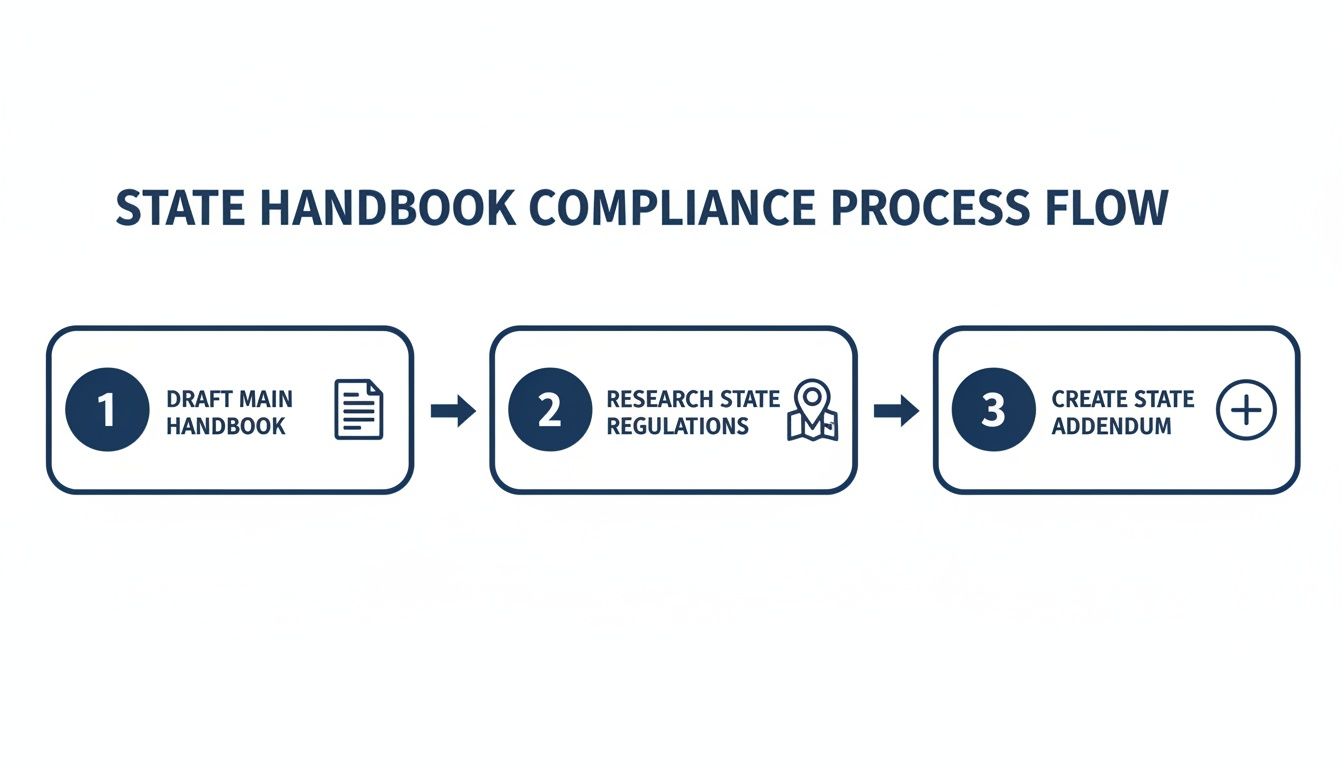
The main takeaway is that compliance is an ongoing cycle, not a one-time project.
You need to establish a formal review schedule. At a minimum, your handbook needs a thorough review once a year with qualified legal counsel or an HR expert. You also have to be ready to make immediate updates when significant laws change.
A solid maintenance plan should include:
- Annual Review: Assign a person or team (like your HR manager or an outsourced PEO partner) to do a full review every year.
- Trigger-Based Updates: Stay on top of legal alerts for any changes that require an immediate policy update.
- Redistribution and Re-Acknowledgment: Anytime you make a material policy change, you must redistribute the updated handbook (or at least the updated policy) and collect a new signed acknowledgment from all employees.
This disciplined approach ensures your employee handbook template grows with your company and remains a valuable, legally sound asset for years.
Frequently Asked Questions About Employee Handbooks
Even with a great employee handbook template, we see the same questions and concerns pop up time and again. It’s completely normal. Let’s walk through some of the most common issues we hear from business owners and clear up the confusion so you can move forward with confidence.
Can I Just Copy Another Company’s Employee Handbook?
This is one of the biggest—and riskiest—shortcuts we see employers take. While it might seem like a quick fix, you should never simply copy another company’s handbook. Doing so can create significant legal exposure.
A handbook has to be tailored to your specific company culture, your internal processes, and most importantly, the state and local laws that apply to you. For example, a handbook from a California company will have policies on meal breaks and leave that are completely different from what’s required in Utah or Idaho. Using their document could mean you’re promising benefits you don’t actually offer or, worse, failing to comply with your own state’s specific laws.
Does an Employee Handbook Create a Legal Contract?
It absolutely can if you are not careful with your wording. This is one of the biggest legal traps for employers. Without the right disclaimers, mandatory or promissory language about job security or progressive discipline could be interpreted by a court as an implied contract of employment.
To prevent this, your handbook must include a clear and prominent At-Will Employment disclaimer. This statement clarifies that the handbook is a guideline, not a contract, and that both the employee and employer can end the employment relationship at any time, for any lawful reason.
This language is non-negotiable for preserving the at-will relationship and is a critical part of a legally sound handbook.
How Often Should I Update My Employee Handbook?
You should plan on conducting a thorough review of your entire handbook at least once a year with a qualified professional. But laws and business needs change, so think of your handbook as a living document. Updates are often required much more frequently.
Here are a few common triggers that should prompt an immediate review:
- New State or Federal Laws: When a new regulation passes, like a new paid leave law or minimum wage increase, you need to update your policy right away.
- Changes in Company Operations: If you shift to a remote or hybrid work model, you need a formal policy to manage it.
- Expansion into a New State: Hiring an employee in a new state—say, expanding from Wyoming into Arizona—means you need a state-specific addendum immediately.
Whenever you make a significant change, you must redistribute the updated handbook and get a new signed acknowledgment from every single employee.
Is a Digital Signature on a Handbook Acknowledgment Legally Valid?
Yes, digital signatures are legally valid and, in our experience, often the better option. The federal Electronic Signatures in Global and National Commerce (ESIGN) Act gives e-signatures the same legal weight as a handwritten signature for most business purposes, including handbook acknowledgments.
Using an HRIS, a PEO platform, or a service like DocuSign is often more reliable than chasing down paper copies. It creates an immediate, time-stamped, and easily trackable record. For modern and remote teams, it’s simply the most efficient and defensible method for proving compliance.
Call today for a Free, 15-Minute benefits audit: 1-800-748-5102
Further Readings:
Unlock Affordable Health Benefits for Small Businesses in 2026
What Is a PEO—and Is It Worth It? Insights from Lever1’s Erica Brune & Chad Braymer
Unlock Growth with Outsourced HR Services Small Business
Creating and maintaining a compliant employee handbook is one of the most complex HR challenges for a growing business. If you’re struggling with state-specific laws or simply don’t have the time to manage it all, Helpside can help. Our HR experts partner with you to develop a custom handbook, keep it updated, and manage the entire rollout process, giving you complete peace of mind. Learn more about how we support businesses like yours at https://helpside.com.