For small businesses, offering health benefits is no longer a “nice-to-have” perk. It’s one of the most powerful moves you can make for growth and stability. In a tight job market, great candidates don’t just hope for strong health coverage—they expect it as a core part of any serious offer.
Why Health Benefits Are a Strategic Investment, Not an Expense

Many business owners understandably flinch when they see health benefits on the budget. But it’s time to reframe that thinking. This isn’t just another line item; it’s a direct investment in your most critical asset: your people.
When you provide quality health coverage, you are investing in your team’s well-being, which in turn fuels a loyal, engaged, and more productive workforce. This is the foundation of what we call benefits-driven growth.
The Power of Attraction and Retention
In today’s talent market, your best people have options. A compelling benefits package is often the one thing that makes your offer stand out from the rest.
A strong benefits plan does more than cover doctor visits. It sends a clear message that you value your employees as people and are invested in their success, both inside and outside of work.
That message fosters a culture of loyalty that directly combats costly turnover. Think about it: replacing a good employee can cost tens of thousands in recruitment fees, lost productivity, and training time. A solid benefits plan is one of your best defenses against those costs.
Beyond Basic Coverage
The smartest businesses are looking beyond traditional health plans. Investing in transformative employee wellness program ideas can turn a perceived cost into a major asset, boosting both morale and productivity.
This proactive approach shows a genuine commitment to your team’s health and can include things like:
- Mental health support: Offering access to counseling and stress management tools.
- Preventive care incentives: Encouraging annual check-ups and health screenings.
- Wellness challenges: Promoting healthy habits through fun, team-based activities.
This isn’t just a local trend. The global group health insurance market is projected to grow from USD 3.41 trillion in 2024 to USD 6.52 trillion by 2033, a surge driven by companies that recognize the bottom-line value of employee health. You can find more data on this growth in this detailed industry report. By embracing this shift, you’re not just keeping up—you’re positioning your business for sustainable success.
The Reality of Rising Small Group Insurance Costs

If you’re watching your health insurance premiums climb every year, you’re definitely not alone. For small business owners, that annual renewal notice often brings a sense of dread as costs continue to spiral upward, squeezing already tight budgets.
This isn’t a sign of poor planning on your part. It’s the result of systemic issues putting immense pressure on the entire small group market. The hard truth is that traditional insurance is becoming financially unsustainable for many small companies, forcing them to either absorb massive price hikes or offer less competitive plans.
The Forces Driving Your Premiums Higher
Several powerful factors are working in tandem to drive up your costs. Understanding them is the first step toward finding a more sustainable way to take care of your team.
The table below breaks down the key drivers pushing premiums higher for small businesses like yours in 2026.
Key Drivers of 2026 Small Group Health Insurance Costs
| Cost Driver | Impact on Premiums | Example |
|---|---|---|
| Soaring Healthcare Prices | This is the foundation of rising costs. As the price of medical care—from hospital stays to routine check-ups—goes up, those increases get passed directly to you. | A 6% increase in hospital service prices can directly contribute to a 3-4% rise in your annual premium. |
| High-Cost Specialty Drugs | New, life-changing prescription drugs often come with staggering price tags. The cost for even one employee can have an outsized impact on the whole group’s premium. | A single employee needing a specialty medication that costs $80,000 per year will significantly raise the rates for a 20-person company. |
| Small Risk Pools | Small businesses have a major disadvantage here. With fewer employees, the financial risk of one major health event is concentrated, not spread out like it is in a large corporation. | If one employee in a 15-person company has a premature baby requiring NICU care, the renewal increase could easily be 20-30% or more. |
These factors work together, creating a perfect storm of rising costs that can feel impossible to escape within the traditional insurance model.
The Problem With a Small Risk Pool
The concept of a risk pool is critical to understand. Think of it like a group of people sharing a potential risk.
A large corporation has thousands of employees, creating a big, stable pool. The cost of a few very sick individuals gets spread thinly across many healthy ones, keeping rates relatively stable.
A small business, however, has a much smaller, more volatile pool. If just one employee or their dependent has a major health event, the financial impact is concentrated. This leads to the sharp, unpredictable premium spikes you see at renewal.
This is a core challenge for all small businesses, whether you’re exploring health insurance for CPA firms or running a local restaurant. The math just doesn’t work in your favor.
Hard Numbers and a Troubling Outlook
The data confirms what small business owners are feeling. For 2026, premium increase proposals for the small group market are significant in many states. Projections and rate filings vary widely, but a double-digit average increase is not uncommon in some regions, largely driven by rising healthcare costs.
For example, in some states, proposed rate hikes for small group plans have exceeded 10%. These trends reflect a nationwide challenge.
This relentless upward trend isn’t an anomaly; it’s the new normal for the traditional small group market. It creates a difficult cycle where you’re forced to choose between footing a larger bill or reducing coverage—neither of which helps you attract and keep great people.
Unlock Better Benefits with a PEO Partnership
Many small business owners feel trapped when it comes to health benefits. You’re watching premiums skyrocket year after year, but the plans available in the traditional small group market just aren’t cutting it. You know you need great benefits to hire and keep top talent, but the cost feels completely unsustainable.
What if you could break out of that cycle? What if you could get the same access to high-quality, affordable health plans as a Fortune 500 company?
That’s where partnering with a Professional Employer Organization (PEO) can be a game-changer. Think of a PEO as a massive buying club for employee benefits. The PEO brings together hundreds—or even thousands—of small businesses, pooling all their employees into one enormous group for insurance purposes.
Suddenly, your 15-person shop has the negotiating power of a group with thousands of employees. This scale gives the PEO incredible leverage with top insurance carriers, allowing them to secure better plans and lower rates than any single small business could ever get on its own.
The Power of the PEO Model
The engine that makes this all work is a concept called co-employment. This is a legal partnership where the PEO becomes the “employer of record” for your team for specific administrative tasks—like benefits, payroll, and HR compliance. You still run your company, manage your employees’ day-to-day work, and shape your unique culture. Nothing about that changes.
This co-employment relationship unlocks two huge advantages for your business:
- Access to Fortune 500-Level Plans: Because the PEO legally represents a massive pool of employees, it qualifies for large-group health insurance. These are the same high-quality, feature-rich plans usually reserved for the biggest corporations.
- Significant Cost Savings: With the buying power of a huge group, a PEO can negotiate much more stable and favorable premium rates. This helps turn health benefits from a crippling expense into a manageable, strategic investment in your people.
By joining forces with other businesses through a PEO, many small companies can access more favorable rates than they could on the small group market. The impact goes far beyond just benefits; businesses that partner with a PEO grow faster and are 50% less likely to fail. You can dig into more of the data behind rising premiums in this 2026 health insurance briefing.
Turning Benefits Into a Competitive Advantage
The difference between what’s available on the small group market and what a PEO can offer is stark. When you’re on your own, you’re at the mercy of a small, volatile risk pool where one or two large claims can cause your renewal rates to soar. The plan options are often limited and unappealing to the best candidates.
With a PEO, you join a large, stable risk pool. This dramatically reduces that year-to-year volatility and gives you predictable, sustainable costs. It allows you to offer benefits that genuinely compete with—and often beat—what much larger companies can provide.
This completely transforms your ability to attract and retain the best people. When a star candidate is weighing multiple offers, a superior health plan can easily be the deciding factor. You’re no longer just another small business with a basic, high-deductible plan; you’re an employer that provides exceptional care for its team.
For a deeper dive into how this partnership works, check out our ultimate guide to PEO health insurance for more details. This strategic move levels the playing field, empowering your small business to compete for top-tier talent and grow with confidence.
How to Navigate Complex Health and Employment Laws
Offering health benefits is about more than just picking a plan and paying the bill. It’s an invitation into the complex world of federal and state employment law—a place where one wrong turn can lead to some seriously staggering fines.
For any business owner trying to focus on growth, this administrative minefield is a huge distraction and a real source of risk. The legal side is a dense web of rules, with federal laws setting the baseline and state-specific regulations adding another messy layer. This gets especially tricky when you have remote employees in different states, as state-level leave laws, benefits mandates, and wage-and-hour rules can vary significantly.
The Big Three Federal Laws You Must Know
While there are countless regulations to be aware of, three major federal acts are the foundation of benefits compliance. Getting a handle on what they demand is the first step to protecting your business.
-
The Affordable Care Act (ACA): This is the big one. The ACA brought a host of requirements around health coverage, reporting, and notifications. For instance, businesses with 50 or more full-time equivalent employees are considered Applicable Large Employers (ALEs) and have to navigate specific mandates to avoid penalties.
-
The Consolidated Omnibus Budget Reconciliation Act (COBRA): COBRA kicks in for businesses with 20 or more employees on their group health plan (though some states have “mini-COBRA” laws that apply to smaller groups). It requires you to offer a way for former employees and their families to continue their group health coverage after events like a job loss. Managing COBRA—from sending the right notices on time to collecting premiums—is notoriously difficult to get right.
-
The Health Insurance Portability and Accountability Act (HIPAA): HIPAA’s privacy rules are non-negotiable. This law protects sensitive employee health information, and any business sponsoring a group health plan must have iron-clad safeguards in place. A violation can lead to huge financial penalties and seriously damage your company’s reputation.
A compliance mistake isn’t just a simple error; it’s a direct threat to your bottom line. A single COBRA notification slip-up can trigger fines of up to $110 per day per participant, and ACA penalties can quickly run into the tens of thousands.
This is where a partner can step in to manage the moving pieces. A Professional Employer Organization (PEO) works by centralizing these complex responsibilities, creating a protective buffer for both your business and your team.
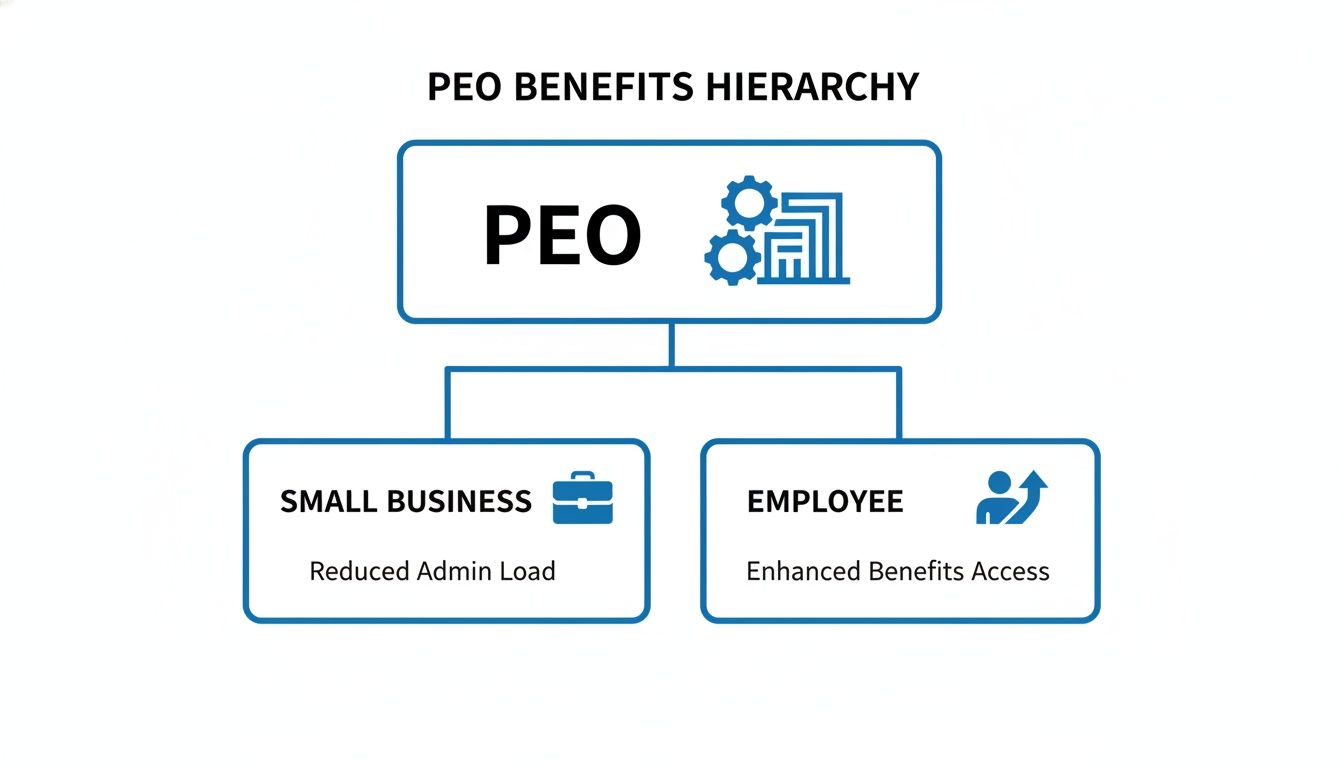
When you look at it visually, you can see how a PEO lifts the administrative and compliance weight off the business owner. This frees you up to get back to what you’re good at—running your company.
Your Expert Partner in Compliance
Let’s be honest: trying to navigate this legal maze on your own is a full-time job. This is where a PEO like Helpside becomes such a game-changer, essentially acting as your own dedicated compliance department.
A PEO offloads this entire administrative burden, handling all the complicated details so you don’t have to. The table below really highlights the difference between the high-risk, high-effort DIY approach and the streamlined, secure model of a PEO partnership.
Managing Benefits In-House Versus with a PEO Partner
| Task or Responsibility | In-House Management | PEO Partnership (e.g., Helpside) |
|---|---|---|
| ACA Compliance & Reporting | You’re on the hook for tracking all employee hours, determining ALE status, and filing complicated annual 1094-C/1095-C forms. One mistake could trigger an audit. | Your PEO handles all tracking, status determination, and reporting. Their experts minimize your audit risk and ensure every form is filed accurately and on time. |
| COBRA Administration | You have to manage every qualifying event notice, enrollment packet, and premium payment for former employees—a process full of strict deadlines and legal traps. | The PEO manages the entire COBRA lifecycle, from initial notices to ongoing administration. You stay compliant without the constant worry and paperwork. |
| Multi-State Compliance | With remote employees, you’re responsible for tracking and following different state laws for sick leave, paid leave, and benefits contributions. | Your PEO’s experts know multi-state employment law inside and out. They automatically apply the correct payroll and benefits rules based on each employee’s location. |
| HIPAA & Data Security | You are responsible for creating and maintaining policies to protect employee health data. This requires specialized knowledge and constant vigilance. | The PEO’s secure platforms and established protocols ensure HIPAA compliance, protecting sensitive data and dramatically reducing your liability. |
Partnering with a PEO brings incredible peace of mind. Instead of losing sleep over changing regulations and potential fines, you gain a team of experts dedicated to keeping your business safe.
This freedom allows you to shift your energy from frustrating administrative work back to what really matters: growing your company.
Beyond Benefits: An Integrated HR and Payroll Solution
Great health benefits are a huge reason businesses look into a PEO, but they’re really just the tip of the iceberg. A top-tier PEO provides more than just an insurance plan; it delivers a fully integrated HR and payroll infrastructure that supports your entire business.
Think about how you’re handling people operations right now. You probably have one vendor for payroll, a different broker for insurance, and maybe another contact for HR questions. This patchwork approach often leads to wasted time, higher costs, and a confusing web of platforms to manage.
A PEO replaces that entire collection of disconnected vendors. You get one expert team and one platform to handle everything.
A Unified Platform for People Operations
Imagine having a single point of contact for all your HR needs. This integration is where a PEO partnership really shines, creating a solid operational backbone that can scale right along with your business.
This unified approach typically bundles the core services every business needs:
- Payroll and Tax Administration: The PEO manages all payroll processing, tax filings, and year-end W-2s. This ensures your team is paid correctly and on time while keeping you compliant with federal, state, and local tax laws.
- HR Expertise and Support: You get access to a team of HR professionals. They can help you build employee handbooks, manage performance reviews, navigate difficult terminations, and foster a positive company culture.
- Risk and Safety Management: A PEO can provide proactive safety training and help manage workers’ compensation claims, which creates a safer workplace and helps keep your insurance costs in check.
This integrated model doesn’t just make administration easier; it gives you strategic advantages. When all your HR functions work together, you start seeing connections you would have missed with separate vendors.
For example, your payroll data can help shape your benefits strategy, and trends in workers’ compensation claims can show you exactly where safety training is needed. This connected approach helps you make smarter, more proactive decisions for your business.
This level of integration is what allows small businesses to build a strong, scalable foundation for their people operations. It lets you get back to focusing on your core business goals.
Proactive Cost Management and Reinvestment
An integrated approach also opens the door to more effective cost-control strategies. Instead of just shifting costs to employees with higher deductibles, a PEO helps you get to the root of those expenses.
By combining risk management, proactive safety training, and expert claims support, a PEO helps reduce the number and severity of workplace incidents. This directly lowers your workers’ compensation costs and can even have a positive impact on your health insurance premiums over time.
This aligns with findings that show proactive cost management, rather than just passing costs to employees, leads to more sustainable savings. You can explore the full Mercer report on health trends to see how these strategies work in practice.
The savings you generate can then be put right back into the business. You could enhance your health benefits for small businesses even further, boost salaries, or fund other growth initiatives—creating a powerful cycle of investment and return.
Your Checklist for Choosing the Right Benefits Partner
Choosing a partner to handle your company’s health benefits is one of the most critical decisions you’ll make. It’s a choice that directly impacts your budget, your legal standing, and your ability to bring in—and keep—great people. This isn’t just about finding another vendor; it’s about finding a true partner.
This checklist will walk you through the essential questions to ask any potential benefits provider, whether it’s a traditional broker, an insurance carrier, or a PEO.
Evaluate the Plan Quality and Flexibility
The first thing to do is look past the price tag and dig into the actual health plans on the table. A low premium on a terrible plan isn’t a bargain for anyone. Your goal is finding high-quality, flexible options that give your employees real value and protect your business.
Key questions to ask include:
- Network Quality: Are the local doctors, specialists, and hospitals your employees actually use in-network? A narrow network can be a major source of frustration and limit access to care.
- Plan Variety: Can you offer a mix of plans (like a PPO, HMO, or high-deductible option) to fit the different needs and budgets of your team?
- Benefit Design: Do the plans have competitive deductibles, copays, and out-of-pocket maximums? Or will your employees face massive costs before their coverage really starts to help?
If you’re not sure how to balance these different elements, learning more about the top factors to consider when choosing a health plan can give you some much-needed clarity.
Scrutinize the Service and Support Model
The quality of your partner’s service model becomes painfully clear the moment an employee has an urgent question about a claim or a new hire needs to get enrolled. An anonymous call center and a faceless ticketing system are red flags that you’ll be treated like a number. You need a partner who offers responsive, expert support.
A great benefits partner gives you more than a platform; they give you a team. They should know your business, understand your goals, and be ready to provide expert guidance when you need it most.
When you’re evaluating their service, ask these direct questions:
- Dedicated Support: Will we have a dedicated account manager or a small, consistent team we can call directly?
- Employee-Level Support: Can our employees contact you with their questions, or does that responsibility fall back on our internal team?
- Expertise Level: Is your team made up of certified HR and benefits professionals who can give real advice, or are they just data entry clerks?
Verify Compliance and Pricing Transparency
This is where hidden costs and risks love to hide. Any potential partner must show they have deep expertise in federal and state employment law, especially if you have (or plan to have) remote employees. At the same time, their pricing should be simple and transparent, with zero surprises.
Compliance Checklist:
- How do you make sure ACA reporting and COBRA administration are handled correctly?
- What’s your process for managing multi-state payroll and benefits compliance?
- Can you show me proof of certifications (like SHRM or CEBS) for your HR team?
Pricing Transparency Checklist:
- Is your pricing a flat, predictable fee (like a per-employee-per-month rate), or is it a percentage of payroll that will go up and down?
- Are there any implementation fees, renewal fees, or other hidden charges we should know about?
- Will you provide a clear, itemized quote that breaks down every single cost?
Taking the time to go through this checklist will help you see past the sales pitch and make a confident, informed decision. It ensures you pick a partner that truly supports your goals for providing excellent health benefits for small businesses.
Frequently Asked Questions About Small Business Health Benefits
Trying to figure out health benefits for your small business can feel like a maze. To give you some clarity, we’ve tackled a few of the most common questions we hear from business owners every day.
What Is a PEO and How Does It Help with Benefits?
A Professional Employer Organization (PEO) is a partner that helps small businesses gain the advantages of a much larger company. Through a model called co-employment, a PEO pools employees from many small businesses into one large group.
This is the key to unlocking better health plans at more stable, predictable rates than you could ever get on your own. It essentially levels the playing field, giving you the buying power of a major corporation so you can compete for top talent.
Is My Business Big Enough for a PEO?
Many business owners think PEOs are only for big companies, but that’s a common misconception. While every PEO is different, many—including Helpside—specialize in working with businesses that have as few as 5 employees.
The “sweet spot” is often companies with 10 to 75 employees. These are the businesses that really feel the pain of HR administration and rising benefit costs but are still too small to have a dedicated internal HR department.
A PEO partnership is less about your current size and more about your readiness to build a scalable foundation for growth. If you’re struggling with compliance, payroll, and benefits, you are likely the right size.
What If We Already Have an Insurance Broker?
That’s great! A good PEO doesn’t replace your broker; it works with them. In fact, many PEOs, including Helpside, are built to be broker-friendly.
Your broker can help you evaluate whether a PEO makes sense and can continue to advise on your overall benefits strategy. The PEO simply becomes another powerful tool in their toolbox to bring you better options and service.
Aren’t PEOs More Expensive Than Handling HR In-House?
While there is a service fee, many businesses discover that a PEO partnership actually creates significant savings. When you factor in potential savings on medical premiums, reduced administrative work, and avoiding costly compliance mistakes, the value becomes much clearer.
You’re not just paying for a service; you’re investing in an entire HR, payroll, and compliance infrastructure that protects your business and frees you up to focus on growth. When you’re comparing costs, be sure to look at the total value, not just a single line item. For a deeper look at different plan types, you can also explore the difference between HSA-qualifying health plans and traditional plans to understand all your options.
Ready to offer better benefits without the rising costs?
Call Helpside today for your Free 15-Minute Benefits Audit: 1-800-748-5102 and see how much time and money your business could save.
Further Readings:
- Why Small Businesses Are Rethinking HR, Payroll, and Benefits
- Why Onboarding with a PEO Can Make or Break Your Business Growth
- How Small Businesses Are Scoring Fortune 500 Benefits: A Guide to PEO Pricing
Ready to stop worrying about HR and start focusing on growth? Helpside provides the expert support and Fortune-500 level benefits that empower small businesses to thrive. Find out how we can help your company.