
On the surface, calculating overtime seems simple enough: pay a non-exempt employee 1.5 times their regular rate of pay for any hours they work over 40 in a workweek. If you’re paying a straight hourly wage, the math is straightforward.
But here’s where it gets tricky. The real challenge is making sure you’ve correctly calculated that “regular rate of pay” while staying on the right side of a complex web of federal and state laws.
Understanding the Fundamentals of Overtime Pay
Getting overtime pay right isn’t just a good practice—it’s a non-negotiable part of running a business. The core rule comes from the federal Fair Labor Standards Act (FLSA), a landmark law that has set the standard for wages and hours since 1938. Miscalculating overtime isn’t a small payroll hiccup; it’s a direct violation that can spiral into serious legal and financial trouble.
For small to mid-sized businesses, especially those in the 20 to 150 employee range, the stakes are incredibly high. A single, seemingly minor mistake can quickly cascade into a much larger liability.
Overtime errors are one of the most common—and costly—reasons businesses face wage and hour claims. Even if the miscalculation was unintentional, it can lead to significant back pay, government fines, and legal fees that can easily destabilize a growing company.
The Basic Federal Formula
The FLSA establishes the minimum overtime standard for the entire country. The rule applies to all non-exempt employees, a classification determined by specific job duties and salary thresholds, not simply by whether someone is paid hourly or has a salary.
Here’s a quick look at how the basic formula works for an hourly employee:
- Straight-Time Pay: The pay for the first 40 hours worked in a workweek.
- Overtime Rate: The employee’s regular hourly rate multiplied by 1.5.
- Overtime Pay: The overtime rate multiplied by the hours worked beyond 40.
- Total Pay: The sum of the straight-time pay and the overtime pay.
Let’s say you have an employee who earns $20 per hour and works 43 hours one week. Their straight-time pay is $800 (40 hours x $20), and their overtime pay is $90 (3 hours x $30). Their total gross pay for that week would be $890.
To help you visualize this simple calculation, here is a quick breakdown.
Standard Overtime Calculation at a Glance
| Component | Calculation | Example Value ($15/hr, 45 hours) |
|---|---|---|
| Regular Hourly Rate | The employee’s base hourly wage. | $15.00 |
| Straight-Time Pay | Regular Rate × 40 hours | $600.00 |
| Overtime Rate | Regular Rate × 1.5 | $22.50 |
| Overtime Hours | Total Hours – 40 hours | 5 hours |
| Overtime Pay | Overtime Rate × Overtime Hours | $112.50 |
| Total Gross Pay | Straight-Time Pay + Overtime Pay | $712.50 |
This table shows the core mechanics, but remember, things get more complicated once bonuses, commissions, or multiple pay rates are involved.

Why Accuracy Is Critical
State and federal agencies are vigilant in enforcing these rules. In FY2023 alone, the U.S. Department of Labor’s Wage and Hour Division recovered $274 million in back wages for over 163,000 workers. With penalties often exceeding $1,000 per violation, the financial risk adds up fast.
Of course, all of this starts with paying a legal wage in the first place. Adhering to minimum wage laws is the absolute foundation of fair compensation and directly impacts overtime rates. As highlighted in Stewart Accounting’s expert view on NMW, failing to meet these basic standards can have severe consequences. While this guide focuses on the calculation itself, never forget that compliance begins with a lawful base wage.
Calculating Overtime with Multiple Pay Rates
Things can get tricky when your employees wear multiple hats. What happens when someone works two different jobs at two different pay rates in the same week? You can’t just pick one rate—and definitely not the lower one. That’s a fast track to a wage and hour violation.
The Fair Labor Standards Act (FLSA) requires you to use a “weighted average” regular rate of pay, often called a “blended rate,” to figure out the correct overtime compensation. This method is designed to make sure employees are paid fairly for their overtime hours based on their total earnings for that week.
The Blended Rate Calculation in Action
Let’s walk through a common scenario. Imagine you have a versatile team member, Alex, who splits their time between two roles:
- Role 1: Administrative work at $18 per hour
- Role 2: Specialized project support at $26 per hour
This week, Alex worked a total of 48 hours: 30 hours as an admin and 18 hours on the special project. Because Alex went over 40 hours, they are owed 8 hours of overtime. Here’s exactly how to calculate their pay using the weighted average method.
First, you need to find their total straight-time pay before even thinking about overtime.
- Administrative Pay: 30 hours × $18/hour = $540
- Project Support Pay: 18 hours × $26/hour = $468
- Total Straight-Time Earnings: $540 + $468 = $1,008
Next, calculate the blended regular rate by dividing the total straight-time earnings by the total hours worked. This gives you the weighted average hourly rate for that specific week.
- Weighted Average Regular Rate: $1,008 ÷ 48 total hours = $21 per hour
This $21 per hour is Alex’s true “regular rate of pay” for this workweek.
Key Takeaway: The blended rate isn’t a simple average of the two pay rates ($18 and $26). It’s a weighted average that correctly reflects how many hours were worked at each rate. Just averaging the two rates would lead to a non-compliant calculation and an underpayment.
Finalizing the Overtime and Total Pay
Once you have the weighted average rate, the rest of the calculation is straightforward. You’ll find the overtime premium—that extra “half” you pay for overtime hours—and add it to their straight-time earnings.
- Overtime Premium Per Hour: $21 × 0.5 = $10.50
- Total Overtime Premium: $10.50 × 8 overtime hours = $84
Finally, add the overtime premium to the straight-time pay to get their total gross wages for the week.
- Total Gross Pay: $1,008 (Straight Time) + $84 (Overtime Premium) = $1,092
Following this process is absolutely critical for compliance. It prevents underpayment mistakes that can attract some serious penalties. In fact, getting this right is a cornerstone of FLSA compliance, and you can learn more about calculating the regular wage rate under the FLSA in our detailed guide.
It’s also important to remember that while the weighted average method is the federal default, some states allow alternatives. For instance, California permits employers to pay overtime based on the “rate-in-effect” when the overtime hours were actually worked, provided certain conditions are met. This is a perfect example of why localized expertise is just as important as knowing federal law.
Handling Overtime for Salaried Non-Exempt Employees
One of the most common and costly mistakes employers make is assuming a salaried employee is automatically exempt from overtime. It’s a compliance trap that can lead to significant penalties.
The truth is, many salaried employees are classified as non-exempt based on their job duties and pay level, which means they are fully entitled to overtime pay under the Fair Labor Standards Act (FLSA).
For these employees, you must track every hour they work. The key is to convert their fixed weekly salary into an hourly “regular rate of pay” to ensure you’re calculating their 1.5x overtime premium correctly.
The Standard Calculation for Salaried Non-Exempt
The most straightforward method involves a simple conversion. You start by determining the employee’s regular rate of pay, which is their weekly salary divided by the number of hours the salary is intended to cover—typically 40 hours.
Let’s walk through an example. Imagine you have a salaried non-exempt employee, Maria, who earns a weekly salary of $800. This week, she worked 45 hours.
- Calculate the Regular Rate: Divide her weekly salary by 40 hours.
$800 ÷ 40 hours = $20 per hour - Calculate Total Straight-Time Pay: Maria’s salary already covers her first 40 hours, so her straight-time pay is her full $800 salary.
- Calculate Overtime Pay: She worked 5 overtime hours. Her overtime rate is 1.5 times her regular rate ($20 x 1.5 = $30).
5 overtime hours × $30/hour = $150 - Calculate Total Pay: Add the salary and the overtime pay together.
$800 (Salary) + $150 (Overtime Pay) = $950 total gross pay
This method keeps you compliant and ensures Maria is paid correctly for every hour she worked. If you want to dig deeper into this topic, you can learn more about paying overtime to salaried employees and the specific rules involved.
The Fluctuating Workweek Method
Another option for salaried non-exempt employees is the Fluctuating Workweek (FWW) method. This can be a useful tool for employers with staff whose hours truly vary week to week, but it comes with very strict rules and isn’t allowed in some states (like California, Pennsylvania, and New Mexico).
With the FWW method, the employee’s fixed salary is understood to cover all hours worked in a week, whether it’s 30 or 50. The overtime premium is then paid at a “half-time” rate instead of “time-and-a-half.”
To use this method, you have to meet several conditions:
- The employee’s hours must genuinely fluctuate from one week to the next.
- They must receive a fixed salary that doesn’t change, no matter how many hours they work.
- The salary must be large enough to ensure the regular rate never falls below the applicable minimum wage.
- There needs to be a clear, written mutual understanding that the salary is intended to cover all hours worked.
Important Compliance Note: The FWW method has been the subject of legal challenges and changing regulations. It’s a complex area, and we always advise checking your state and local laws before trying to implement it.
The process for salaried employees mirrors the complexity of calculating overtime when an employee works at different pay rates, as shown below.
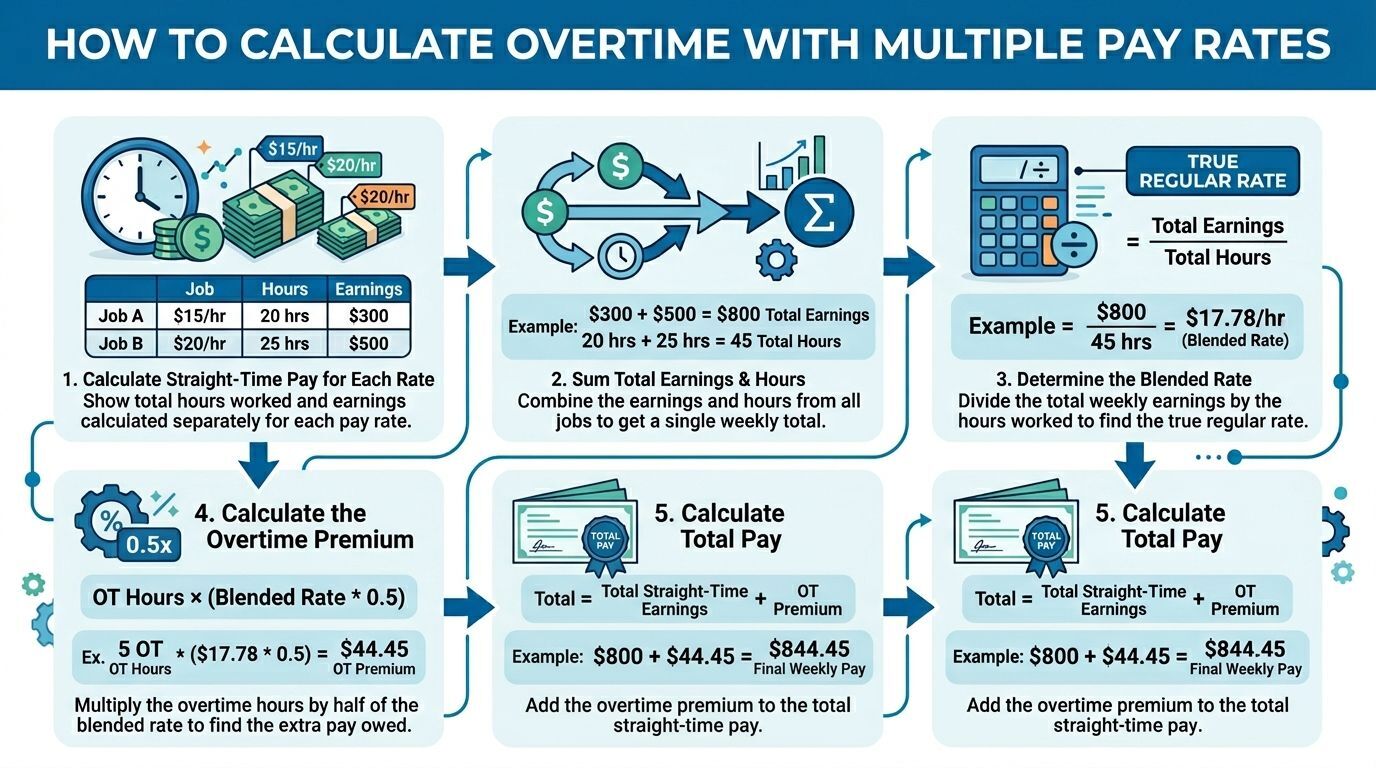
Both scenarios underscore the importance of correctly determining a single, compliant “regular rate” from an employee’s total earnings. Getting this right is fundamental to accurate payroll.
Navigating the Maze of State-Specific Overtime Laws
When it comes to overtime, think of federal law as the starting point. The Fair Labor Standards Act (FLSA) sets the minimum requirements, but it’s just the floor—not the ceiling. Many states have their own overtime laws that are much more generous to employees, and this is where things can get tricky.
If you’re a multi-state employer, you can’t just apply one payroll policy across the board. You must always follow the law—whether federal or state—that provides the greater benefit to the employee. We see this trip up well-intentioned businesses all the time, especially those expanding into new states. For companies with teams in places like Utah, Arizona, Wyoming, and Idaho, staying on top of these local nuances is absolutely essential for avoiding costly compliance mistakes. To get a better handle on this, you can explore our guide on crucial state labor laws employers need to know.
California: A Case Study in Complexity
To really understand how different state laws can be, you just have to look at California. The state’s overtime rules are famously complex and much stricter than the federal standard. While the FLSA only looks at a 40-hour workweek, California requires employers to calculate overtime on a daily basis.
In California, an employer must pay overtime for:
- Daily Overtime (1.5x): Any hours a non-exempt employee works over eight in a single workday.
- Weekly Overtime (1.5x): The first eight hours worked on the seventh consecutive day of a workweek.
- Double Time (2x): Any hours worked over 12 in a single workday or over eight on the seventh consecutive day.
This means an employee in California could earn both daily and weekly overtime in the same pay period—something that simply wouldn’t happen under federal law alone. It’s a perfect example of why state-specific payroll knowledge is non-negotiable.
Comparing Federal and State Standards
The difference isn’t subtle. Imagine a non-exempt employee who works ten hours a day for four days (totaling 40 hours for the week). Under federal law, that employee is owed zero overtime pay. In California, that same employee is owed 8 hours of overtime pay (two extra hours per day for four days).
The table below breaks down the stark contrast between the two.
Federal vs. California Overtime Rules
| Rule | Federal Standard (FLSA) | California Standard |
|---|---|---|
| Daily Overtime | None. Only weekly overtime applies. | 1.5x pay for hours over 8 in a day. |
| Weekly Threshold | 1.5x pay for hours over 40 in a week. | 1.5x pay for hours over 40 in a week. |
| Double Time | Not required by federal law. | 2x pay for hours over 12 in a day or over 8 on the 7th consecutive day. |
| Seventh-Day Rule | No specific rule. | 1.5x for the first 8 hours; 2x for hours beyond 8 on the 7th consecutive day. |
While California is one of the more extreme examples, it’s not alone. Other states like Alaska, Colorado, and Nevada also have daily overtime rules. This web of regulations drives home a key takeaway for any growing business: you have to look far beyond the federal FLSA guidelines and dig into the specific laws for every single state where you have an employee.
Avoiding Common and Costly Overtime Pitfalls
Good intentions don’t stop payroll errors. We see it all the time—even the most careful business owner can fall into common traps when calculating overtime, leading to some pretty costly wage and hour claims. Knowing what these pitfalls are is the first step to building an audit-proof payroll process.
One of the most frequent and expensive mistakes is forgetting to include non-discretionary bonuses and commissions when figuring out an employee’s regular rate of pay. If you give out a bonus for hitting production goals or a commission on sales, that money is part of their total compensation. It absolutely must be factored into the overtime calculation, or you’re underpaying them.
Another big one is employee misclassification. A lot of employers mistakenly think that putting an employee on salary automatically makes them exempt from overtime. That’s a dangerous assumption. Employee exemption is determined by specific job duties and salary thresholds, not how you pay them. Misclassifying a non-exempt employee as exempt can rack up years of unpaid overtime liability before you even spot the problem.
Paying for “Unauthorized” Work and Poor Timekeeping
One of the most misunderstood rules is the FLSA’s “suffer or permit” standard. Here’s the bottom line: if an employee works extra hours, you are legally on the hook to pay for that time, including any overtime. This is true even if you didn’t explicitly approve it. If you know work is being done (or have reason to believe it is), you must pay for it.
- The Scenario: An employee regularly stays 15 minutes late to wrap things up, even though you’ve told them not to.
- The Compliance Risk: Ignoring this “off-the-clock” work is a direct violation. You can—and should—address the performance issue through disciplinary action, but you absolutely cannot withhold their pay for the time they worked.
This is exactly why accurate timekeeping is so critical. Relying on guesswork, manual spreadsheets, or just having employees “write down their hours” is an open invitation for disputes and errors. A solid, digital timekeeping system is your best defense.
When you get right down to it, these common mistakes all stem from a lack of clear systems and a deep understanding of wage and hour laws. The cause-and-effect is simple: small oversights snowball into massive financial and legal headaches. The only way to protect your business is to proactively audit your practices. Make sure your method for calculating overtime accounts for every form of compensation and all hours worked, authorized or not. It’s the only way to stay compliant and maintain your team’s trust.
How a PEO Simplifies Overtime and Protects Your Business
Let’s be honest: navigating overtime is a huge administrative burden. Trying to keep track of blended rates, state-specific laws, and the nuances of salaried non-exempt employees is more than just a headache—it’s a major compliance risk. For many small and mid-sized businesses, managing this process internally eats up valuable time, resources, and peace of mind.
This is the point where many business owners start looking for a better way. And that’s often where a Professional Employer Organization (PEO) like Helpside comes in. A PEO doesn’t just give you advice; it takes on the full responsibility of your payroll and HR compliance. Instead of drowning in spreadsheets and worrying about the latest Department of Labor ruling, you can offload the entire process to a team of dedicated experts.
From Complex Calculations to Automated Accuracy
The real advantage of a PEO is its blend of expert human oversight and smart, integrated technology. The payroll platform is built from the ground up to handle the exact complexities we’ve been discussing.
- Blended Rates: When an employee works at different pay scales, the system automatically figures out the correct weighted average regular rate. No more manual math.
- Bonuses and Commissions: Non-discretionary bonuses are automatically factored into the regular rate for the correct workweek. This ensures overtime is paid accurately on all compensation, every single time.
- Multi-State Compliance: If you have employees in states like Utah, Arizona, and beyond, the platform is already programmed with each state’s specific rules. It automatically applies whichever law is most favorable to the employee, keeping you compliant everywhere.
By automating these tedious calculations, a PEO all but eliminates the manual errors that so often lead to costly wage and hour violations. Payroll is transformed from a major source of risk into a seamless, predictable function.
Partnering with a PEO means you are no longer alone in navigating the maze of employment law. You gain a co-employer that shares the liability and is contractually obligated to get it right, protecting your business and giving you the freedom to focus on growth.
A Proactive Partner in Compliance
Beyond just running the numbers, a PEO provides invaluable strategic support. The HR experts at a PEO help with critical tasks like correctly classifying employees as exempt or non-exempt, which helps prevent the misclassification errors that can trigger massive back-pay claims. They also provide compliant timekeeping solutions to ensure all “suffered or permitted” work is properly recorded and paid.
For businesses looking to simplify their processes, integrating robust payroll solutions can help to accurately calculate instructor pay correctly and ensure compliance with complex wage laws.
Ultimately, a PEO acts as your outsourced HR department, lifting the administrative weight so you can get back to what you do best—running your business. This partnership minimizes risk, reduces your workload, and gives you the expertise you need to manage a growing team with confidence.
Frequently Asked Questions About Overtime Calculation
Even for seasoned business owners, the finer points of overtime can get tricky. We often field questions about a few specific, thorny situations that come up again and again. Let’s clear up some of the most common points of confusion.
What About Bonuses and Commissions?
This is a big one. The short answer is yes, most of the time you have to include extra compensation when you’re figuring out an employee’s overtime rate.
Any non-discretionary bonuses and commissions—the kind that are promised for meeting goals or as part of a regular compensation plan—must be added to an employee’s base pay. This new total is then used to calculate their “regular rate of pay” for that workweek, which is what the overtime premium is based on.
The only exception is a truly discretionary bonus. Think of an unexpected holiday gift or a spot bonus given without any prior promise or expectation. Those can typically be excluded from the calculation.
Handling Unauthorized Overtime
What happens if an employee works late to finish a project without getting approval first? You still have to pay them. It’s a hard rule to swallow sometimes, but the FLSA’s “suffer or permit” standard is crystal clear.
If you know, or even have reason to suspect, an employee is working, you must pay them for that time. That includes any overtime they may have accrued.
While you must pay for every hour worked, you aren’t powerless. You absolutely can—and should—enforce your company policies. This means you can discipline the employee for working unapproved hours, but you can never legally withhold their pay as a punishment.
Comp Time Instead of Overtime Pay
For private businesses, offering comp time is almost always a no-go. The Fair Labor Standards Act is very specific: non-exempt employees must be paid cash for overtime, at the 1.5x rate.
Compensatory time, or “comp time,” is a practice you’ll see in the public sector (government agencies), and even then, it’s only allowed under strict conditions. A private company trying to swap overtime pay for future time off is taking a major compliance risk.
Ready to offer better benefits without the rising costs?
Call Helpside today for your Free 15-Minute Benefits Audit: 1-800-748-5102 and see how much time and money your business could save.
Further Readings:
- Why Small Businesses Are Rethinking HR, Payroll, and Benefits
- Why Onboarding with a PEO Can Make or Break Your Business Growth
- How Small Businesses Are Scoring Fortune 500 Benefits: A Guide to PEO Pricing
Navigating the tangled web of federal and state overtime rules is a huge challenge for any business. Helpside takes the guesswork out of the equation with integrated payroll technology and expert HR support, ensuring every paycheck is accurate and compliant. Learn how Helpside can protect your business and simplify your payroll.