
Think of an independent contractor agreement as more than just a piece of legal paperwork. It’s a foundational document that spells out the terms of your working relationship with a self-employed professional. This contract makes it crystal clear that the worker is not an employee, defining everything from the project’s scope to payment terms and deadlines. In short, it’s one of the most important tools you have to protect your business from the very real risks of worker misclassification.
Why a Strong Contractor Agreement Is Your Best Defense
Let’s move past the idea that an independent contractor agreement is just a formality. In today’s economy, it’s a critical tool for strategic growth, giving you the flexibility to bring on specialized talent without the overhead that comes with hiring a full-time employee.

This shift toward flexible work isn’t just a small trend, either. The U.S. Bureau of Labor Statistics reported that in its 2023 data, contingent workers (which includes independent contractors) made up a significant portion of the workforce. While precise numbers can fluctuate, the trend toward non-employee labor is undeniable. You can dig into the data yourself in the official BLS contingent worker summary.
For businesses in states like Utah, Arizona, and Idaho, using contractors is a key strategy for scaling up efficiently. But it has to be done right.
The Employee vs. Independent Contractor Distinction
Getting this classification right is the whole point. Regulators like the IRS and the Department of Labor (DOL), as well as state agencies, look at a number of factors to determine if a worker is truly independent or a misclassified employee. A well-drafted agreement helps establish the correct relationship from day one.
Here’s a quick breakdown of the general principles that distinguish the two.
Employee vs. Independent Contractor Key Differences
| Factor | Employee | Independent Contractor |
|---|---|---|
| Behavioral Control | Company controls how the work is done (e.g., set hours, specific methods). | Worker controls how the work is done; client controls the final result. |
| Financial Control | Company controls key financial aspects (e.g., provides tools, reimburses expenses). | Worker has their own tools, pays their own expenses, and can work for others. |
| Relationship | Typically has an ongoing relationship, may receive benefits (health insurance, PTO). | Works on a project-by-project basis, does not receive employee benefits. |
| Payment | Receives a regular wage or salary. | Paid by the project or on an invoice basis. |
| Termination | Can be fired; can quit at any time (at-will employment). | Relationship ends when the contract is complete; termination follows contract terms. |
This table just scratches the surface, but it highlights the core differences that your agreement—and your actions—must reflect.
More Than a Formality: A Strategic Business Tool
A solid contract is your first line of defense against costly misclassification lawsuits and audits. It’s a proactive step that draws clear lines from the very beginning.
The purpose of the agreement isn’t to box in talented professionals. It’s to create a transparent, business-to-business relationship that respects their independence while protecting your company. A strong agreement achieves several critical goals:
- Defines the Relationship: It explicitly states that the worker is an independent business, not an employee. This is the foundation of the entire engagement.
- Mitigates Financial Risk: It helps you steer clear of devastating back taxes, fines, and penalties from agencies like the IRS and the Department of Labor.
- Clarifies Project Scope: It details the specific services, deliverables, and deadlines, which prevents “scope creep” and future misunderstandings.
- Protects Intellectual Property: It clearly outlines who owns the work product created during the project—a crucial detail many businesses forget.
An independent contractor agreement is your operational blueprint for compliance. It’s not about the paper it’s printed on; it’s about the mutual understanding and legal clarity it creates for both you and the contractor.
Viewing this document as a strategic asset rather than a bureaucratic hurdle changes everything. It frames the relationship in a professional, business-to-business context. This distinction is vital, as it guides your day-to-day interactions and keeps you from accidentally treating a contractor like an employee—a common slip-up that can completely undo the legal protections your agreement was meant to provide.
Ultimately, a robust independent contractor agreement shows your commitment to compliant and ethical business practices. It builds trust with the skilled professionals you work with and gives you peace of mind, letting you focus on growth without the looming threat of legal and financial blowback. It’s not just a defense; it’s just smart business.
The Real Cost of Worker Misclassification
Getting worker classification wrong can be a devastating financial blow, especially for a small or growing business. It’s easy to think of misclassification as a minor paperwork issue, but the reality is that the consequences can stack up alarmingly fast. This isn’t just about a single fine; it’s a cascade of liabilities that can threaten your company’s stability and future.

The financial fallout is often severe. We’re not talking about small change here. Real-world examples show just how high the stakes are—from Microsoft’s reported $97 million settlement over temp worker issues to FedEx’s landmark $228 million payout for misclassifying its delivery drivers in California.
Even for smaller companies, the penalties can be crippling. State fines can reach tens of thousands of dollars per violation. On top of that, you could be on the hook for back payroll taxes (including Social Security and Medicare), unpaid overtime, workers’ compensation premiums, and massive class-action lawsuits that can destroy your company’s reputation.
It often starts with a single complaint from a worker, which can trigger a full-blown audit from the Department of Labor (DOL), the IRS, or a state agency. These agencies don’t just look at one person; they scrutinize your entire workforce, potentially turning one mistake into dozens of violations.
The DOL’s “Economic Reality” Test
To determine a worker’s status under the Fair Labor Standards Act (FLSA), the federal DOL uses a framework known as the “economic reality” test. This isn’t about what your independent contractor agreement says—it’s about the real substance of the working relationship.
The core question is simple: Is the worker economically dependent on your business for work, or are they truly in business for themselves?
As of 2024, the DOL’s test generally revolves around six key factors, with no single factor being determinative:
- Opportunity for Profit or Loss: Can the worker increase their profit through their own managerial skills, or is their only path to more income just working more hours for you?
- Investment by the Worker and the Employer: Does the worker invest in their own equipment and materials, or does your company provide all the necessary tools?
- Permanence of the Relationship: Is the engagement for a single, defined project, or is it a long-term, indefinite relationship?
- Degree of Control: Who really controls the work—things like pay rates, schedules, and how the job gets done?
- Skill and Initiative: Does the work require specialized skills that the contractor markets independently to other clients?
- Integral Part of the Business: Is the service they provide a core, essential part of what your company does?
Think about it this way: In a case involving a home health company, a court found the company liable for misclassifying nurses. The court pointed to the fact that the company set pay rates and supervised the nurses—actions that strongly suggest an employer-employee relationship.
This shows that how you manage the relationship day-to-day is just as critical as the contract itself. Actions that suggest an employer-employee dynamic can completely undermine your legal standing. A thorough employment agreement review can help you spot these risks before they become major problems.
When Penalties Become Personal
One of the most overlooked risks is that liability doesn’t always stop with the company. In many misclassification cases under the FLSA, owners, founders, and managers can be held personally liable for unpaid wages and other damages.
A case against a home healthcare agency serves as a stark reminder. A court found that not only the company but also its owner and Director of Nursing were “employers” under the FLSA. Because they were directly involved in setting pay, supervising work, and deciding on worker classification, they were held personally accountable for damages.
This isn’t a theoretical risk; it’s a real-world outcome that can put your personal assets on the line. Getting this right is one of the most important things you can do to protect your business and yourself. To dive deeper, check out our complete guide on independent contractor vs. employee classification for small businesses.
Essential Clauses for Your Independent Contractor Agreement
Alright, we’ve covered the why—now let’s get into the how. It’s time to actually build your independent contractor agreement.
Think of a good contract not as a rigid template, but as a series of clear, specific clauses that create a strong legal foundation for your relationship. It’s the blueprint that defines every critical part of the project, leaving no gray areas that could later be twisted to look like an employer-employee dynamic.
Each section has a job to do, from spelling out the work to protecting your sensitive information. Getting these right isn’t just a good idea; it’s non-negotiable for staying compliant and having a successful partnership. Let’s walk through the essential pieces you absolutely must include.
Independent Contractor Status
This is, without a doubt, the most important clause in the entire document. It needs to state—in no uncertain terms—that the worker is an independent contractor, not an employee. This isn’t the place for subtlety. The language has to be direct and crystal clear.
Your clause should plainly state that:
- The worker is engaged as an independent contractor.
- The company will not withhold taxes, Social Security, or Medicare from payments.
- The contractor is 100% responsible for paying their own income, self-employment, and other taxes.
- The contractor is not eligible for any employee benefits, like health insurance, 401(k) plans, or paid time off.
This section sets the entire legal tone for the agreement. It’s your first and best line of defense in defining the relationship correctly from the start.
Statement of Work (SOW)
The Statement of Work (SOW) is where you define the what and the when—but critically, not the how. This is a vital distinction for keeping the contractor’s independent status intact. The SOW should be about the project, not the person.
Focus on the results you’re paying for, not the process for getting there. For instance:
- Weak (Implies Control): “Contractor will work from 9 AM to 5 PM, Monday through Friday, to develop marketing copy.”
- Strong (Focuses on Results): “Contractor will deliver five (5) finalized blog posts, each 1,500 words, on the topics in Appendix A by October 31, 2024.”
The second your agreement starts dictating the specific hours, location, or methods of work, you’re treating the contractor like an employee. Always frame the SOW around deliverables and deadlines. This gives the contractor the autonomy to decide how, when, and where they complete the project—a cornerstone of the contractor relationship.
Payment Terms and Compensation
When it comes to getting paid, clarity is everything. Your agreement must spell out exactly how the contractor will be compensated to head off disputes and reinforce their standing as a separate business. Employees get a salary; contractors send invoices for services.
Be sure to include these details:
- Payment Amount: Is it a fixed fee for the project, an hourly rate, or based on milestones?
- Invoicing Process: How and when should they submit invoices? (e.g., “Contractor will email a detailed invoice to accounts.payable@company.com on the last business day of each month.”)
- Payment Schedule: How quickly will you pay? (e.g., “Payments will be issued within 15 days of receiving a valid invoice.”)
- Expense Reimbursement: The default is that contractors cover their own business expenses. If you agree to reimburse specific, pre-approved costs, that process needs to be outlined precisely.
For roles like sales, where compensation can get complicated, using a solid commission contract template can be a lifesaver for outlining these terms with no room for error.
Confidentiality and Intellectual Property (IP)
During a project, your contractor will likely get access to sensitive business info or create valuable work for you. The agreement has to protect both.
Confidentiality: Often called a Non-Disclosure Agreement (NDA), this clause stops the contractor from sharing your trade secrets, customer lists, financial data, or internal processes with anyone—both during and after the project.
Intellectual Property: This is a huge one. This section determines who owns the work that’s created. The default position for most businesses should be that the company owns all intellectual property the contractor creates as part of the project. This is usually done with a “work-for-hire” provision. Without it, the contractor could legally own the code, design, or content you paid them to create.
Termination
Unlike at-will employment, ending a contractor relationship is governed entirely by the contract. Your agreement needs to spell out exactly how either party can end the engagement professionally.
Common termination provisions include:
- For Cause: Lets either party terminate immediately if the other one breaches the contract (e.g., they don’t pay, or they miss a major deadline).
- Without Cause: Allows either party to end the agreement for any reason, as long as they give a specified amount of notice (e.g., “30 days written notice“). This gives you a clean, orderly way to wrap things up if the project just isn’t working out, no fault necessary.
- End of Project: The contract simply ends on its own once the work is done and the final payment has been made.
Indemnification and Insurance
This clause is all about managing risk. An indemnification clause means the contractor agrees to cover any losses or legal costs your company faces because of their mistakes, negligence, or breach of the contract. In short, it makes them financially responsible for their own errors.
To give this clause real teeth, you should also require the contractor to carry their own insurance.
- General Liability Insurance: Covers things like property damage or bodily injury.
- Professional Liability Insurance (Errors & Omissions): Covers financial losses that come from mistakes in their professional services.
- Workers’ Compensation: The agreement should state the contractor is responsible for their own workers’ comp coverage, as required by their state’s laws.
Requiring proof of insurance is one of the strongest signals that you’re working with a legitimate, independent business—not a misclassified employee. It shifts risk where it belongs and reinforces the business-to-business nature of the relationship.
How to Handle State-Specific Contractor Rules
An independent contractor agreement that’s airtight in one state can create a massive legal headache in another. What works for a contractor you’ve engaged in Utah might land you in hot water in California.
Getting this right isn’t just a concern for huge corporations. Any business hiring remote or out-of-state contractors has to pay close attention. States use different legal tests to determine who is a contractor and who is an employee, and a misstep can completely unravel the protections your agreement was supposed to provide.
The Spectrum of State-Level Tests
State tests generally fall into two categories: a “common law” test or a stricter “ABC” test. While the federal Department of Labor and the IRS have their own multi-factor tests that set a baseline, many states add their own unique layers of scrutiny, especially for unemployment insurance and workers’ compensation purposes.
-
The Common Law Test: This traditional approach, used in some form by states like Wyoming, Arizona, and Texas, primarily asks: does the hiring party have the right to control the manner and means by which the work gets done? The more you control the “how,” the more likely the worker is an employee.
-
The ABC Test: This is a far more rigid standard and makes it significantly harder to classify a worker as an independent contractor. To pass, the relationship must meet all three prongs of the test. States like California, Massachusetts, and New Jersey are well-known for using this strict test.
No matter which state’s rules apply, certain clauses are non-negotiable for a strong agreement.
A Closer Look at the Intermountain West
If your business is based in the Intermountain West, understanding the local landscape is your first priority.
Utah and Idaho both use versions of a “right to control” test. In Utah, statutes provide helpful factors that point toward a contractor relationship—such as the contractor having their own place of business or being free to hire their own assistants. Idaho also focuses on control, but you have to watch out for specific statutory tests for unemployment insurance and workers’ comp that can have different criteria.
Arizona and Wyoming also lean on the common law “right to control” standard. In these states, a court or agency will look at the totality of the circumstances to see who is really directing the work. A critical piece of evidence is whether the contractor operates as a distinct business entity, bringing their own tools, serving other clients, and showing real financial independence.
A Word of Caution: Even in states that use a similar “right to control” test, the specific evidence they prioritize can differ. The safest bet is to always draft your agreement to minimize any language that even hints at controlling the contractor’s process.
State Contractor Classification Tests at a Glance
Navigating the different legal tests can feel overwhelming. This table offers a simplified look at the primary tests used in a few key states to help you spot the differences quickly.
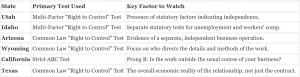
Remember, this is a simplified overview. The “test” is often just the starting point for a much deeper legal analysis, so it’s always wise to get specific advice.
Putting It in Perspective: California vs. Texas
To really see the difference, it helps to compare a state with a very strict approach to one that’s more traditional.
California is the poster child for a stringent test. Under its AB5 law, a worker is automatically considered an employee unless the company can prove all three parts of the ABC test:
- (A) The worker is free from the control and direction of the company.
- (B) The worker performs work that is outside the usual course of the company’s business.
- (C) The worker is customarily engaged in an independently established trade or business.
Prong “B” is the real sticking point for many businesses. If you’re a marketing agency and you hire a freelance writer, that work is central to your business, making it extremely difficult to classify them as a contractor in California without falling into a specific statutory exemption.
Texas, on the other hand, mainly uses the common law “right to control” test, which is much more aligned with the traditional IRS standard. But don’t get too comfortable. Texas courts and the Texas Workforce Commission will still look at the entire relationship. Having a strong contract is vital, but if your day-to-day actions treat the person like an employee, that contract won’t save you from a misclassification claim.
The complexity of these rules is exactly why a one-size-fits-all approach is so risky. If your business operates in more than one state, you need a smart, adaptable strategy. You can dive deeper into this topic by checking out our multi-state employment compliance guide.
Managing the Contractor Relationship Without Crossing the Line
The contract is signed, but your work isn’t over. How you interact with a contractor day-to-day is just as critical as the independent contractor agreement itself. It’s easy for the line between a contractor and an employee to get blurred through casual, everyday actions, which can quickly undo all your careful legal work.
A compliant and productive partnership connects your legal framework to your operational reality. It’s about building a strong, professional business-to-business relationship that doesn’t accidentally chip away at the contractor’s independent status.
Fostering Autonomy The Right Way
The core principle here is simple: contractors control the how, and you control the what. Any action you take that dictates their methods or processes erodes their independence and pushes them closer to being classified as an employee.
Here are some practical do’s and don’ts for your daily interactions:
- Avoid providing company-specific tools and equipment. Contractors are expected to have their own. Supplying a company laptop, phone, or proprietary software is often a red flag for an employment relationship.
- Do not set specific work hours. A contractor’s value is in the final product, not a timecard. Telling them they must work from 9 a.m. to 5 p.m. is a classic example of exerting employee-like control.
- Refrain from performance reviews. Performance reviews are an employee management tool. Instead, your focus should be on whether their work meets the quality standards and deadlines specified in the Statement of Work (SOW).
This mindset shift is crucial. You aren’t managing a person; you are managing a project and a vendor relationship.
Integrating Contractors Without Creating Employees
It’s completely normal to include contractors in team projects or communications, but how you do it really matters. You want to foster collaboration without creating a sense of employment.
The goal is to treat contractors as respected external partners, not as part of the internal team. This means avoiding things like including them in “employee-only” meetings, adding them to company-wide social email lists, or giving them a company email address unless absolutely necessary for the project.
This distinction might seem small, but it’s a powerful signal to both the contractor and any regulators about the true nature of your relationship. It reinforces that they are a separate business entity providing a service.
The market for top-tier independent talent is incredibly competitive. Experts predict that retaining these professionals will be more critical than just recruiting them, as high turnover leads to service disruptions and onboarding costs. To build a true partnership model built on respect and clear agreements, businesses must shift from a purely transactional client-vendor dynamic. For a deeper look into these trends, you can explore insights on the future of independent contractor relationships.
Communication and Payment Protocols
Clear communication and prompt payment are the foundation of any healthy contractor partnership. Your independent contractor agreement should already lay out the invoicing and payment process, but your follow-through is what truly builds trust.
- Stick to the agreed-upon payment schedule. Consistently paying invoices on time as outlined in the contract shows respect for their business and livelihood.
- Use designated channels for communication. Funnel all project-related discussions through a specific point person rather than having multiple managers giving different directions.
- Keep feedback focused on the deliverable. When you need to provide feedback, tie it directly back to the project requirements in the SOW, not their personal performance or work habits.
Ultimately, managing the relationship successfully comes down to consistently reinforcing the business-to-business dynamic you established in your agreement. Every interaction is an opportunity to either strengthen or weaken that legal distinction.
When You Need Expert Support for Contractor Compliance
While a solid independent contractor agreement is a fantastic starting point, some situations carry so much risk that a DIY approach becomes a real liability. Knowing when to call for professional backup isn’t a sign of weakness; it’s a smart, strategic move to protect your business.
Certain red flags should immediately tell you it’s time to consult an employment attorney or partner with a Professional Employer Organization (PEO). These experts live and breathe compliance, and they provide a crucial layer of defense when the stakes get high.
Scenarios Demanding Professional Oversight
If you find your business in any of the following situations, the risk of misclassification multiplies. A simple contract template just might not be enough.
It’s time to consider expert help when:
- The contractor performs core business functions. If a worker’s role is central to your company’s primary service (like a software developer for a tech company), regulators are far more likely to see them as an employee, especially in ABC test states.
- You’re managing a large or distributed team of contractors. The more contractors you have, especially across different states, the higher the odds of an accidental compliance slip-up.
- The contractor works exclusively or for a long duration for you. Long-term, exclusive relationships can start to look a lot like employment, even with a strong agreement in place.
- The role is highly integrated into your company. If the contractor has a company email, attends regular internal team meetings, or represents the company to clients, the line between contractor and employee gets dangerously blurred.
These scenarios don’t automatically mean you can’t use a contractor, but they drastically increase the legal complexity. An attorney can help structure the engagement correctly from the start.
Merely calling legal counsel after a problem arises isn’t enough to establish a good-faith defense. Companies must proactively seek and act on informed legal advice to protect themselves from severe penalties.
The PEO Partnership as a Compliance Shield
For many growing businesses, partnering with a PEO is a powerful solution. A PEO acts as your outsourced HR department, becoming a co-employer of your workforce—which is particularly valuable when you’re balancing a mix of employees and contractors. You can learn more about how this works by exploring the fundamentals of what HR outsourcing can do for your company.
A PEO doesn’t just offer advice; it provides a hands-on compliance framework. This includes managing payroll complexities, handling risk management, and ensuring adherence to ever-changing multi-state regulations. This kind of partnership frees you from heavy administrative burdens and lets you focus on growth, confident that an expert team is keeping your business safe.
Worker misclassification can cost far more than you think.
Let Helpside review your contractor agreements and practices to ensure you’re protected from audits, penalties, and personal liability.
Call Helpside today for your Free 15-Minute Benefits Audit: 1-800-748-5102
Further Readings:
Independent Contractor vs. Employee Classification for Small Businesses
The Best PEO for Small Business: Helpside vs. ADP TotalSource (Why Local Wins in UT, ID, WY, & AZ)
Debunking Common PEO Myths: The Truth for Small Business Owners
At Helpside, we understand these challenges. Our team of HR experts can help you navigate the complexities of worker classification and compliance, giving you the peace of mind to grow your business. Find out how we can help at helpside.com.