
A lot of small business owners think about intellectual property protection only when something has already gone wrong. A salesperson leaves with a client list. A contractor reuses internal templates for another client. A former employee downloads process documents before giving notice. By then, the legal question is only part of the problem. The bigger issue is that the business never built clear rules for who owned what, who could access it, and what happened when someone walked out the door.
That's why the strongest IP programs usually don't start with a filing. They start with people, workflows, and documentation. If you can't show what information mattered, who had access to it, and what guardrails were in place, enforcement gets harder and recovery gets more expensive.
Why IP Protection Is a Core Business Function
For most small and midsize businesses, intellectual property isn't a side issue. It's the pricing model, the delivery process, the training materials, the brand reputation, the customer knowledge, and the know-how that makes the company different from the next firm down the street.
That matters economically, not just legally. IP-intensive industries are among the largest drivers of the U.S. economy, supporting tens of millions of jobs and contributing trillions in economic output annually. For a business owner, the practical takeaway is simple: IP protection is part of business infrastructure.
Where SMBs actually lose IP
Most losses don't start with a dramatic court case. They start with ordinary operational failures:
- Loose access: Too many employees can open folders, repositories, pricing files, or customer records they don't need.
- Weak hiring documents: Offer letters and contractor agreements never clearly assign ownership of work product.
- Informal offboarding: No one collects devices, shuts off accounts, or reminds a departing worker of confidentiality obligations.
- Confused ownership: Founders assume "we paid for it, so we own it," even though the contract language never says that.
Practical rule: If your company's value lives in expertise, process, software, content, client relationships, or brand recognition, you already have IP exposure.
Why HR belongs in the conversation
IP risk often shows up in employment practices before it shows up in litigation. Job descriptions, confidentiality policies, contractor onboarding, access approvals, exit interviews, and document retention all affect whether a company can protect what it built. If those basics are sloppy, the legal rights on paper may not carry much weight in a real dispute.
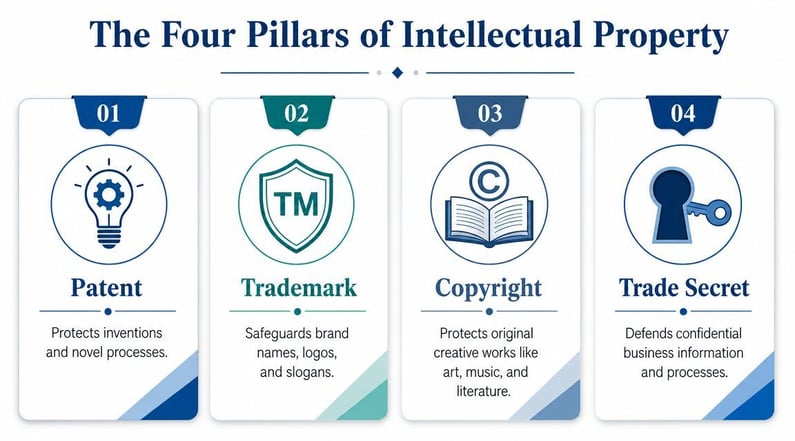
The Four Pillars of Intellectual Property
A manager hires a freelance designer to refresh the company logo, a salesperson saves the client list to a personal drive, and an operations lead builds a better delivery process in a shared document no one labels as confidential. All three situations involve intellectual property. Each one needs a different form of protection.
Business owners don't need a law school version of IP. They need a working map. The four pillars are patents, trademarks, copyrights, and trade secrets — and each protects a different business asset.
Patent
A patent protects inventions and certain new processes. It applies to a technical solution, not a general business concept or a useful way of organizing work. If your company develops a device, proprietary machinery, or a new technical method, a patent may be worth examining. For many SMBs, though, patents are less relevant than owners first assume — a service workflow, internal checklist, or management method usually belongs in another category, often trade secret.
Patents also come with a real trade-off. They can provide strong exclusion rights, but they require formal filing, cost, time, and public disclosure. For some companies, that is a sound investment. For others, keeping a process confidential is the better business decision.
Trademark
A trademark protects the brand signals customers use to identify your business — names, logos, slogans, and sometimes product or service names. Brand confusion costs money. If another business uses a name close to yours, customers may assume an affiliation, send business to the wrong place, or question your credibility when service quality differs. For a small business, trademark assets often include the company name, logo, and any named programs or service lines tied to your reputation.
This category often intersects with employment practices more than owners expect. Marketing staff, agencies, and contractors create brand assets every day. If agreements do not assign ownership clearly, the company can end up using a mark or design it does not fully control.
Copyright
Copyright protects original creative works such as website copy, training materials, handbooks, videos, graphics, articles, software code, and presentations. In many cases, protection begins when the work is created — but that does not solve the ownership question inside a business.
An employee handbook drafted by HR, a course built by a contractor, and code written by a freelance developer may all qualify for copyright protection. The business still needs documents that say who owns the final work, who can reuse it, and what happens if the relationship ends. If a contractor designs your logo or writes your code, the agreement should state who owns it, who can modify it, and whether that contractor can reuse any part of it for other clients.
Trade Secret
Trade secrets are often the most valuable IP asset in a growing company because they cover the information that makes the business run better than competitors. That can include methods, formulas, internal tools, pricing logic, customer segmentation, delivery systems, scripts, and proprietary workflows. Common examples in service businesses include client lists and segmentation logic, internal pricing frameworks, sales scripts and qualification models, operating playbooks, and delivery methods that produce better margins or results.
Trade secret protection depends entirely on conduct. If sensitive material is broadly accessible, casually shared, or never identified as confidential, the company has a weaker position later. Courts look at whether the business treated the information like a secret.
Side-by-side comparison
| IP Type | What It Protects | SMB Example | How Protection Is Secured |
|---|---|---|---|
| Patent | Inventions and novel processes | A new technical product design | Usually through formal registration |
| Trademark | Brand identifiers | Business name, logo, slogan | Through use plus formal registration strategy |
| Copyright | Original expressive works | Website copy, training guides, software code | Often automatic at creation, with stronger enforcement options when formal steps are taken |
| Trade Secret | Confidential business information | Pricing method, internal process, customer list, proprietary workflow | Through secrecy, restricted access, and contracts |
The legal category matters. Daily handling matters just as much. If your team shares sensitive information with vendors, prospects, or partners, a non-disclosure agreement gives managers a cleaner process for documenting what is being shared and under what terms.
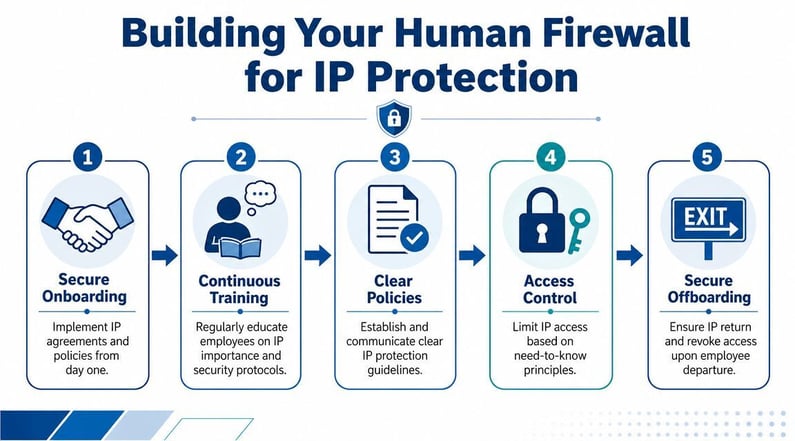
Building Your Human Firewall for IP Protection
Most businesses don't lose valuable information because a law was missing. They lose it because a person had broad access, unclear instructions, or no meaningful exit process. IP protection has to follow the employee and contractor lifecycle. The legal framework matters, but the daily controls matter just as much. Effective trade secret protection depends on maintaining secrecy through need-to-know access, NDAs, and documented exit procedures that reaffirm confidentiality.
Start at hiring, not after a problem
The offer letter and related agreements should answer basic ownership questions before work begins. If an employee creates work within the scope of employment, your documents should clearly address assignment of intellectual property and confidentiality expectations. The same principle applies to contractors, agencies, and consultants — where ownership can become much messier if the contract is silent.
At a minimum, review whether your agreements cover:
- IP assignment: Work product created for the business should be assigned clearly where appropriate.
- Confidentiality: The agreement should define what information is confidential and how it must be handled.
- Return of property: Devices, files, records, credentials, and materials should be returned at separation.
- Permitted use: Workers should understand what they may and may not reuse outside the engagement.
Use onboarding to define what matters
A lot of businesses hand new hires a stack of forms and never explain what information is sensitive. People protect what they understand. During onboarding, identify the company's real IP categories in plain language — not just "confidential information," but specifically: pricing models, client lists, code repositories, proposal templates, training materials, product roadmaps, and internal process documents.
Useful onboarding habits include:
- Role-based explanation: Tell each employee which information matters in their specific role.
- Storage rules: Make it clear where files belong and where they don't.
- Sharing rules: Define whether personal email, personal cloud drives, and unsecured messaging are prohibited.
- Incident reporting: Require prompt reporting of accidental disclosure or suspicious access.
Restrict access while people are employed
Need-to-know access isn't just a cybersecurity slogan — it's evidence that the company treated its trade secrets like trade secrets. If someone in recruiting can open engineering files, and a contractor can see every client record, the business has a harder time arguing that the information was tightly controlled.
Managers and HR should work with IT to review access when roles change, promotions happen, or projects end. A simple access review is often more effective than a long policy no one reads. For guidance on aligning employee practices with broader security expectations, Helpside's workplace cybersecurity guidance is a useful reference.
Offboarding is where discipline shows
When an employee resigns, the company should move quickly and consistently. A strong offboarding checklist includes:
- Revoke access to email, shared drives, apps, repositories, and messaging tools.
- Collect company property including laptops, phones, keys, badges, and storage devices.
- Confirm return or deletion of business information from personal accounts or devices if permitted work practices involved them.
- Conduct an exit conversation that reaffirms confidentiality and document that it occurred.
- Preserve evidence such as signed agreements, access logs, and ownership records in case of later dispute.
Essential Digital and Technical Safeguards
People create most IP risk, but weak systems make the damage easier. If your company stores source code in an open repository, keeps sensitive documents in broadly shared folders, or lets staff move files to unmanaged personal tools, legal protection won't do much on its own.

Controls that matter most
- Least-privilege access: Employees should get access based on role, not convenience.
- Encryption: Sensitive information should be protected both when stored and when transmitted.
- Multi-factor authentication: Important systems should require more than a password.
- Repository discipline: Code, templates, product files, and internal content should live in managed systems with auditable access.
- Watermarking or attribution controls: Where feasible, use methods that help trace copying or unauthorized distribution.
Software needs extra attention
Software is easy to duplicate and easy to move. If a former developer can still access repositories, or if license checks are easy to bypass, proprietary logic becomes much harder to defend in practice. Technical controls don't replace contracts — they make your contracts more credible when you need to enforce them. Another smart habit is monitoring: watch app stores, marketplaces, social platforms, and domain registrations for misuse of your content, code, or brand assets.
Registration vs. Contracts: A Strategic Choice
Registration and contracts are not interchangeable tools. They solve different problems, and the right choice usually depends on how the asset is used, who can access it, and whether its value depends on public exclusivity or private control.
When registration earns its keep
Registration makes practical sense when the asset will be visible, market-facing, or easy for an outsider to copy without ever touching your internal systems. It also matters when investors, buyers, or licensees will ask for clean proof of ownership. Registration is usually the stronger move when:
- The asset shapes your market identity — your name, logo, slogan, or product branding.
- The asset will be disclosed publicly, so secrecy is not a realistic protection strategy.
- You expect disputes with competitors or imitators, not just breaches by employees or contractors.
- You want a cleaner path for licensing, sale, or due diligence.
When contracts do more work than registration
SMBs lose a surprising amount of IP through people, not pirates. A departing employee takes templates. A contractor reuses code blocks. A sales leader downloads customer segmentation logic before resigning. Those problems usually turn on employment documents, access limits, and proof of ownership — not filing certificates.
That is why IP protection has to run through HR and operations. Offer letters, invention assignment clauses, confidentiality agreements, contractor terms, job-based access, and documented offboarding often matter more than a registration for day-to-day protection.
Many companies need both registration and contracts. The mistake is treating IP as a legal filing project instead of an operating discipline. Ownership should be established before work starts, confidentiality reinforced during employment, and access ended cleanly when someone leaves.
A better decision test
Ask four questions: Is the asset public or private? Is the main threat a competitor in the market or a person with internal access? Does the asset gain value from exclusivity on the record or from staying confidential? Can you prove ownership through your hiring, onboarding, and contractor paperwork? The answers usually point clearly toward registration, contracts, or both.
Enforcing Your Rights and Responding to Infringement
When you suspect infringement, speed matters, but panic doesn't help. Preserve screenshots, contracts, access records, file histories, dated drafts, communications, and evidence of ownership. If an employee or contractor is involved, secure the personnel file and signed agreements immediately.
Escalate in stages
- Investigate internally: Confirm what was taken, copied, posted, or reused.
- Preserve evidence: Lock down records before they disappear.
- Send formal notice: Demand that the conduct stop and relevant materials be returned or removed.
- Consider negotiation or mediation: Some disputes can be resolved faster through agreement than litigation.
- Litigate when necessary: If the asset is important enough and the evidence is strong, formal enforcement may be worth the cost.
One more issue matters for growing companies. Intellectual property rights are territorial — protection typically has to be secured in each country where the business operates. If you sell software, content, or services across borders, enforcement planning can't be an afterthought.
The companies that enforce best usually aren't the most aggressive. They're the most prepared.
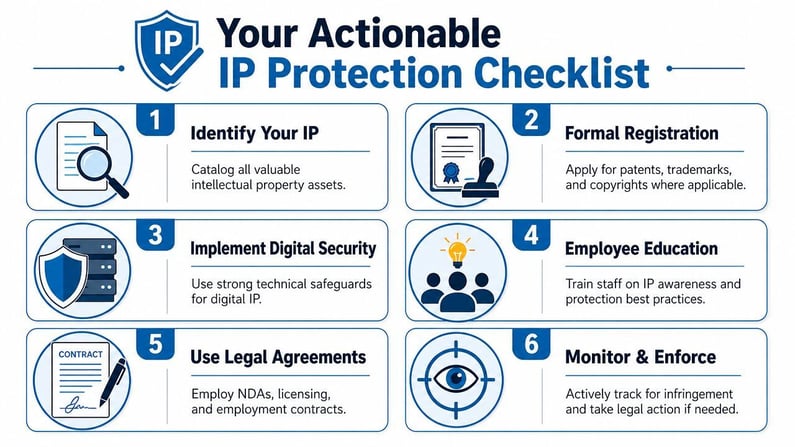
Your Actionable IP Protection Checklist
New hire and onboarding
- Define ownership early: Make sure employment and contractor documents address IP assignment and confidentiality.
- Train by role: Tell people exactly what counts as confidential in their jobs.
- Set storage rules: Require business information to stay in approved systems.
Employee and contractor management
- Use NDAs appropriately: Put confidentiality terms in place before sharing sensitive information.
- Limit access: Review who can see pricing, client lists, code, and internal methods.
- Track creators and approvals: Keep records showing who developed important work and when.
Digital security
- Protect critical systems: Use encryption, multi-factor authentication, and controlled repository access.
- Separate personal from business tools: Reduce informal file-sharing habits that blur ownership and control.
- Monitor for misuse: Watch for copied content, leaked files, and brand misuse online.
Departure and annual review
- Run a formal offboarding checklist: Revoke access, recover property, and document confidentiality reminders.
- Audit agreements: Check that employee, contractor, and vendor contracts still match current operations.
- Update your IP inventory: List brands, content, software, methods, templates, and confidential business information that matter most.
A good IP program isn't built by legal paperwork alone. It's built when HR, operations, and leadership treat company know-how like the asset it is.
If your business is growing and your IP practices still depend on informal habits, Helpside can support the HR, onboarding, policy, payroll, and risk management side of building a more controlled operating environment — which is often where intellectual property protection either holds up or falls apart.