This article was written by Josh Hancey, Safety Director at Helpside.
Each year, around 2 million work-related injuries occur in the U.S., with more than 25% of them affecting the head, eyes, hands, or feet. Unfortunately, many of these injuries could be prevented if workers wore the appropriate safety gear.
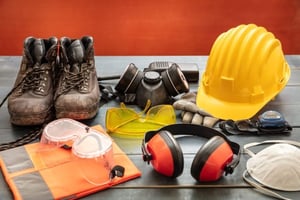
Here are some common injuries and the protective gear employees can wear to stay safe:
Head Protection
Despite the risks, only 16% of workers who sustained head injuries were wearing hard hats at the time. A hard hat can be life-saving in hazardous environments, especially where tools or objects could fall from above. For instance, a five-pound tool dropped from a height of 20 feet can be deadly.
To prevent such accidents, using tool lanyards and ensuring your employees’ hard hat meets OSHA standards with the ANSI Z89.1.29 stamp is crucial. Type I hard hats provide protection for the top of the head, while Type II hard hats cover both the top and sides. If electrical hazards are a concern, Class G or Class E hard hats offer necessary protection from up to 2,200 and 20,000 volts, respectively.
Eye and Face Protection
Eye injuries are also prevalent, with only 40% of injured workers wearing eye protection and a shocking 1% using face protection. Not all safety glasses provide the same level of defense, so it’s important to select ones suited to the hazards in your work environment, such as heat, dust, chemicals, or flying debris.
Safety glasses that meet OSHA standards must have the ANSI Z87.1 marking. For high-impact jobs, such as using power tools, it is essential to wear glasses marked with ANSI Z87.1+, which indicates a high-velocity impact rating. When working with high-speed tools like grinders, both safety glasses and a face shield are required to provide full protection.
Hearing Protection
Hearing damage is often irreversible, making protection critical in noisy environments. Exposure to noise levels of 85 decibels (dBA), which is roughly equivalent to the sound of a motorcycle or heavy traffic, can cause damage after just two hours.
Louder noises, like a chainsaw or power tools that produce around 100 dBA, can cause hearing loss in as little as 14 minutes. Hearing protection reduces noise levels by 10 to 13 dBA, offering much-needed relief in loud environments. OSHA’s permissible exposure limit is 90 dBA for an eight-hour workday, but exposure time decreases as noise levels rise. Choosing hearing protection with a solid Noise Reduction Rating (NRR) can help reduce the risk of permanent hearing loss.
Footwear Protection
Foot injuries are another common hazard, but only 23% of workers who suffered these injuries were wearing safety shoes or boots. The right footwear is essential for protecting against various risks, including impact, compression, punctures, and electrical hazards. Safety footwear should meet ASTM F2413 standards for impact and compression protection, depending on the work environment. These standards ensure that footwear can withstand the pressures and dangers encountered in many industrial settings.
Hand Protection
Hand injuries can be significantly reduced by wearing the right gloves, which protect against a range of hazards such as cuts, abrasions, chemical burns, and excessive vibrations. In fact, wearing proper gloves can reduce the risk of hand injuries by 60%.
However, it’s important to avoid wearing gloves near machinery with moving parts, as they can get caught and cause serious harm. Cut-resistant gloves are particularly valuable for tasks involving sharp objects, with ratings ranging from A1 for minimal protection to A9 for maximum protection.
Lung Protection
Respirators are essential for protecting the lungs from harmful airborne particles, such as silica dust, asbestos, and toxic chemical vapors. These devices create a tight seal around the face and are equipped with filters that can block particles as small as 0.1 microns.
For example, N95 respirators filter out 95% of particulates, while P100 respirators offer even higher protection by filtering out 99.9%. Different types of respirators are designed for different environments: N-series for non-oil environments, R-series for environments with oil-based particulates, and P-series for oil-proof protection.
Wearing proper protective gear can prevent severe injuries and even save lives. From hard hats and eye protection to hearing guards and respirators, each piece of equipment plays a critical role in keeping workers safe. Always take the time to assess your work environment, identify potential hazards, and choose the right gear to protect yourself and your employees.
Stay up-to-date with our HR, payroll, and employer compliance newsletter sent straight to your inbox!
Ready to see what Helpside can do for you?