
So, what exactly is a new hire checklist template? Think of it as a structured document that guides HR managers and team leads through every single step of the onboarding process. It’s designed to make sure all the critical compliance, administrative, and cultural integration tasks are completed—creating a consistent and positive experience that boosts retention from day one.
Why a Structured Onboarding Checklist Is Your Best Retention Tool

For growing businesses, that first month is a make-or-break window. A new hire’s initial experience heavily influences their decision to stay long-term. This is where a structured new hire checklist template becomes much more than just paperwork; it’s your first and best tool for improving employee retention.
The real-world costs of a disorganized welcome are huge. We’re talking early turnover, lost productivity, and even a damaged employer reputation. When a new team member walks into confusion, delays, and a lack of clear direction, they immediately start to question their decision.
Research shows that 70% of new hires decide whether a job is right for them within their first month, with an alarming 29% making that decision in their first week.
That compressed timeline is exactly why a detailed checklist is so critical, especially for organizations with 20–150 employees. You just don’t have time for a bad first impression.
From Confusion to Confidence
A simple checklist can completely transform the onboarding experience, taking it from chaotic to confident. It provides a clear roadmap for everyone involved—HR, the hiring manager, and the new employee. This ensures nothing important falls through the cracks, whether that’s setting up a workstation, completing compliance paperwork, or just scheduling a welcome lunch with the team.
This structured approach delivers several key advantages:
- Ensures Compliance: It systematizes collecting critical documents like the Form I-9 and W-4. This seriously reduces the risk of costly legal missteps, especially for businesses operating in multiple states where laws differ.
- Boosts Productivity Faster: When employees have the tools, access, and information they need from the very start, they can begin contributing to team goals much more quickly.
- Fosters a Positive Culture: A well-organized process sends a powerful message. It says your company is professional, values its people, and is invested in their success from day one.
For companies in competitive markets like Utah, Arizona, and Idaho, a repeatable, compliant onboarding process is a powerful advantage. And while a checklist provides the foundation, taking a deeper dive into comprehensive employee retention strategies can cement your long-term success.
Ultimately, this isn’t about just checking boxes; it’s about proving to your new hire that they made the right choice.
The Critical Pre-Boarding Phase Before Day One
A great onboarding experience starts long before a new employee ever sets foot in the office. That crucial window between the moment they accept the offer and their first day is what we call pre-boarding. This is your golden opportunity to make them feel expected, valued, and completely confident in their decision to join your team.
When new hires sign their offer and are then met with silence, anxiety can start to creep in. They might second-guess their choice. A structured pre-boarding process replaces that uncertainty with genuine excitement and gets all the tedious administrative work out of the way early.
Essential Administrative and Compliance Tasks
First things first: the paperwork. Getting the official documentation handled upfront ensures compliance is buttoned up from the start, preventing stressful—and potentially costly—mistakes down the road. This is especially important as employment laws vary significantly from state to state.
Here are the non-negotiables for your pre-boarding checklist:
- Send the Official Offer Letter and Employment Agreement: Make sure all key details are crystal clear—start date, salary, reporting structure, and employment classification (e.g., exempt/non-exempt). Get a signed copy back for your records.
- Initiate the Background Check: With the candidate’s written consent, begin any required background screenings. Always comply with the federal Fair Credit Reporting Act (FCRA) and any applicable state or local “ban the box” laws, which regulate when you can inquire about criminal history.
- Provide Early Access to Your HR Portal for Paperwork: Give your new hire a head start on foundational documents like their W-4 and direct deposit forms. This frees up their first day for what really matters: connecting with the team and diving into their new role.
By addressing compliance tasks like tax forms and background checks before day one, you transform the employee’s first day from a session of tedious paperwork into a welcoming and engaging experience focused on culture and team connection.
Setting the Stage for a Warm Welcome
Beyond the necessary paperwork, pre-boarding is your chance to start building a personal connection. Simple, thoughtful actions show you’re genuinely prepared for their arrival and excited to have them on board.
Consider adding these items to your checklist to make a lasting impression:
- Mail a Welcome Package: A small box with company swag—a t-shirt, a water bottle, maybe a handwritten note from their new manager—is a surprisingly powerful gesture.
- Set Up All Technology and Workstation Needs: Nothing screams “we weren’t ready for you” like a new hire spending their first day waiting on IT. Create their email, grant software access, and get their desk ready or ship their remote work equipment ahead of time.
- Send a Team-Wide Introduction Email: A few days before they start, let the team know who’s coming. Include their role, a short bio, and their start date so they walk into a warm welcome from everyone, not just their direct manager.
Completing these tasks makes a new employee feel like part of the team before they even start. For those looking to refine their processes, exploring a library of free HR templates can offer even more resources to support your onboarding efforts.
Crafting an Impactful First Day and Week Experience
That first week is make-or-break. It’s the moment all the promises you made during the hiring process get put to the test. A chaotic, disorganized first day can immediately undo all the excitement you’ve built, leaving your new hire feeling like an afterthought instead of a valued team member.
A great first week comes down to striking the right balance between handling the necessary paperwork and making a genuine human connection.
Your Game Plan for Day One
The first day should start with a personal welcome from their direct manager—not just an HR representative. This small gesture immediately sets a positive, personal tone. From there, it’s time for a tour, whether that’s a physical walk-through of the office or a guided virtual tour of the key communication tools and digital hangouts your remote team uses.
A planned lunch with the team is essential. It can be in-person or virtual, and if it’s remote, providing a meal delivery stipend is a nice touch. This simple act shifts the focus from processes to people, giving the new hire a chance to connect with colleagues in a low-pressure setting. It sends a clear message: you’re joining a team, not just filling a slot.
Navigating First-Week Compliance and Paperwork
While building connections is the goal, getting the compliance details right is non-negotiable. The first few days are packed with time-sensitive documents that protect both your business and your new employee. Getting this wrong can lead to serious legal and financial headaches, especially if you’re managing employees in different states.
Here’s a quick rundown of what needs to be handled:
- Complete Form I-9 Verification: This is an urgent task. You must physically inspect the employee’s eligibility documents (or use an authorized representative for remote hires) and complete Section 2 of the Form I-9 within three business days of their start date. Missing this deadline is a common—and costly—compliance mistake.
- Finalize Tax and Payroll Documents: Make sure the employee has filled out their federal Form W-4 and any required state-specific tax withholding forms. Double-check that their direct deposit information is entered correctly to ensure their first paycheck arrives without a hitch.
- Review Key Company Policies: Block out dedicated time to go over the employee handbook. Focus on crucial policies like the code of conduct, safety procedures, and IT security. Have them sign an acknowledgment form confirming they’ve received and reviewed it.
- Initiate Benefits Enrollment: Give them a clear overview of their health insurance options, retirement plans, and any other benefits. Most importantly, clearly communicate the enrollment deadline, as missing this window can leave an employee without coverage until the next open enrollment period.
A new hire’s first day should be memorable for all the right reasons. By getting the essential paperwork handled efficiently, you free up more time for what really matters: making them feel welcome, connected, and ready to succeed.
To help you map out these critical touchpoints, we’ve put together a sample action plan. Think of this as a template you can adapt to fit your company’s specific needs for that crucial first week.
First Week Onboarding Action Plan
| Day | Administrative & Compliance Tasks | Team & Culture Integration | Role & Performance Focus |
|---|---|---|---|
| Day 1 | Complete I-9 & W-4. Review key policies. | Welcome by manager. Office/systems tour. Team lunch. | Set up workstation. Overview of role expectations. |
| Day 2 | Finalize any remaining payroll forms. | Introduction to onboarding buddy. Coffee chat with a colleague. | First one-on-one with manager. Review 30-day goals. |
| Day 3 | Benefits enrollment overview and Q&A session. | Attend a team stand-up or huddle. | Begin first small project or training module. |
| Day 4 | Confirm all paperwork is submitted and correct. | Introductory meetings with 1-2 key collaborators. | Shadow a team member. Learn core software. |
| Day 5 | N/A | Team happy hour or casual end-of-week check-in. | Weekly wrap-up with manager. Review progress and ask questions. |
This timeline ensures you cover your bases without overwhelming your new team member, leaving them feeling confident and prepared by the end of the week.
Building Connection and Clarifying the Role
Once the core administrative tasks are out of the way, the rest of the week should be all about integration and role clarity. This is your chance to shift the focus from paperwork to performance.
An onboarding buddy program is one of the most effective tools for this. Pairing a new hire with a peer—someone who isn’t their manager—gives them a safe person to ask all the small, informal questions they might hesitate to ask their boss. It’s an instant way to foster a sense of belonging. You can learn more about this and other great ideas by exploring these 10 employee onboarding best practices.
Schedule some initial training sessions and make sure they have introductory meetings with key collaborators from other departments. This helps the new person start connecting the dots and see how their role fits into the bigger picture. When it’s all said and done, they should end their first week feeling confident, integrated, and genuinely ready to contribute.
Guiding the First 90 Days to Boost Long-Term Success
A great first week is a fantastic start, but the real work of onboarding happens over the next three months. The first 90 days are when a new employee truly finds their footing, moving from a newcomer to a confident, productive member of your team. A structured plan for this period is what solidifies their place in the company and sets them up for long-term success.
The first week is all about initial welcomes and essential tasks, laying the groundwork for what’s to come.
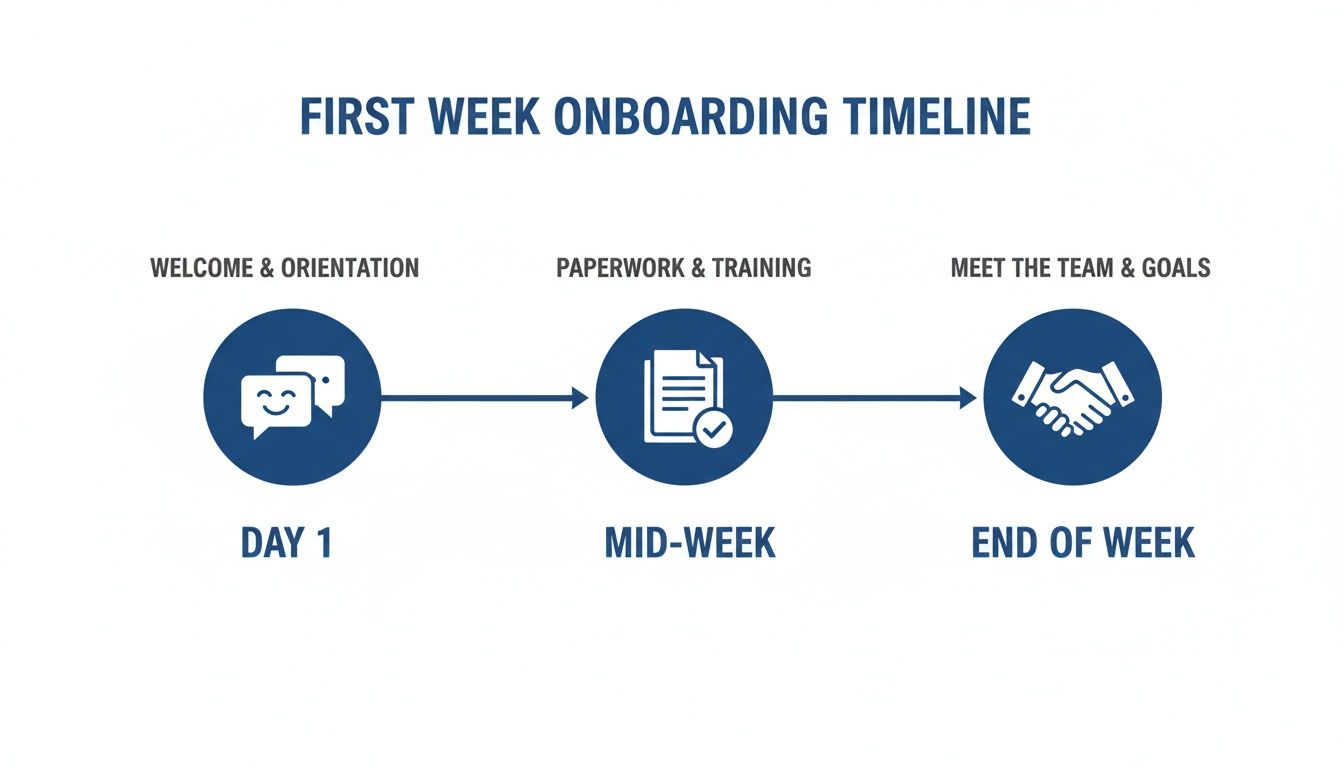
This timeline shows how a well-planned first week should balance administrative needs with team integration. It sets a positive tone, but the efforts that build real retention and engagement happen in the weeks that follow.
The 30-60-90 Day Framework
A 30-60-90 day plan is a powerful tool to include in your new hire checklist template. It breaks the onboarding journey into clear, manageable phases, each with its own goals and focus areas. This framework gives both the manager and the new hire a roadmap to follow, making it easy to track progress and stay aligned.
-
First 30 Days: Learning and Observation. The main goal here is immersion. New hires should be focused on absorbing the company culture, learning core processes, and getting to know their team. Check-ins should be about answering questions, clarifying role expectations, and making sure they have everything they need to get started.
-
Next 30 Days (Days 31-60): Contribution and Collaboration. The focus now shifts toward active participation. The employee can start taking ownership of smaller tasks and contributing to team projects. This is also a great time to introduce them to people in other departments so they can see how their work connects to the bigger picture.
-
Final 30 Days (Days 61-90): Initiative and Autonomy. By this point, your new employee should be working with more independence. They should feel comfortable taking the lead on certain tasks and even start bringing their own ideas to the table. The 90-day review is a key milestone to discuss their performance, set goals for the future, and officially wrap up the initial onboarding period.
The manager’s role is the single most important factor in onboarding success. An actively engaged manager who provides regular feedback, clarifies expectations, and champions the new hire’s integration can make all the difference.
The Manager’s Critical Role in Onboarding
The data is clear: a strong onboarding process dramatically improves employee retention. In fact, companies with a structured program can see new hire retention improve by 82%. On the flip side, roughly one-third of new hires might leave within their first 90 days if the experience is poor.
And who makes the biggest difference? The manager. New employees with actively involved managers are 3.4 times more likely to say their onboarding was successful. You can dig deeper into these onboarding statistics and their impact on retention.
This shows just how crucial it is for managers to be equipped for and accountable for their part in the process.
To make check-ins truly effective, managers should:
- Come Prepared: Review the 30-60-90 day plan and the employee’s recent work before the meeting.
- Ask Open-Ended Questions: Go beyond “How’s it going?” and ask things like, “What has been the most surprising thing about your role so far?” or “What obstacles are you running into?”
- Provide Specific Feedback: Offer both positive reinforcement for things going well and constructive guidance on areas for improvement.
- Connect Their Work to Company Goals: Help the new hire see the “why” behind their tasks and how their contributions matter.
This kind of hands-on approach helps pave the way to full productivity, turning your new hire into a committed, high-performing member of the team.
Navigating Multi-State HR Compliance and Payroll
Hiring talent across state lines is a fantastic way to grow your team, but it also opens the door to a whole new world of HR complexity. We see it all the time with businesses expanding into states like Utah, Arizona, Wyoming, and Idaho—what’s perfectly compliant in one state can be a serious violation in another.
Getting a handle on multi-state payroll and legal duties isn’t just good practice; it’s absolutely critical for avoiding costly penalties.
The moment you hire an employee in a new state, you establish what’s called a “nexus” there. This means your business is immediately subject to that state’s employment laws, tax rules, and reporting requirements. A common pitfall is to simply apply your home state’s rules everywhere, which can quickly lead to major compliance headaches.
The Multi-State Compliance Checklist
Your new hire checklist template needs a dedicated section just for state-specific compliance. Each new state you enter requires its own set of administrative tasks before you can legally employ and pay someone there. Getting this wrong can lead to fines, back taxes, and other penalties that can easily derail a growing business.
When hiring in a new state, here are the absolute must-dos:
- Register for Payroll Taxes: You must register with the new state’s tax agency to withhold and remit state income tax. This is the first thing you have to do before running a single paycheck.
- Secure State Unemployment Insurance (SUI): You’ll need to set up a state unemployment tax account. Be aware that the rates and wage bases can vary dramatically from state to state.
- Verify Workers’ Compensation Coverage: Check that your current workers’ compensation policy covers employees in the new state. If it doesn’t, you may need a new policy or a state-specific rider.
- Complete State-Specific New Hire Reporting: On top of federal requirements, most states have their own deadlines and portals for reporting new hires, primarily used to enforce child support orders.
The most critical takeaway for multi-state employers is that employment law is not uniform. You must actively verify the requirements for withholding, paid leave, and mandatory notices for every single state where you have an employee.
Beyond the Basics: State-by-State Differences
True compliance goes far beyond just tax registration. The legal landscape can change dramatically the moment you cross a state line. For example, some states have very specific rules about an employee’s final paycheck, mandated meal and rest breaks, or required paid sick leave laws that may not even exist in your home state.
Just look at these common variations:
- State-Specific Tax Forms: In addition to the federal W-4, many states require their own withholding allowance certificates that new hires must complete.
- Mandatory Workplace Notices: States often require you to provide employees with specific notices about their rights, like paid leave policies, minimum wage, or whistleblower protections. These often need to be physically posted or sent out digitally.
- Paid Leave Laws: A growing number of states and cities have passed laws mandating paid sick leave, and each one comes with its own unique rules for accrual, usage, and documentation.
Trying to manage these differences manually for each new state is a massive administrative burden and a huge risk for error. For businesses navigating this complexity, our comprehensive multi-state employment compliance guide offers a deeper dive into these crucial details. Staying ahead of these regulations is the key to confident, compliant growth.
Frequently Asked Questions About New Hire Checklists
Even with the best template, questions always come up when you start putting it into practice. Here are some of the most common things business owners and HR managers ask us about getting their new hire checklists just right.
How Do I Customize a Checklist for Remote vs In-Office Roles
The most efficient way to handle this is to use a master template for universal tasks and then add role-specific sections.
Start with a core checklist that applies to every new hire, regardless of location. This includes federal compliance tasks (Form I-9, W-4), benefits enrollment, and a review of the company-wide employee handbook. These are your non-negotiables.
From there, create smaller, “bolt-on” checklists for different work arrangements:
- For Remote Hires: This list would include tasks like “Ship equipment and welcome kit,” “Confirm home office address for tax purposes,” and “Schedule virtual introductions with key team members.” It should also include a process for remote I-9 verification using an authorized representative.
- For In-Office Hires: This list would have items like “Assign a desk and provide building access,” “Conduct a physical office and safety tour,” and “Set up an in-person lunch with the team.”
This modular approach prevents you from creating a new document from scratch for every hire, ensuring consistency while accommodating different needs.
What Is the Best Way to Track Checklists for Multiple New Hires
When you’re just starting out and only hiring a few people, a shared cloud spreadsheet like Google Sheets or Excel Online works perfectly well. It’s a low-cost solution where you can duplicate your master new hire checklist template for each person and share it with managers to get real-time visibility.
As your team grows, however, manual tracking becomes a liability. The risk of missing a critical compliance or payroll deadline increases exponentially with each new hire you bring on board.
Once you find yourself onboarding several people at once—or across different locations—it’s time for an upgrade. A dedicated tool can be a lifesaver.
- Project Management Tools: Platforms like Asana, Trello, or Monday.com let you create checklist templates, assign tasks to specific people (like IT or the hiring manager), set due dates, and even automate reminders.
- HRIS Platforms: An integrated Human Resources Information System (HRIS) is the next level. These often have built-in onboarding modules that automate the workflow and connect everything directly to payroll and benefits administration.
The goal is to have a system that prevents critical tasks from slipping through the cracks. Automation and clear task ownership are your best friends here.
What Are the Biggest Onboarding Compliance Mistakes to Avoid
The two most frequent and financially risky errors involve the Form I-9 and multi-state payroll setup. For the Form I-9, the employer must complete their portion (Section 2) within three business days of the employee’s first day of work for pay. Missing this deadline is a common and costly violation that can lead to significant government fines.
For multi-state employers, a major pitfall is failing to register for payroll taxes in a new hire’s state of residence before running their first paycheck. You must assume every state has unique rules for withholding, mandatory employee notices, final pay, and paid leave laws. Applying your home state’s rules to an out-of-state employee is a frequent source of compliance violations.
Ready to streamline your onboarding and stay compliant from day one?
Let Helpside handle your payroll, HR, and multi-state compliance—so you can focus on growing your team with confidence.
Call Helpside today for your Free 15-Minute Benefits Audit: 1-800-748-5102
Further Readings:
Why Onboarding with a PEO Can Make or Break Your Business Growth
The Ultimate New Employee Onboarding Checklist: 10 Critical Steps
Four Tips for Onboarding Remote Employees
At Helpside, we specialize in removing these compliance burdens so you can focus on growth. We manage the complexities of multi-state payroll, benefits, and HR, ensuring your onboarding process is not just welcoming but also 100% compliant. Learn how we can help you hire with confidence at https://helpside.com.