
Your calendar is full, your managers are stretched, and your one-on-ones probably don’t feel like they’re helping enough.
For many small businesses, these meetings start with good intentions and slowly turn into rushed status checks, project triage, or the first thing that gets moved when the week gets messy. That’s a problem. In a growing company, the one on one meeting agenda isn’t administrative overhead. It’s one of the few recurring moments where a manager can surface risk early, coach clearly, and build the kind of trust that keeps people engaged.
That matters even more when your team is spread across locations, when managers are onboarding new hires while trying to hit deadlines, and when compliance, documentation, and consistency all matter at the same time.
Why Your One-on-Ones Need a Strategic Overhaul
A weak one-on-one usually looks familiar. The employee gives updates the manager could’ve read in Slack or Asana. A few urgent issues eat the rest of the time. Nobody talks about development, workload pressure, or what might go wrong next. Then the meeting ends without a clear next step.
That format wastes one of the most useful management tools you have.
The volume alone should force a rethink. The shift to remote and hybrid work pushed the average number of one-on-one meetings per professional from 0.9 per week to 5.6 per week, an increase of over 500%, or more than 278 one-on-ones a year according to Reclaim’s productivity report on one-on-one meetings. If your managers are spending that much time in recurring conversations, those meetings need to do more than cover task updates.
What growing companies miss
In a business with 20 to 150 employees, a good one-on-one does work that no dashboard can do well on its own.
It helps a manager catch burnout before it becomes resignation. It reveals whether a new hire is confused but hesitant to say so in a team setting. It creates a record of coaching, priorities, and expectations. It gives employees a predictable place to raise concerns before they become performance issues, culture problems, or legal headaches.
That’s why I treat the one on one meeting agenda as part retention tool, part operating rhythm, and part risk control.
Practical rule: If a recurring meeting happens often, it needs structure. If it involves performance, workload, or employee concerns, it also needs consistency.
The cost of treating them casually
Small companies often assume culture is built in the hallway, through founder visibility, or by hiring good people. Some of that helps. But as teams grow, managers become the culture. Their weekly habits shape whether employees feel supported, ignored, or surprised by feedback.
A strong one-on-one creates three things founders usually want more of:
- Alignment: The employee knows what matters now and what can wait.
- Signal detection: Managers hear about blockers, conflict, and confusion earlier.
- Trust: Employees see that their manager remembers prior conversations and acts on them.
When those three are missing, turnover often feels sudden even though the warning signs were there.
If your company is moving away from annual-only performance conversations, Helpside’s perspective on replacing annual performance reviews with frequent one-on-ones is a useful reminder that frequent conversations only help when they’re intentional.
The Anatomy of a High-Impact Agenda
Most one-on-ones don’t fail because people don’t care. They fail because nobody designed them.
Only 37% of meetings use a structured agenda, and that gap contributes to poor meeting quality. The same data also shows a trade-off managers need to understand. Meetings can feel less valuable when structure becomes too rigid, especially when employees aren’t involved in shaping the discussion. In one study, 1 in 3 employees had no input on their one-on-one topics, according to Archie’s 2025 meeting statistics roundup.
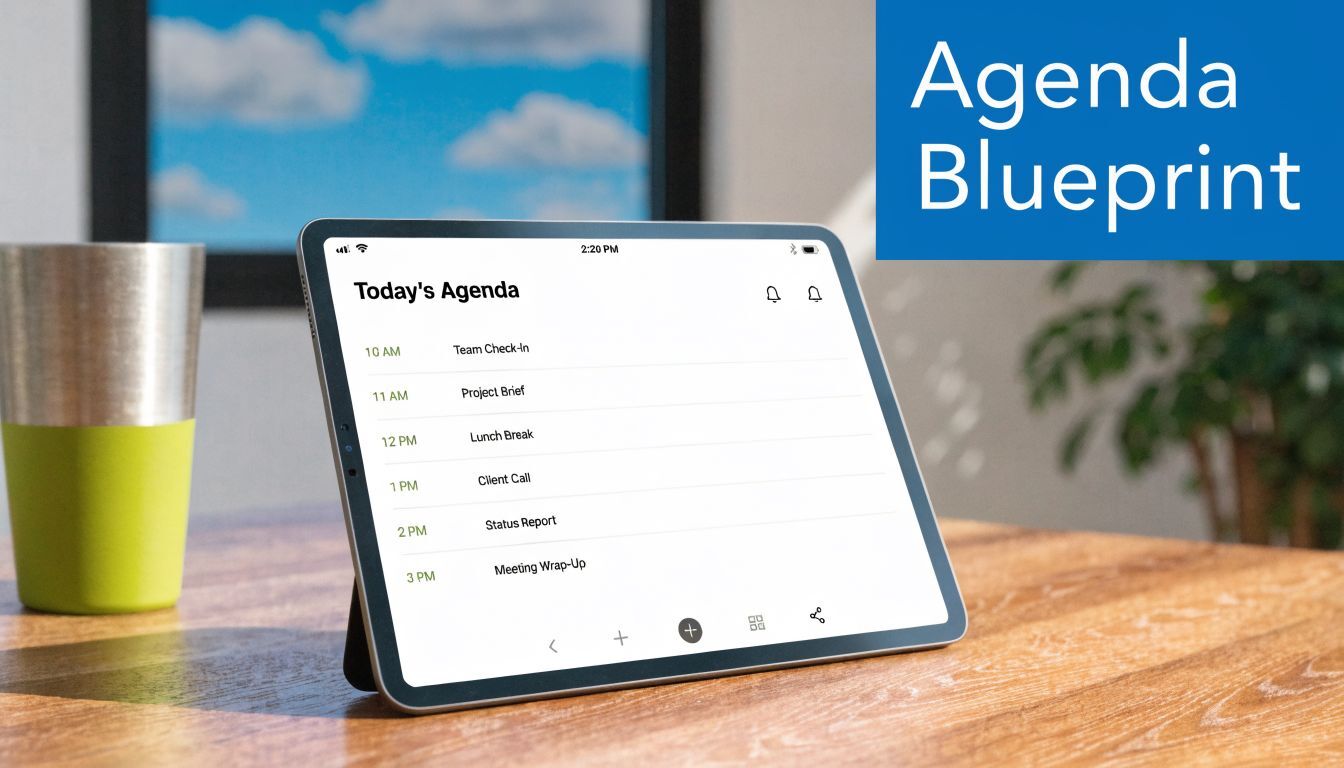
That’s the balance to aim for. A one on one meeting agenda should be structured enough to keep the meeting useful, but flexible enough to reflect what the employee needs to discuss.
Five parts that belong in the agenda
The most reliable format uses five segments:
| Agenda segment | What it’s for | What to avoid |
|---|---|---|
| Check-in | Build rapport and gauge energy, stress, and context | Turning it into small talk that never reaches work reality |
| Progress review | Clarify priorities and review meaningful movement | A line-by-line status report |
| Challenges | Surface blockers, conflict, and uncertainty | Problem solving everything on the spot |
| Development | Discuss growth, feedback, and support | Skipping this whenever the week is busy |
| Wrap-up | Confirm actions, owners, and next steps | Ending with vague intentions |
Why each segment matters
Check-in comes first because employees don’t always open with what’s really going on. A short personal and workload check often reveals whether the rest of the conversation should stay tactical or shift into support and coaching.
Progress review keeps the meeting grounded. This isn’t where the employee reads a project tracker aloud. It’s where the manager asks what’s moving, what’s stuck, and whether the priorities still make sense.
Challenges deserve their own space. If blockers only come up when there’s extra time, managers miss patterns. Repeated confusion, cross-functional tension, or resource issues often show up here long before they show up in a resignation letter.
A useful one-on-one doesn’t just ask, “What are you working on?” It asks, “What’s making your work harder than it should be?”
Development is where many managers drop the ball. In a small business, people don’t need grand career ladders to feel invested in. They need signs that someone is thinking about their growth, skills, and future contribution.
Wrap-up is the discipline point. If nobody leaves with clarity, the agenda didn’t work.
Collaborative beats manager-only
The best agendas aren’t written by the manager alone. They’re co-created.
That means both people can add topics during the week. It also means the employee has room to raise issues that wouldn’t surface in a manager-led checklist. If you want candor, don’t make the meeting feel scripted. Use a framework, not a script.
How to Prepare and Share Your Agenda
A one on one meeting agenda does most of its work before the meeting starts. If the manager builds it five minutes before the call, the conversation will usually stay reactive. If both people contribute in advance, the meeting becomes calmer, sharper, and easier to trust.
Research summarized by Monday.com’s one-to-one meeting guide recommends sharing the agenda 24 hours in advance and using a simple structure: 5 minutes for check-in, 10 to 15 minutes on progress, 5 to 10 minutes on challenges, 5 to 10 minutes on development, and 5 minutes to wrap up.
A repeatable prep rhythm
Use the same rhythm every time so your managers don’t reinvent the process each week.
-
Set the purpose early
Label the meeting clearly. Weekly sync, onboarding check-in, development conversation, or performance snapshot all require a different emphasis. -
Keep one shared place for topics
A shared Google Doc, Notion page, Microsoft OneNote, or agenda field inside your HR system works well. The tool matters less than consistency. -
Ask for employee input before you finalize
Don’t ask, “Anything you want to cover?” That usually gets a thin response. Use prompts that produce detail. -
Trim the list
If there are too many topics, decide what must be handled live and what can move to email, Slack, or a separate project meeting. -
Send it with enough time to think
A day ahead gives both people space to prepare, gather context, and avoid using the meeting for first-draft thinking.
Prompts that get better agenda items
Managers often want collaboration but ask weak questions. These work better:
- What’s on your plate right now that feels heavier than it should?
- Where do you need a decision from me?
- Is there anything you’ve been meaning to raise but haven’t had the right time to bring up?
- What’s one win and one frustration from this week?
- What would make the next two weeks easier or clearer?
Those questions pull out workload, support needs, and hidden blockers. That’s where the value is.
Tools that reduce admin drag
You don’t need complicated software to make this work. A shared doc is enough for many teams. But as companies grow, managers often need help capturing notes and tracking commitments without turning the meeting into a typing exercise.
That’s where tools like an AI Meeting Assistant can help. Used carefully, they can reduce note-taking burden, preserve action items, and create a searchable record of what was discussed. For any team using these tools, be clear about expectations, confidentiality, and where meeting records are stored.
A practical manager workflow looks like this:
- During the week: Both parties drop in topics as they arise.
- Day before: Manager reviews, groups topics, and adjusts time.
- Before the meeting: Employee sees the final draft and adds anything missing.
- After the meeting: Notes and commitments stay in the same place.
For managers who need a simple coaching rhythm around those conversations, Helpside’s guidance on making time for coaching employees with four simple steps fits well with this approach.
Shared agendas work best when they stay lightweight. If updating the agenda feels like paperwork, people stop using it.
Customizable One-on-One Agenda Templates
A good template saves time. A useful template also fits the situation.
That distinction matters because a weekly tactical check-in shouldn’t sound like a career conversation, and a new hire meeting shouldn’t use the same agenda as a veteran employee who mostly needs space for strategic discussion. In fast-growing companies, retention issues often show up early, and generic one-on-one advice often misses the pressure managers face when onboarding new people while trying to keep execution on track, as noted in the 18F one-on-ones guide.
Here’s a simple reference point.
| Template Type | Primary Goal | Recommended Frequency | Key Focus Areas |
|---|---|---|---|
| Weekly sync | Keep work moving and remove blockers | Weekly | priorities, support needs, decisions, next steps |
| Career and development | Build growth and retention | Monthly or quarterly | strengths, goals, skill building, feedback |
| New hire onboarding | Accelerate ramp-up and reduce early friction | Weekly during early tenure | clarity, relationships, confidence, questions |
| Performance snapshot | Address patterns early and keep expectations clear | As needed on a recurring cadence | wins, gaps, coaching, accountability |
Weekly sync template
This is the most common agenda and the easiest one to misuse. If you let it become a status recital, employees will stop bringing real issues.
A better version looks like this:
-
Opening check-in
How’s your workload feeling this week? Anything outside the task list affecting focus? -
Priority review
What are your top priorities before we meet again? What changed since last week? -
Blockers and decisions
Where are you stuck? What do you need from me to move faster or with less friction? -
Team dynamics
Is anything in communication, handoffs, or cross-functional work slowing you down? -
Wrap-up
What are we each taking away from this conversation?
This agenda works best when the employee owns part of it. Managers should come ready with observations, but not with all the talking points.
Career and development template
Many businesses say they care about growth but only discuss it during reviews. That’s too late and too formal for many employees.
Use a separate development-focused agenda with prompts like:
- What kind of work has felt most energizing lately?
- Which skills do you want to strengthen next?
- Where are you ready for more scope, and where do you want more support?
- What feedback have you gotten that you want to act on?
- What kind of opportunities would help you grow here?
This conversation often reveals retention risk in a constructive way. An employee may not say, “I’m thinking about leaving,” but they may say they feel stagnant, underused, or unclear about what’s next.
New hire onboarding template
Most generic advice falls short here. New hires need more than task review. They need orientation, confidence, and permission to ask questions that feel basic.
A practical onboarding agenda includes:
-
Role clarity
What still feels fuzzy about the role, team, or expectations? -
Early wins
What’s starting to click? Where have you felt useful? -
Gaps and confusion
What systems, acronyms, or processes still don’t make sense? -
Relationships
Who do you need more access to? Where are handoffs unclear? -
Support
What would help you feel more effective before our next meeting?
In a growing company, these conversations keep the manager from assuming silence means confidence. Often it just means the employee is still trying to decode the environment.
New hires don’t only need answers. They need a manager who notices where confusion is likely and makes room for it early.
Performance snapshot template
This isn’t a formal review. It’s a lighter recurring agenda for keeping expectations visible and addressing patterns before they become bigger problems.
Use prompts such as:
- What’s gone well since we last checked in?
- Where are expectations being met consistently?
- Where are you running into trouble, and what’s behind it?
- What should continue, stop, or change before the next check-in?
- What support or clarification do you need from me?
This format works especially well when performance concerns are still coachable. Keep the conversation factual, specific, and tied to observable work. Don’t turn a one-on-one into an emotional ambush.
Running the Meeting and Ensuring Follow-Through
A strong agenda helps, but execution is what employees remember. They remember whether the manager listened, whether hard topics were handled directly, and whether anything happened afterward.

How to run the conversation without taking it over
Managers often think leading the meeting means doing most of the talking. It doesn’t. Leading means holding the structure, asking better questions, and making it safe to discuss what isn’t working.
Try this pattern:
-
Open with context, not control
Confirm the agenda and ask what needs to move higher. -
Listen for patterns
Don’t just react to the latest issue. Notice repeated themes in workload, communication, ownership, or confidence. -
Coach before you solve
Sometimes the employee needs a decision. Other times they need help thinking clearly. -
Close with precision
Summarize decisions and confirm who owns what.
If your managers need a sharper model for providing and receiving feedback effectively, that resource is useful because it focuses on how feedback lands, not just how it’s delivered.
The non-negotiable part of follow-through
A common failure in one-on-ones is weak follow-through. Action items need three parts: a specific owner, a realistic deadline, and measurable success criteria, as explained in TechClass’s guidance on effective one-on-one meetings.
That means “look into benefits issue” is not an action item.
This is better:
| Action item | Owner | Deadline | Success criteria |
|---|---|---|---|
| Clarify PTO carryover question with HR | Manager | Friday | Employee receives written answer |
| Draft project handoff checklist | Employee | Next one-on-one | Checklist is shared and reviewed |
| Introduce new hire to billing lead | Manager | Tuesday | Intro meeting is scheduled |
If a manager repeatedly forgets what they promised, the employee stops trusting the meeting long before they say it out loud.
For teams handling employee concerns, accommodation questions, attendance issues, or early performance coaching, keep notes factual and consistent. Record what was discussed, what expectations were set, and what support was offered. Avoid opinions, labels, or emotional shorthand. Employment law varies by state, so managers should know when a discussion needs HR involvement rather than casual documentation.
Here’s a short training resource worth sharing with supervisors:
Adjustments for remote and hybrid teams
Distributed teams need a few extra habits because informal repair doesn’t happen as easily through a screen.
Use shared agendas so both people can add context asynchronously. Be explicit about which issues need live discussion and which can be handled in writing. If the employee works in another location or time zone, don’t treat the meeting as the only place communication happens. The agenda should capture ongoing topics during the week so neither side has to rely on memory.
For businesses that want support tying manager practices to broader feedback and compliance habits, providing employee feedback makes a difference is a practical internal resource to keep in the mix.
Common One-on-One Mistakes to Avoid
Most one-on-one problems aren’t complicated. They’re repeated habits.
The mistakes that quietly break trust
-
Canceling too often
Employees notice when their meeting is always the first thing bumped. If you must move it, reschedule it quickly. -
Using the meeting as a status dump
Project updates matter, but they shouldn’t consume the whole conversation. Save detailed status reporting for project tools and team meetings. -
Owning the entire agenda yourself
If the employee has no real input, the meeting becomes performative. -
Skipping development every time work gets busy
Tactical urgency always feels justified. If growth conversations never happen, employees conclude there’s no real path forward. -
Leaving with fuzzy commitments
Vague endings create repeat discussions and frustration. -
Talking more than you listen
Managers often answer too fast. A better habit is to ask one more question before offering a fix.
A simple self-check
If your one-on-ones feel stale, ask:
- Are employees bringing up real issues, or only safe ones?
- Do action items from prior meetings get revisited?
- Does each person know why this meeting exists?
- Would a new hire experience this meeting as helpful or intimidating?
A strong one on one meeting agenda won’t solve every management problem. It will, however, expose them sooner and give your managers a repeatable way to handle them with more clarity, consistency, and trust.
One-on-ones shouldn’t feel like another meeting to get through. They should be one of your most effective management tools.
If your team is growing and your managers need help building consistent habits around feedback, documentation, and employee support, Helpside can help you put the right structure in place.
Call today for a Free, 15-Minute benefits audit: 1-800-748-5102
Further Readings:
Designing Meetings Your Team Will Actually Want to Attend
Six Simple Steps to Immediately Improve Your Meetings
If your team is growing and your managers need more support with feedback, documentation, payroll coordination, benefits questions, and multi-state HR practices, Helpside helps small and midsize employers build more consistent people operations without stitching together separate vendors and manual processes.