
A manager approves a busy week. A non-exempt employee stays late, solves the problem, and then says, “I’d rather take time off next week than get overtime.” For a small business owner, that can sound practical, generous, and efficient.
For a private employer, it usually isn’t a legal option.
That’s the core issue in overtime pay vs comp time. In private business, this is not a flexible menu where you choose the cheaper or more convenient path. Federal law requires cash overtime for non-exempt employees who work more than 40 hours in a workweek. Comp time belongs to a different legal framework that applies to public employers under specific rules.
A lot of wage-and-hour trouble starts with good intentions. The owner wants to help. The employee asks for flexibility. The supervisor tries to solve the problem informally. Then payroll inherits an arrangement that doesn’t comply with the Fair Labor Standards Act, and the business has created exposure it never meant to create.
An Employee Asks for Comp Time Now What
The conversation usually starts casually.
An employee worked late all week to hit a deadline. They don’t want the extra cash. They want next Friday afternoon off instead. The manager says yes, thinking it’s fair and that everyone wins.
For a private employer, that answer can create a wage-and-hour problem immediately.

The safest response is simple: thank the employee, explain that the company must follow overtime rules, and pay overtime if the employee is non-exempt and worked more than 40 hours in the workweek. Then solve the flexibility issue separately through scheduling, PTO, or workload planning. If your policies aren’t clear on that point, your small business employee handbook is one of the first places to tighten up.
What the manager should say
A compliant answer sounds like this:
We appreciate the extra work. Because you’re in a non-exempt role, we have to pay overtime in cash for qualifying hours. If you need time off next week, let’s look at the schedule and available PTO.
That response does two things well. It pays wages correctly, and it still treats the employee like a person with real scheduling needs.
Why this matters so much
Private employers often think employee consent fixes the issue. It doesn’t. An employee’s preference for comp time doesn’t override wage law.
That’s why I tell owners to treat comp time requests as a policy moment, not a negotiation. You’re not rejecting flexibility. You’re separating pay compliance from schedule flexibility, which are not the same thing.
The Fundamental Divide Overtime Pay vs Comp Time
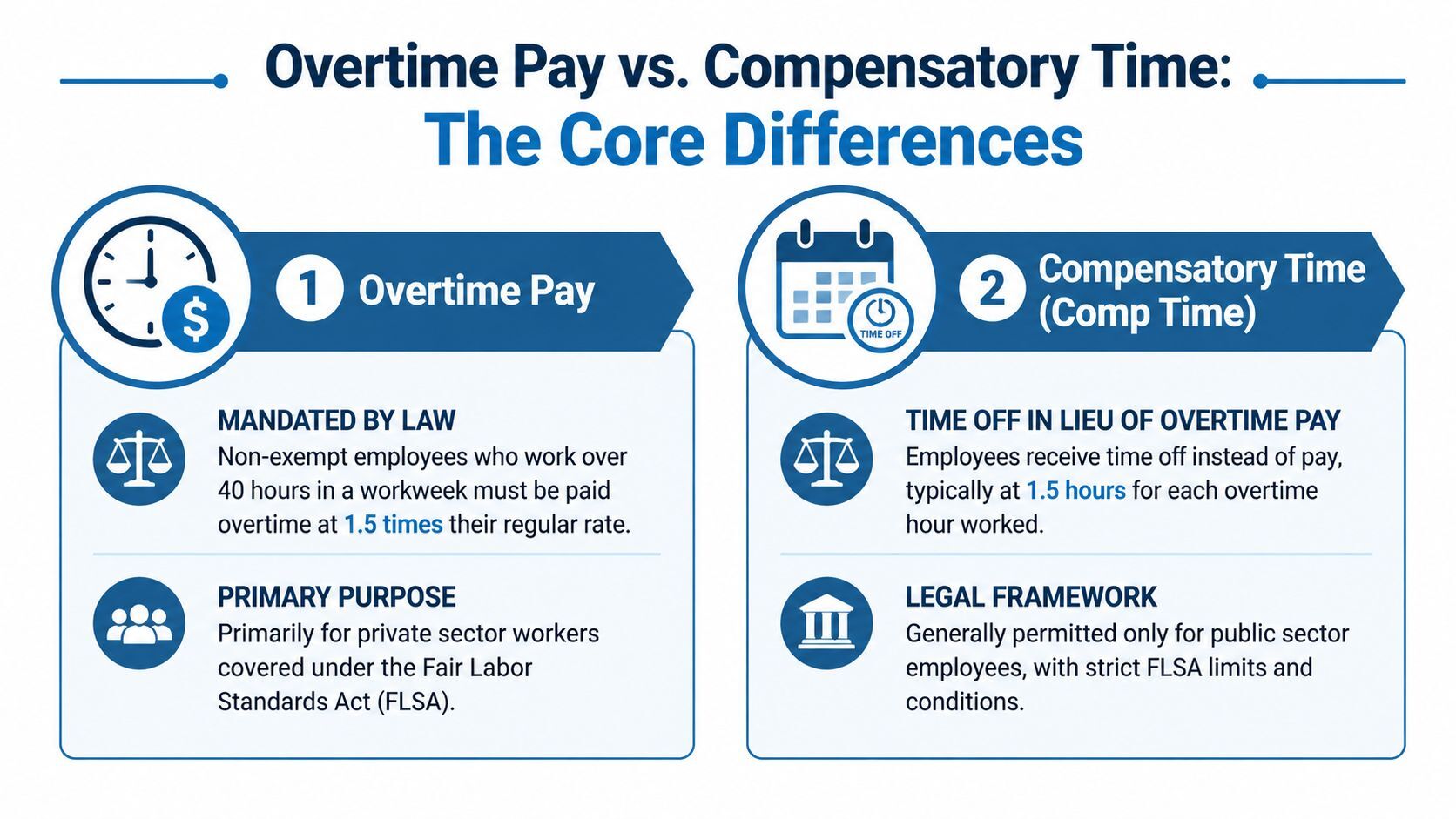
The legal difference is sharper than many employers expect. Overtime pay and comp time may look similar because both deal with extra hours worked, but they come from different rules and serve different purposes.
Use this comparison as the quick answer.
| Issue | Overtime pay | Comp time |
|---|---|---|
| Who commonly uses it | Private-sector non-exempt employees | Public-sector employees under specific rules |
| Form of compensation | Cash wages | Paid time off |
| Rate | 1.5 times the regular hourly wage for hours over 40 in a workweek | 1.5 hours of leave for each overtime hour worked |
| Private employer status | Required | Prohibited as a substitute for overtime pay |
| Public employer status | Allowed | Allowed under FLSA rules with limits |
What the FLSA actually does
The Fair Labor Standards Act was established in 1938 and created the overtime framework that still governs U.S. employment. Under that law, private-sector employers must pay non-exempt employees 1.5 times their regular hourly wage for hours worked beyond 40 in a single workweek, and private businesses cannot use comp time instead. Public-sector employees operate under different rules and may accrue comp time at 1.5 hours per overtime hour, generally capped at 240 hours for many public employees. That legal distinction has remained in place for nearly 90 years, as explained in this overview of FLSA comp time and overtime rules.
Why the law draws that line
This isn’t random. The overtime rule was built to make extra hours more expensive for private employers.
If overtime costs more, employers have a reason to limit long workweeks, spread work more carefully, and hire when needed. Cash overtime is not just compensation. It’s also a labor-cost signal built into the law.
Comp time works differently. It defers compensation into future paid leave. Public agencies are allowed to use that model because the law gives them a narrower path to do so, with caps and payout rules. Private businesses don’t get that option.
Practical rule: If you’re a private employer, stop thinking of comp time as an alternative pay method. For non-exempt employees, it isn’t an alternative. It’s off the table.
Where employers get confused
The confusion usually comes from one of three places:
- Employee preference: A worker asks for time off later instead of money now.
- PTO bank thinking: A manager assumes extra hours can just be “banked” like vacation time.
- Public-sector examples: Someone has seen comp time used in government settings and assumes the same practice works in private business.
None of those facts changes the legal result.
Classification also matters. The overtime requirement applies to non-exempt employees, not everyone on payroll. If your team needs a refresher on where that line sits, this guide on non-exempt vs exempt employees is a useful starting point.
The real takeaway
In private business, overtime pay vs comp time is not a policy preference question. It’s a compliance question with a bright-line answer. Pay overtime in cash when the law requires it. Find flexibility somewhere else.
Federal and State Overtime Rules for Private Employers
For private employers, the federal baseline is straightforward. If a non-exempt employee works more than 40 hours in a workweek, overtime must be paid at time-and-a-half.
That’s the rule you build around first. Then you check whether state law adds stricter requirements.
The federal standard private employers must follow
The federal rule turns on three questions:
- Is the employee non-exempt
- What is the defined workweek
- Did the employee work more than 40 hours in that workweek
If the answer to all three leads to overtime, cash payment is required. You can’t replace it with future paid time off, even if everyone involved agrees.
A lot of mistakes happen because owners focus on daily schedules instead of the workweek. Under the federal rule, the workweek is the measuring unit. That’s why accurate timekeeping and a clearly defined workweek matter so much.
What this looks like in Utah, Arizona, Idaho, and Wyoming
For employers in Utah, Arizona, Idaho, and Wyoming, the practical rule for most private businesses is the same core one. Follow the FLSA overtime standard for non-exempt employees, and do not use comp time in place of overtime wages.
That’s especially important for growing employers that operate across state lines. A manager in one office may think they’ve found a flexible workaround, while payroll in another location is trying to keep a uniform process. The safest model is consistent: track all hours worked, define the workweek, and pay overtime when due.
If you operate in multiple states, consistency helps. But consistency alone isn’t enough. Your process still has to comply with the law that applies to the employee’s work location.
Multi-state caution points
Even where the basic overtime rule feels familiar, multi-state employers should stay disciplined about a few issues:
- Work location matters: Apply the rules based on where the employee performs work, not where your headquarters sits.
- Manager habits matter: One supervisor who informally promises “take the time later” can create a company-wide problem.
- Payroll setup matters: If the system isn’t configured correctly, wage issues can repeat every pay cycle.
If you need a practical refresher on mechanics, this guide on how overtime is calculated covers the payroll side in more detail.
What private employers should put in writing
Your written policy should make four points unmistakably clear:
- Overtime eligibility: State which employees are non-exempt and eligible for overtime under applicable law.
- Approval process: Require supervisor approval before overtime is worked when possible.
- Payment obligation: Confirm that all overtime worked will be paid, even if it wasn’t approved in advance.
- No comp time substitute: State that the company does not offer comp time in lieu of overtime pay for non-exempt employees.
The last point matters because informal promises often start at the manager level. A written policy helps stop the problem before it becomes payroll debt.
Calculating Overtime Correctly Examples and Pitfalls
Knowing the rule isn’t enough. You also have to calculate overtime correctly every pay period.
That sounds simple until payroll has to deal with mixed rates, bonuses, shift premiums, or salaried non-exempt employees.

A clean example
One verified example shows the math clearly. For a non-exempt private-sector employee earning $20 per hour and working 45 hours, the pay due is $800 in regular wages for 40 hours plus $150 in overtime wages for 5 hours at $30 per hour, for a total of $950, paid in the next payroll cycle, as outlined in this private-sector overtime calculation example.
That example is simple because the regular rate is simple.
Where employers get tripped up
The hard part is often the phrase regular rate of pay. Many employers treat it as the employee’s base hourly wage and stop there. That’s where errors start.
In practice, the regular rate analysis can get more complicated when compensation includes items such as:
- Non-discretionary bonuses
- Commissions
- Shift differentials
- Other earnings that may need to be included
The details matter because overtime is based on the regular rate, not just the number printed on the hiring offer.
When payroll errors happen, they often come from inputs, not arithmetic. The calculator is usually fine. The regular-rate setup is what needs attention.
Common operational mistakes
The payroll mistakes I see most often are not exotic. They’re routine process failures.
- Rounding away real work time: Small daily deductions can become a larger wage issue over time.
- Ignoring off-the-clock work: Email, texts, prep work, and after-hours calls still count if the company knows or should know the work is happening.
- Paying straight time for overtime hours: This often happens when someone tries to “fix it later” through PTO or an off-cycle adjustment.
- Assuming salary means exempt: A salaried non-exempt employee can still be owed overtime.
This short walkthrough is useful if you want a quick visual explanation before you audit your own payroll process.
A better internal check
Before each payroll runs, ask:
- Did we capture all hours worked?
- Did we identify every non-exempt employee correctly?
- Did we calculate the regular rate correctly for that week?
- Did we pay overtime in cash, not through informal time-off arrangements?
If any answer is uncertain, fix the process before it turns into a pattern.
The High Cost of Non-Compliance With Informal Comp Time
Illegal comp time rarely starts as fraud. It starts as convenience.
A supervisor says, “Leave early next week and we’ll call it even.” Payroll never sees the actual hours. The employee may not complain right away. Then the practice spreads, and the business has a wage-and-hour problem across a department, not just one pay period.

Why informal comp time is risky for workers too
The legal problem isn’t just technical. Economic research has found that comp time arrangements reduce worker compensation and increase overtime hours beyond what employers would schedule under mandatory overtime pay rules. That same analysis also notes that workers who accept comp time can face the loss of accrued hours if the employer goes bankrupt, creating wage suppression and heavier work burdens. The reasoning is summarized in this economic analysis of comp time and worker pay.
That point matters for employers because the law is designed to avoid exactly those outcomes. Prompt wage payment protects workers and limits manipulation.
How the business risk builds
A private employer that uses informal comp time can trigger several layers of exposure at once:
- Back wage liability: If overtime should have been paid, the company may owe it later.
- Payroll record problems: Bad time records make defense harder because the company may not have reliable proof.
- Manager inconsistency: One manager may follow policy while another runs side deals with employees.
- Employee relations damage: Workers usually become upset when they learn a “flexible” arrangement reduced lawful pay.
The cost isn’t only what should have been paid. It’s also the distraction, the legal spend, the management time, and the cleanup across prior periods.
A private employer doesn’t make comp time lawful by calling it “flex time,” “banked hours,” or “time-off in exchange.” If the arrangement substitutes time off for overtime wages, the label won’t save it.
Why these cases get harder over time
Informal practices age badly. The longer they continue, the more likely it is that records are incomplete, managers have changed, and employees remember the arrangement differently.
That’s why the right move is immediate correction. Stop the practice. Audit affected roles. Train supervisors. Fix the handbook. Tighten timekeeping.
Small businesses usually don’t get in trouble because they meant to violate the law. They get in trouble because they left a bad process in place too long.
Building a Compliant and Flexible Overtime Policy
Employers often hear “no comp time” and assume the law leaves no room for flexibility. That isn’t true. The law limits one kind of flexibility. It doesn’t ban thoughtful scheduling.
The key is to build a policy that protects wages while giving managers lawful tools to handle real life.
Start with clear handbook language
Your policy should be plain, direct, and hard to misread. Something like this works:
Non-exempt employees will be paid overtime in accordance with federal and applicable state law for all hours worked over the overtime threshold that applies to them. The company does not provide compensatory time or banked time off in place of required overtime wages. All time worked must be accurately recorded. Overtime should be approved in advance when possible, but all overtime worked will be paid.
That language does several jobs. It confirms the pay rule, bans informal comp time, requires timekeeping, and avoids the common mistake of refusing to pay unauthorized overtime.
Give managers lawful flexibility tools
A compliant policy shouldn’t just say no. It should show managers what they can do instead.
Here are practical options:
- Adjust schedules within the same workweek: If an employee needs time for an appointment, move hours around inside that same workweek when operationally possible.
- Use existing PTO programs: If the employee wants extra time off after a heavy week, PTO can be requested and approved under normal policy.
- Offer flexible start and end times: Many businesses can support schedule variation without creating overtime problems.
- Distribute workload earlier: If a project is trending toward overtime, reassign tasks before the week closes.
These options solve the employee’s underlying issue without turning wages into an informal leave bank.
Why employers are tempted to cut corners
The temptation is easy to understand. Overtime pay requires immediate payment and raises labor cost by 50% per overtime hour, so 5 overtime hours at a $20 base rate create a $150 immediate liability. Comp time in public settings defers that cost, but private employers that mimic comp time through PTO banks violate the FLSA and can face 2x damages plus attorney fees, as described in this analysis of overtime cost and comp time risk.
That short-term budget pressure is real. It just doesn’t create a legal exception.
What a good policy looks like in practice
Strong overtime policies usually share the same features:
- One fixed workweek: Everyone knows when the week starts and ends.
- One timekeeping process: No side spreadsheets, no text-message reporting, no manager memory.
- One approval rule: Supervisors know how to authorize overtime and how to escalate staffing issues.
- One compensation rule: Overtime is paid in cash when required. It is never swapped for future time off.
A good policy also separates discipline from pay. If an employee breaks the approval rule, you can address that through coaching or discipline. You still pay for the hours worked.
How a PEO Simplifies Overtime and Payroll Compliance
Overtime compliance gets harder as a business grows. You add locations, new managers, remote staff, different schedules, and more complicated payroll inputs. The legal rule may stay clear, but the operating environment gets messy fast.
That’s where many small employers start feeling the strain. They don’t need a lecture on the FLSA. They need a system that catches errors before wages go out wrong.
Where the burden usually falls
In a growing company, overtime administration often gets split across too many hands:
- Managers approve schedules but may not understand wage law.
- Payroll processes hours but may not see off-the-clock work.
- HR writes policy but may not control how departments behave day to day.
- Owners and finance leaders absorb the risk when the process breaks.
A PEO helps by pulling those pieces into one operating model. That matters even more in multi-state settings like Utah, Arizona, Idaho, and Wyoming, where consistency is hard to maintain without strong systems and experienced review.
The value of a compliance partner
One overlooked reason employers try to imitate comp time is cash flow. Some business-side commentary notes that comp time defers payroll taxes until time off is used, while overtime pay creates immediate taxable wages and employer payroll tax obligations. One example states that for a $20 per hour employee working 5 overtime hours weekly, overtime adds about $150 immediate after-tax cost at 7.65% FICA. The same source also describes a projected 30% rise in 2025-2026 DOL audits on overtime misclassification, framing that increase as a projection rather than a current fact, in this discussion of comp time, overtime costs, and PEO demand.
That pressure is real for finance leaders. The answer, though, isn’t to build an illegal workaround. It’s to use compliant alternatives and better controls.
What a strong PEO relationship helps you do
A capable PEO can make overtime compliance much more manageable by helping employers:
- Standardize timekeeping: Hours worked are captured consistently across teams and locations.
- Support classification reviews: Non-exempt and exempt decisions get more disciplined.
- Improve payroll accuracy: Overtime calculations are handled correctly and on time.
- Tighten policies and handbooks: Manager guidance gets aligned with the law.
- Reduce multi-state confusion: The company has a clearer process for applying the right rules in the right place.
The best compliance setup is one that managers can actually follow on a busy Tuesday, not just one that looks good in a handbook.
Why this matters to growth-stage employers
Founders and lean finance teams usually don’t struggle because they don’t care. They struggle because wage-and-hour compliance is operational detail work, and detail work breaks when responsibility is fragmented.
A PEO can’t erase every payroll challenge, but it can reduce the chance that an employee’s simple request for “time off instead of overtime” turns into a larger legal and administrative problem. That’s valuable risk management, especially for employers growing across state lines.
Call Helpside today for your Free 15-Minute Benefits Audit: 1-800-748-5102
Further Readings:
What Is a Professional Employer Organization (PEO)?
Why Small Businesses Plateau (And How a PEO Fixes It)
Why Onboarding with a PEO Can Make or Break Your Business Growth
If overtime rules, payroll accuracy, handbooks, and multi-state compliance are starting to pull attention away from running your business, Helpside can help you simplify the work. Their team supports growing employers with payroll, HR, benefits, and compliance guidance built for the realities of small and midsize businesses across the Intermountain West.