
You're reviewing health plans at renewal, trying to keep payroll stable, and an employee asks a simple question that isn't simple at all: "Will my medication be covered?"
That's the moment prescription drug coverage stops being a line item and becomes a business issue.
For a small employer, pharmacy benefits sit right at the intersection of recruiting, retention, productivity, and cost control. A candidate comparing your offer to a larger company's offer may not know the deductible details, but they absolutely understand whether they can afford the prescriptions they rely on. The vast majority of Americans under 65 have some form of prescription drug coverage, according to HHS — which means candidates are comparing your pharmacy benefits against a market where coverage is the norm, not the exception. Small businesses feel the pressure from both sides — employees expect credible coverage, and employers need a plan they can fund without creating a second budget crisis inside the health plan.
Why Prescription Coverage Is a Small Business Imperative
A lot of owners assume employees mainly compare premiums, doctor networks, and whether the company offers insurance at all. In practice, pharmacy questions show up faster than most leaders expect. An employee with asthma, ADHD, diabetes, high blood pressure, or an autoimmune condition doesn't experience the plan as an abstract benefit. They experience it at the pharmacy counter.
That's why prescription drug coverage carries more weight than it might appear to on a benefits summary. It affects whether an employee sees your plan as usable, not just available.
Where the talent issue shows up
For small employers, the challenge isn't only "Can we offer coverage?" It's "Can we offer coverage that doesn't feel like a downgrade?" Large employers often have deeper buying power and dedicated HR teams to manage plan design. Smaller companies usually have an owner, CFO, or office manager trying to make good decisions with limited time and incomplete information.
A health plan can look competitive in a proposal and still disappoint employees the first time they fill a prescription.
That gap matters because people tend to judge benefits through the parts they use repeatedly. Payroll happens every cycle. Prescription fills happen every month. If the experience is confusing, expensive, or inconsistent, employees notice — and they remember it when a competitor calls.
Why owners should treat this as a strategic issue
Prescription drug coverage is now part of the core employment package, not an add-on. The market has moved that way, and employee expectations have moved with it. If your plan handles prescriptions poorly, your team won't blame "the system." They'll blame the employer who chose the plan.
For a small business owner, that changes the decision framework. This isn't just about checking the box on medical coverage. It's about whether the plan supports hiring, reduces avoidable friction, and helps employees stay healthy enough to work consistently.
The Building Blocks of a Prescription Drug Plan
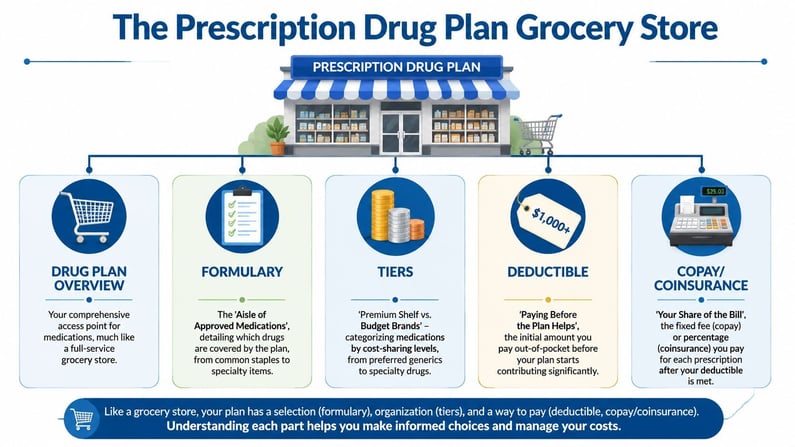
Most prescription drug plans feel complicated because the language is unfamiliar, not because the structure is impossible to understand. The easiest way to think about it is a grocery store. The plan is the store. The formulary is the list of products the store agrees to stock. Tiers are the shelves where products are placed, from lower-cost staples to premium items with a higher price tag.
Formulary means the approved drug list
A formulary is the plan's approved list of medications. If a drug is on the formulary, the plan will help pay for it, subject to the plan's rules. If it isn't on the formulary, the employee may face a substitute, an exception request, or full out-of-pocket cost. This matters more than many employers realize — coverage doesn't automatically mean affordable, and not every clinically similar drug costs the same for the patient.
Tiers decide how expensive "covered" feels
Tiers are where real employee experience starts to diverge. A generic drug may sit on a low-cost tier. A preferred brand may sit one shelf up. A non-preferred or specialty drug may land on the expensive shelf. Two employees being treated for the same condition can have very different costs depending on which medication their doctor prescribes and where that medication lands on the formulary.
Practical rule: Don't ask only whether a plan covers prescriptions. Ask which drugs are on the formulary, what tier they're on, and what restrictions apply.
What owners should look for in plan documents
When you review a proposal, focus on these questions:
- Which medications are favored: Look for the generic and preferred brand structure, not just the existence of a drug list.
- How specialty drugs are handled: Specialty tiers often create the sharpest employee cost exposure.
- Whether the plan uses pharmacy channels: Some plans require certain drugs to go through mail order or designated pharmacies.
- How exceptions work: A plan should have a clear process when a drug is non-formulary or clinically inappropriate to substitute.
A grocery store with full shelves still isn't useful if the item your employee needs is on the locked top shelf at premium pricing. That's how many drug plans work in practice.
How Employees Share the Prescription Cost
Once you know what the plan covers, the next question is who pays what, and when. These cost-sharing specifics often surprise employees. Three terms matter most: deductible, copay, and coinsurance. If your team doesn't understand those terms, they'll often assume "covered" means inexpensive. It doesn't.
The three cost-sharing terms
| Term | What It Is | Example |
|---|---|---|
| Deductible | The amount an employee pays first before the plan starts paying | An employee may pay the full negotiated cost of a prescription until the deductible is met |
| Copay | A fixed dollar amount for a prescription | An employee pays the same set amount each time they fill a generic drug |
| Coinsurance | A percentage of the drug's cost | An employee pays a share of the price, so the amount changes based on the medication |
A simple pharmacy-counter example
Take a prescription with a retail price of $100. If the employee hasn't met a deductible that applies to prescriptions, they may pay the full $100 first. If the plan uses a copay after the deductible, they might later pay a fixed amount for each refill. If the plan uses coinsurance, they pay a percentage of that $100 — which means their cost can rise or fall with the drug's price.
Employees usually prefer predictability. Employers often focus on premium savings. Those goals can conflict if the plan shifts too much cost to the point of sale.
Why this becomes an HR problem
When employees can't predict prescription costs, they turn to HR, payroll, or the owner for help. Some employers pair high-deductible plans with account-based strategies to soften out-of-pocket pressure. If you're comparing funding approaches, Helpside's breakdown of HRA vs. HSA options is useful because the plan design and the reimbursement tool need to work together.
The most common mistake is choosing a lower-premium plan without tracing what an employee with recurring prescriptions will actually pay in March, July, and November.
A strong pharmacy design doesn't eliminate cost-sharing. It makes the cost-sharing understandable and survivable.
Understanding Plan Guardrails: Prior Authorization and Step Therapy
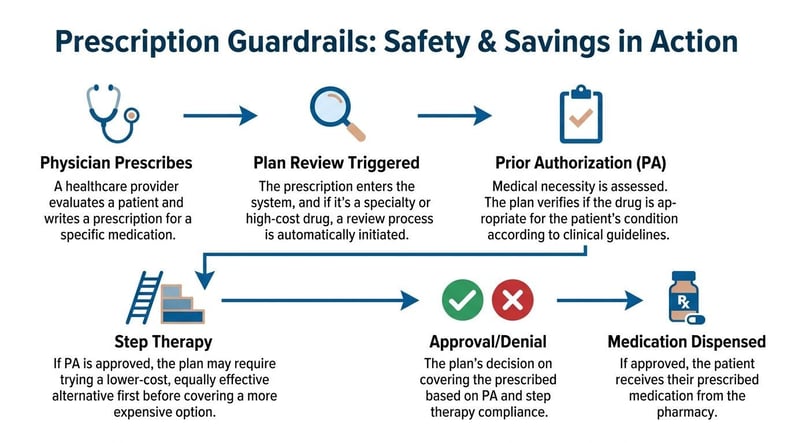
Many employers first encounter prior authorization and step therapy through employee complaints. Both can feel like delay for delay's sake when a prescription is urgent. But from a plan-design standpoint, these guardrails exist for a reason — they help the plan verify medical necessity, steer use toward effective lower-cost options when appropriate, and reduce unsafe prescribing patterns.
What prior authorization really does
Prior authorization is a clinical checkpoint. Before the plan agrees to cover certain medications — usually high-cost, specialty, or higher-risk drugs — it asks for supporting information from the prescribing provider. That process can be frustrating. It can also prevent avoidable errors and unnecessary spending. In benefit terms, pharmacy controls are not just financial tools — they are safety tools.
How step therapy works in real life
Step therapy is often called "fail first," but that label oversimplifies it. The better description is sequenced treatment. The plan may require the patient to try a standard, lower-cost, clinically accepted option before moving to a more expensive alternative. For some conditions, that sequencing makes sense. For others, it can create friction if the first-step drug is a poor fit for the patient's medical history. That's why employers should care less about whether step therapy exists and more about whether the exception process is workable.
A good utilization management program should slow down the wrong prescription, not the right patient.
What to audit in your current plan
Ask your broker, carrier, or advisor:
- Which drugs trigger prior authorization: High-cost and specialty lists should be transparent.
- How exceptions are handled: Employees need a path when the standard rule doesn't fit their case.
- Whether the pharmacy team coordinates with the medical plan: Fragmented reviews create avoidable delays.
- How pharmacy channels are enforced: Maintenance and specialty medications often come with dispensing rules.
Guardrails work when they are precise. They fail when they create paperwork without clinical value.
Designing a Plan That Works for Your Small Business
The wrong way to shop for prescription drug coverage is to ask, "What's the cheapest premium?" The better question is, "What combination of premium, out-of-pocket cost, and access rules fits our workforce?"
There is no universally best design. A younger workforce with low routine medication use may tolerate a leaner structure. A team with more chronic conditions may value richer drug coverage even if the premium is higher.
Cheap on paper can be expensive at work
Affordability doesn't end with enrollment — it shows up every time an employee fills a prescription. A meaningful share of adults report difficulty affording their medications even when they have coverage. That's the point many small employers miss. A plan can technically include prescription drug coverage and still leave employees functionally underinsured if deductibles, coinsurance, or non-preferred tiers create too much friction.
The trade-offs worth discussing internally
If you're choosing between plan designs, pressure-test these issues with leadership:
- Premium versus pharmacy usability: Lower employer premium often means higher employee exposure at the counter.
- Broad formulary versus tighter management: More open access can improve employee satisfaction but may raise plan cost.
- Predictable copays versus percentage-based coinsurance: Fixed costs are easier for employees to budget.
- Rich brand coverage versus generic-first strategy: This decision affects both spend and disruption risk.
One useful exercise is to build a few employee personas. Look at the employee who takes one maintenance generic, the employee on several chronic medications, and the employee who may need a specialty drug. Then compare how each plan treats those people.
What usually works better
Small employers tend to get stronger long-term results when they choose a plan that employees can use effectively, then communicate the rules clearly. That doesn't mean buying the richest option available. It means avoiding designs that look affordable only because they push too much cost and complexity onto workers.
If retention matters, pharmacy affordability belongs in the same conversation as wages, flexibility, and manager quality. Employees may accept cost-sharing. They rarely accept being blindsided by it.
Actionable Strategies to Control Pharmacy Spend
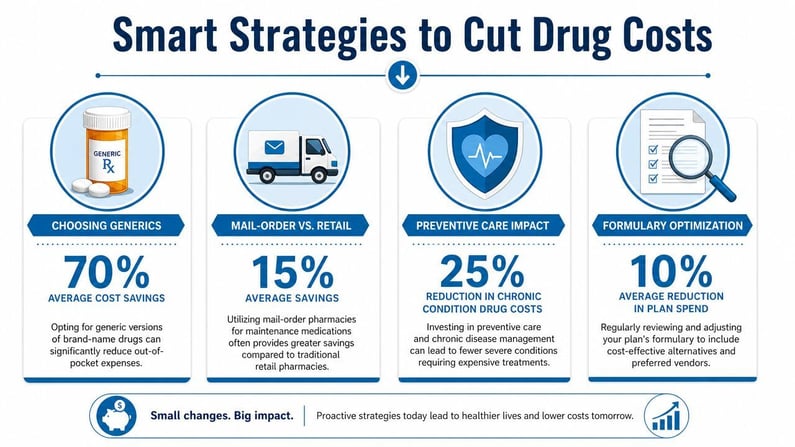
Prescription costs don't stay controlled just because you picked a plan once. Pharmacy spend needs active management. CDC data shows that 1 in 12 adults who take prescription medications skip doses, take less than prescribed, or delay filling prescriptions specifically to save money. For a small business, pharmacy strategy can't live only in the renewal meeting — it has to show up in communication, plan administration, and periodic review.
Four tactics that usually pay off
- Promote generics thoughtfully: Employees often don't know when a lower-tier alternative exists. Education matters, especially when the doctor's office defaults to a familiar brand.
- Use maintenance channels correctly: If the plan requires mail order or a preferred retail channel for long-term medications, explain that early. Confusion here often creates unnecessary full-price fills.
- Communicate the formulary before problems happen: Open enrollment materials rarely answer the essential question — what happens when a medication is excluded or needs review.
- Review employee friction points: Track the complaints that repeatedly hit HR. Denials, surprise pharmacy costs, and refill-channel confusion usually point to a design or communication weakness.
Manage spend like an operating issue
A smart employer treats prescription drug coverage the way they treat payroll or workers' comp. Watch it, audit it, and correct drift. That includes asking carriers or advisors for practical reporting, not just renewal summaries. Which classes are producing friction? Where are specialty claims showing up? Which plan rules are generating employee escalations?
For a broader framework on plan oversight, Helpside's guide on how to reduce healthcare costs puts pharmacy decisions inside the larger employer health-cost picture.
If employees keep making avoidable full-price fills, the problem usually isn't employee behavior alone. The plan may be poorly explained or poorly enforced.
What doesn't work
Three approaches tend to fail consistently:
- Set it and forget it: Drug trends and formularies change year to year.
- Over-focus on premium: Savings disappear if employees can't use the benefit effectively.
- Treat communication as optional: Even a solid plan performs badly when employees don't know the rules.
Pharmacy cost control works best when plan design, employee education, and vendor oversight reinforce one another.
How a PEO Simplifies Your Benefits Strategy
By this point, the issue is clear. Prescription drug coverage isn't difficult because any one concept is impossible. It's difficult because small employers have to manage all of it at once — plan selection, employee communication, cost-sharing design, utilization rules, compliance, vendor coordination, and renewal strategy all stack together.
That's where a PEO model can make sense.
What changes when you stop managing benefits alone
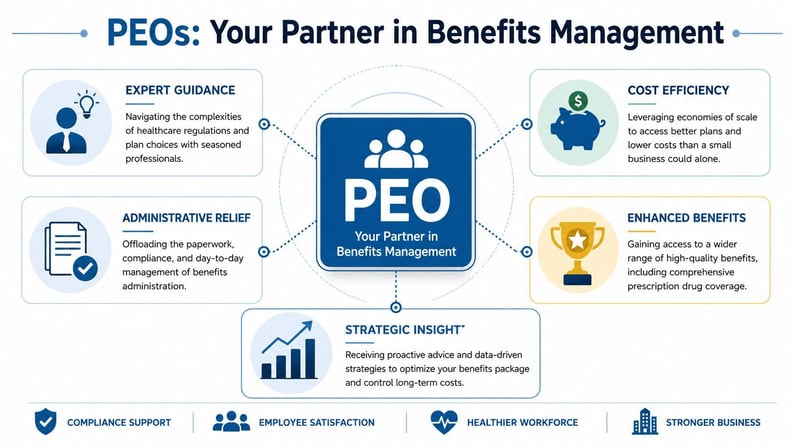
A PEO helps a small employer access a broader benefits infrastructure than the business might secure on its own — stronger medical plans, integrated administration, and more support around employee questions and enrollment decisions. It also changes who owns the workload. Instead of pushing every pharmacy issue onto an internal admin or finance lead, the employer gets outside support for plan management, communication, and operational follow-through.
Where that matters most
This model is especially useful when your company is large enough to need real benefits strategy, but not large enough to build an in-house benefits department. That's the messy middle where many businesses operate. In practical terms, a PEO can help with:
- Plan access: Broader group buying structure can improve the range of available options.
- Administrative relief: Enrollment, deductions, and employee support become more coordinated.
- Decision support: Employers get help evaluating trade-offs rather than reacting after problems surface.
- Compliance alignment: Benefits decisions sit alongside payroll, HR, and employment administration instead of being managed in isolation.
For employers considering that route, Helpside's overview of health insurance through a PEO explains how the model works for growing teams.
The key point isn't that a PEO eliminates all prescription drug complexity. It doesn't. The value is that you don't have to solve every plan-design and administration problem by yourself while also running the business.
Frequently Asked Questions: Prescription Drug Coverage for Small Businesses
What is a formulary in a prescription drug plan?
A formulary is the plan's approved list of covered medications. If a drug is on the formulary, the plan will help pay for it subject to the plan's rules, including tier placement and any prior authorization requirements. If a drug is not on the formulary, the employee may face a substitution, an exception request process, or full out-of-pocket cost. Formulary design is one of the most important factors in whether employees find a plan usable in practice.
What does tiered prescription drug coverage mean?
Tiers are categories within a formulary that determine how much an employee pays for a drug. Generic medications typically sit on the lowest-cost tier with the smallest copay. Preferred brand-name drugs sit on a higher tier. Non-preferred and specialty drugs sit on the most expensive tiers. Two employees treated for the same condition may pay very different amounts depending on which drug their doctor prescribes and which tier that drug occupies.
What is the difference between a copay and coinsurance for prescriptions?
A copay is a fixed dollar amount — an employee pays the same amount each time they fill a prescription, regardless of the drug's price. Coinsurance is a percentage of the drug's cost, so the employee's share changes based on the medication's price. From a budgeting standpoint, copays are easier for employees to predict. Coinsurance can create unexpected costs, especially for higher-priced medications.
What is prior authorization and how does it affect prescription access?
Prior authorization is a plan requirement that the prescribing provider submit clinical documentation before the plan agrees to cover a specific medication — usually high-cost, specialty, or higher-risk drugs. It can create delays and requires coordination between the provider's office and the plan. Employers should confirm that their plan has a clear, workable exception process for situations where prior authorization causes an unreasonable access barrier.
What is step therapy in prescription drug coverage?
Step therapy, sometimes called "fail first," requires patients to try a standard or lower-cost treatment option before the plan will cover a more expensive alternative. For some conditions and medications, this sequencing is clinically appropriate. For others, it can create friction if the first-step drug is a poor fit for the patient. What matters most is whether the plan has a clear and accessible process for exceptions when step therapy is not appropriate for a specific patient.
How can small businesses lower prescription drug costs for employees?
The most effective strategies are promoting generic substitutions when clinically appropriate, ensuring employees understand and use preferred pharmacy channels for maintenance medications, communicating formulary rules before problems occur at the pharmacy counter, and reviewing recurring HR complaints about denied or expensive fills to identify plan design or communication issues. Active management of pharmacy spend is more effective than reactive responses at renewal.
Can a PEO help small businesses get better prescription drug coverage?
Yes. A PEO pools smaller employers into a larger benefits buying group, which can improve access to plan designs and rates that individual small businesses typically cannot obtain on their own. Beyond purchasing power, a PEO also reduces the administrative burden of managing enrollment, employee questions, and compliance around benefits — which is where many small employers lose the value of their coverage investment.
If your team is weighing health plan changes and you want help making sense of prescription drug coverage, Helpside can help you evaluate the trade-offs, reduce administrative burden, and build a benefits strategy that fits a growing business.