
Growth creates a strange kind of risk. Business is better than it was a year ago, the team is larger, clients expect faster response times, and suddenly the systems that worked when you had a handful of employees start cracking under pressure. One person handles onboarding from memory. Payroll depends on a spreadsheet only two people understand. A manager hires in a new state before anyone checks local rules. Then an employee gets hurt, a vendor misses a deadline, and a notice from an agency lands in your inbox on the same day.
That’s how risk shows up in small companies. It rarely arrives as one dramatic event. It usually arrives as several ordinary problems at once, each one manageable on its own, but expensive and distracting when they pile up.
For busy owners, risk management for small businesses isn’t a corporate exercise. It’s the discipline of keeping a growing company stable while you hire, expand, serve customers, and try not to get pulled into preventable fires.
Why Your Business Is More Exposed Than You Think
A lot of owners assume risk means floods, lawsuits, or cybercrime. Those matter, but the more common problem is exposure you can’t see clearly because daily work hides it.
A business can be profitable and still be fragile. One injury claim can disrupt operations. One payroll error can damage trust. One bad hire in the wrong state can create compliance work you didn’t budget for. One supplier problem can hit revenue faster than your team can react.

Small problems become business problems fast
I’ve seen owners treat HR and compliance risk as background noise because nothing bad has happened yet. That works until growth adds complexity. More employees mean more documentation, more manager decisions, more payroll variables, and more chances for inconsistency.
The danger is that these risks don’t announce themselves early. They sit in manual processes, unclear policies, weak training, and assumptions like “we’ve always done it this way.”
Practical rule: If a process only works because one experienced employee remembers how to fix it, that process is a risk.
Disaster risk is the clearest example of why preparation matters. According to FEMA data, one in four businesses never reopen after a major disaster, as noted in this risk management overview. That’s a hard reminder that survival often depends less on the event itself and more on whether the business prepared for it.
Exposure grows when the business grows
Most owners don’t need more theory. They need a clearer view of where exposure is building:
- Hiring exposure: Managers move quickly, but job classifications, wage rules, and onboarding documents lag behind.
- Operational exposure: One person becomes the bottleneck for payroll, customer communication, or vendor approvals.
- Compliance exposure: A company expands into another state and assumes existing policies still apply.
- Claims exposure: A minor workplace incident turns costly because reporting, documentation, and return-to-work steps were weak.
A useful starting point is to review the hidden HR risks that could cost your business and compare them to how your company operates today.
Risk management starts when you stop asking, “What’s likely to happen?” and start asking, “What would hurt us if we’re wrong?”
What Risk Management Really Means for Your Business
Risk management sounds more complicated than it is. In practice, it works a lot like maintaining a vehicle. You don’t wait for the engine to fail before changing the oil. You handle known issues early, reduce the chance of breakdown, and make it easier to keep moving when something unexpected happens.
That’s the right mental model for a small business. Risk management isn’t about eliminating every possible problem. It’s about building routines that help you spot trouble earlier, make better decisions, and recover faster when something goes wrong.
The four moves that matter
Most effective risk management for small businesses comes down to four actions: identify, assess, mitigate, and monitor.
Identify
Start with where work happens, not where policies say it happens. Look at payroll, hiring, supervision, vendor relationships, technology, benefits administration, workplace safety, and customer commitments.
Ask practical questions:
- Where are we relying on memory instead of process?
- Which tasks would stall if one employee were out unexpectedly?
- Where do managers make judgment calls without guidance?
- Which parts of the business involve outside parties we can’t fully control?
This step is often messy, and that’s normal. The goal isn’t a polished report. The goal is a working list of exposures.
Assess
Once you identify risks, sort them by two things: how likely they are and how disruptive they’d be. A rare event with catastrophic impact may deserve serious planning. A common issue with moderate impact may need immediate process fixes because it keeps happening.
A simple way to think about it:
| Risk question | What you’re judging |
|---|---|
| How often could this happen? | Likelihood |
| If it happens, what does it affect? | Impact |
| How quickly would we notice it? | Visibility |
| How hard would it be to recover? | Recovery effort |
In this context, owners often make better decisions. They stop reacting to the loudest issue and start focusing on the most important one.
Mitigate with realistic controls
Mitigation means putting something in place that lowers the odds of a problem, lowers the damage, or both. It can be as simple as a checklist or as formal as insurance, training, written procedures, or outsourced support.
Some controls are operational. Others are administrative.
- Operational controls: backup vendors, access limits, approval workflows, documented handoffs
- Administrative controls: handbooks, manager training, incident reporting steps, job descriptions
- Financial controls: segregation of duties, spending approvals, audit trails
- Transfer tools: insurance policies and third-party service arrangements
A control only works if your team can follow it on a normal Tuesday, not just during an audit.
A common mistake is creating controls that are too complicated for the size of the company. Small businesses need discipline, not bureaucracy.
Monitor because the business won’t stay still
Risk changes as your company changes. A process that worked with twelve employees may fail with forty. A single-state handbook may not fit a multi-state team. A lean payroll workflow may break when commissions, reimbursements, and different schedules enter the picture.
Review your key risks on a schedule. That could be monthly for active issues and quarterly for broader review. Ask department leaders what changed, what failed, and where workarounds are becoming normal.
Watch for these signs:
- Managers asking the same policy question repeatedly
- Frequent corrections in payroll or benefits administration
- More employee relations issues after rapid hiring
- Delayed responses to incidents, claims, or leave requests
Risk management works best when it becomes part of operating rhythm. Not an annual binder. Not a forgotten spreadsheet. Just a regular habit of checking whether the business is protected at the same pace it’s growing.
The Six Critical Risk Categories for Small Businesses
Most owners don’t struggle because they’ve never heard the word risk. They struggle because the risks arrive under different names, in different departments, and at inconvenient times. A clean way to manage that is to sort exposures into categories you can effectively review.
Operational risk
Operational risk is the risk that your business can’t deliver work consistently because the underlying process is too fragile.
For a small company, this often has nothing to do with machinery or warehouses. It looks like key person dependency, undocumented client handoffs, weak approval processes, and vendor concentration. If one office manager, controller, or operations lead holds too much institutional knowledge, your company is more exposed than it appears.
Common examples include:
- Single-point dependency: One employee knows payroll corrections, renewal dates, or benefit deductions, and no one else can step in cleanly.
- Vendor reliance: A single supplier, software platform, or outsourced partner affects a critical workflow with no backup plan.
- Unclear ownership: A problem surfaces, but nobody knows who owns the fix.
Operational issues are dangerous because they feel normal while business is steady. They become visible when someone quits, takes leave, or makes a mistake under pressure.
Financial risk
Financial risk isn’t limited to debt or declining sales. In small businesses, it often comes from poor visibility and delayed response.
A profitable month can hide bad assumptions. A client concentration problem may remain undetected until a contract changes. Rising insurance costs, missed invoices, payroll leakage, and weak internal approvals can drain cash without any single dramatic event.
Here’s a practical distinction:
| Financial issue | Why it creates risk |
|---|---|
| Inconsistent cash flow visibility | You react late to problems |
| Loose reimbursement or expense controls | Small losses accumulate |
| Client concentration | One account change hits revenue hard |
| Unreviewed benefit and payroll costs | Fixed expenses rise without strategy |
Owners often think of finance as reporting. Risk management treats finance as an early warning system.
Compliance risk
Compliance risk is where many growing companies get surprised. The business adds people, enters a new market, or updates policies only when something forces the issue.
That’s risky because employment law doesn’t scale with good intentions. It scales with documentation, timing, consistency, and state-specific rules. For multi-state employers, that complexity rises quickly. A small business compliance checklist is useful here because it forces a review of the basics before small misses become expensive problems.
Compliance risk often shows up as:
- Misclassification: Treating a worker as an independent contractor when the facts don’t support it
- Wage and hour mistakes: Missed overtime, incorrect salary assumptions, off-the-clock work
- Leave administration gaps: Managers making informal promises without a process
- Policy drift: Handbooks and practices no longer matching how the company operates
This category gets worse when managers improvise. A fast answer from a well-meaning supervisor can create a legal issue if it conflicts with policy or state law.
Workforce risk
Workforce risk sits at the intersection of people, management, and culture. It includes turnover, poor onboarding, weak supervision, inconsistent discipline, preventable injuries, and breakdowns in communication.
One of the most common workforce risks in smaller firms is promoting a strong individual contributor into management without giving them tools to lead. They may know the work but not how to document performance, respond to complaints, or apply policies fairly.
Watch for patterns like these:
- New hires leaving quickly because onboarding is vague
- Managers handling conflict informally and inconsistently
- Employees unclear on reporting lines or expectations
- Safety rules that exist on paper but not in practice
Good risk management often looks boring from the outside. Clear expectations, documented coaching, and consistent follow-through prevent a lot of expensive drama.
A strong workforce system lowers the chance that routine people issues become claims, turnover spikes, or morale problems.
Cybersecurity risk
Cyber risk is now a business continuity issue, not just an IT issue. A small business may not have a large internal technology team, but it still has systems, logins, devices, payroll data, client files, and communication platforms that need protection.
A practical IT risk process starts by mapping your environment, identifying vulnerabilities, and then analyzing threats by likelihood and business impact, as outlined in this SMB IT risk management resource. That matters because small companies usually can’t absorb downtime easily. They need controls that are simple, maintained, and tied to real workflows.
Cyber risk often enters through ordinary behavior:
- Old software and delayed updates
- Weak access controls for payroll or HR systems
- No clear backup routine
- Staff who don’t recognize phishing or unsafe file sharing
This short overview is useful if you want a visual explanation before building your internal checklist.
The fix usually isn’t a fancy platform first. It’s clarity. Know what systems matter most, who can access them, how data is backed up, and what the team should do when something looks wrong.
Reputational risk
Reputational risk is often the last category owners think about and one of the first customers notice.
In a small business, reputation is shaped by small operational and people decisions. Payroll mistakes affect trust. Delayed communication affects retention. A mishandled employee complaint can become a public issue. An untrained manager can damage recruiting faster than a marketing budget can repair it.
Reputational risk usually rides on other categories:
- an operational miss that delays client work
- a compliance issue that becomes visible outside the company
- a workforce issue handled poorly
- a cyber incident that affects customer confidence
This is why risk management for small businesses has to be integrated. The categories are separate for review, but in real life they overlap. One weak process often creates several kinds of exposure at once.
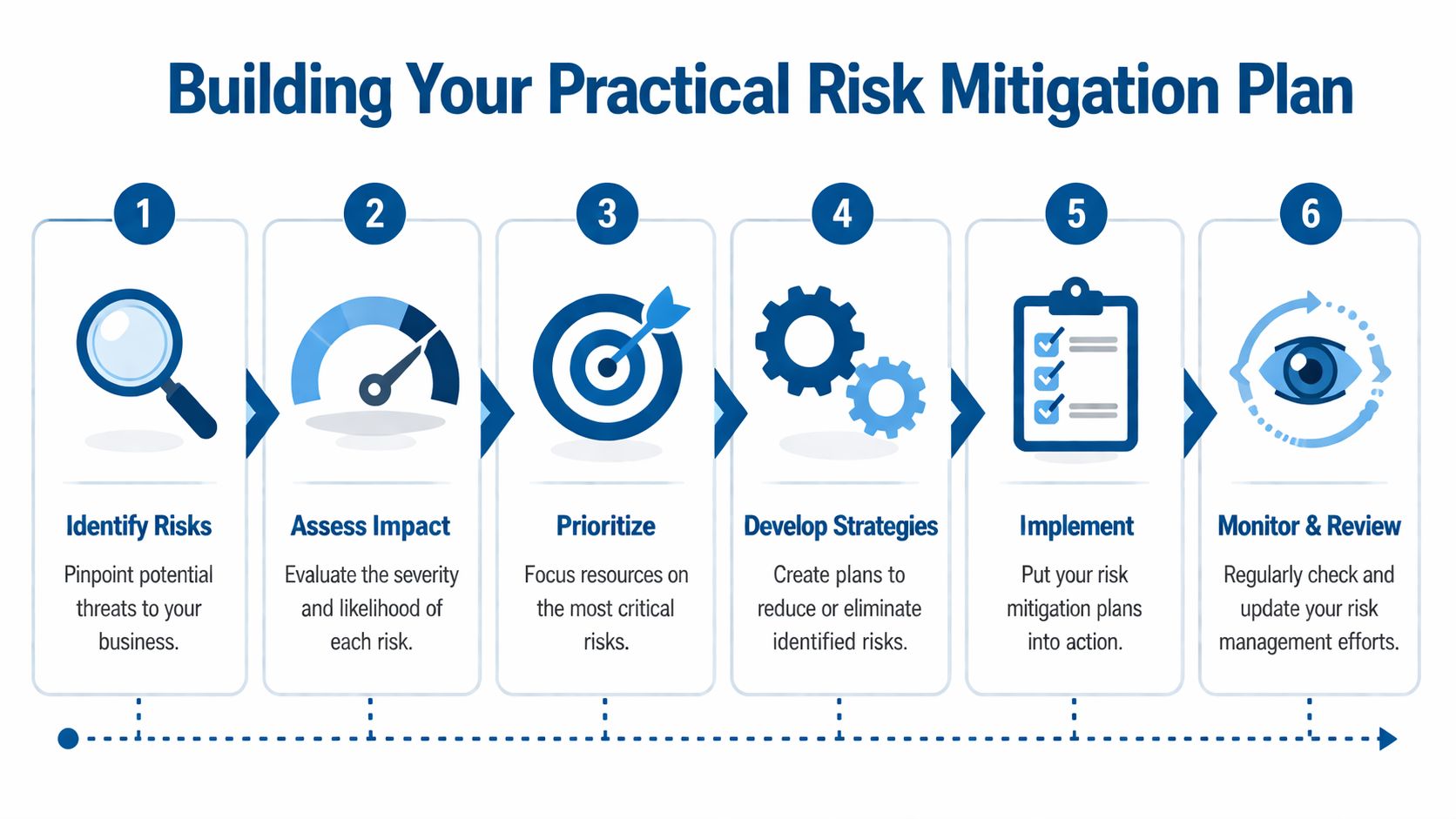
Building Your Practical Risk Mitigation Plan
Once you know your biggest risks, the next step is deciding what to do with them. Many businesses falter at this stage. They can list concerns all day, but they don’t turn that list into action because everything feels important.
A practical mitigation plan solves that by forcing prioritization. You don’t need enterprise software. You need a short working document, clear owners, and a repeatable way to decide where attention goes first.
Start with a simple risk matrix
A risk matrix is just a way to rank issues by likelihood and impact. Think in plain language. Is this likely to happen soon? If it happens, does it create a minor inconvenience, a serious disruption, or a business-threatening problem?
A small matrix can look like this:
| Likelihood | Impact | Priority |
|---|---|---|
| Low | Low | Monitor |
| High | Low | Fix with process |
| Low | High | Build contingency plan |
| High | High | Act now |
The point isn’t mathematical perfection. The point is alignment. If your leadership team can agree that one issue is both likely and damaging, it moves to the top.
Choose one of four responses
Every risk needs a response. Most responses fall into four buckets: accept, avoid, reduce, or transfer.
Accept
Some risks aren’t worth heavy investment. A minor inconvenience with limited downside may be documented and watched.
Acceptance only works when it’s deliberate. If you’re accepting a risk, say so clearly, assign someone to monitor it, and define what would cause you to revisit the decision.
Avoid
Avoidance means stopping the activity that creates the exposure.
That might mean declining work in a state where you aren’t prepared to employ staff properly, refusing a contract structure your systems can’t support, or not storing sensitive data you don’t need. Avoidance can feel conservative, but it’s often smart discipline.
Reduce
Reduction is what most owners think of first. You keep doing the activity, but you lower the chance of harm.
Examples include:
- Training managers: so they document issues consistently and escalate early
- Tightening payroll workflows: so approvals, changes, and audits are cleaner
- Adding safety routines: so incidents are reported and addressed promptly
- Backing up key systems: so one outage doesn’t stop the business
If your company relies heavily on digital files, vendor systems, or shared drives, you should also know where to turn when data becomes unavailable. In that context, a best data recovery service can be a practical resource to keep in mind as part of business continuity planning.
Transfer
Transfer means shifting part of the financial or administrative burden to another party. Insurance is the most familiar example, but contracts and outsourced services also play a role.
Transfer works best when you understand what you’re transferring and what still stays with you. Buying insurance doesn’t replace training. Hiring a vendor doesn’t erase oversight. A PEO relationship, for example, can shift substantial administrative burden in payroll, HR, benefits, and compliance support, but your company still needs managers who follow policy and escalate issues.
Build the plan so someone can use it
A mitigation plan should fit on a page or two, not disappear into a strategic binder. For each top risk, include:
- The risk itself
- Why it matters
- Current controls
- Chosen response
- Owner
- Review date
If a mitigation step has no owner, it’s not a plan. It’s a wish.
A workable entry might read like this: payroll errors during rapid hiring, moderate to high impact, current control is manual review, chosen response is reduction through standardized onboarding inputs and approval checkpoints, owner is finance or HR lead, review date is monthly.
Make reviews short and regular
Risk plans fail when reviews are too formal or too rare. A short monthly check-in is usually more useful than a lengthy annual review.
Use questions like these:
- What changed since the last review?
- Did any control fail or get bypassed?
- Are managers creating workarounds?
- Has a low-priority risk become more urgent because the business changed?
This keeps the plan alive. It also helps you spot how “temporary” processes evolve into permanent ones.
What works and what usually doesn’t
The best mitigation plans are plain, assigned, and reviewed. They focus on a handful of real exposures that could interrupt payroll, create claims, trigger compliance problems, or damage service delivery.
What usually doesn’t work:
- Generic templates that don’t reflect how your company operates
- Overbuilt policies nobody reads
- One-time trainings with no reinforcement
- Insurance-only thinking that ignores process failures
- No ownership at the manager level
Good risk management for small businesses is practical by design. It respects that time is limited, leaders are busy, and the business still has to run while controls are being built.
The Role of Insurance and Workers Compensation
Insurance matters because some losses are too large for a small business to absorb directly. But insurance is only one part of a complete risk strategy. It pays for certain financial consequences after a covered event. It doesn’t train supervisors, fix weak documentation, or keep a multi-state workforce compliant.
That distinction is important because many owners buy coverage and assume they’re protected broadly. They’re not. They’re insured for defined scenarios under defined terms. The operational and legal work still has to happen inside the business.
Insurance transfers financial shock, not operational chaos
A useful way to think about insurance is this: it cushions impact, but it doesn’t remove responsibility.
If a storm damages property, your policy may help with covered loss, but the claim still has to be documented and managed properly. If your building or business assets are damaged and the claim process becomes disputed or complex, it can help to contact For The Public Adjusters Inc. for guidance on the commercial storm damage side of the process.
Workers’ compensation is where this gets very real. Coverage is essential, but your actual risk profile depends on claims handling, safety practices, reporting speed, return-to-work coordination, and whether your company is following the rules in each state where people work.
Workers’ compensation gets harder in multiple states
Small businesses with growing teams often underestimate how quickly workers’ compensation becomes a compliance issue, not just an insurance issue.
Small businesses with 20-150 employees face fragmented state-specific employment laws and varying workers’ compensation requirements, and a 2023 study found that SMEs operating across states struggle with multi-jurisdictional risk clustering, resulting in 27% higher failure rates from compliance issues, according to this analysis of small business growth risk.
That means a policy decision that seems simple can become complicated fast if you have remote staff, field employees, or expansion into another state. Coverage rules, posting requirements, reporting obligations, payroll treatment, and claims administration may differ. What worked in one location may create exposure in another.
A practical place to start is reviewing your options for workers’ comp insurance for small business and comparing that against how your current claims and safety process operates.
What owners should pay attention to
Workers’ compensation is easier to control when you focus on the parts you can influence directly:
- Accurate classification and payroll reporting: Errors here create downstream problems.
- Immediate incident reporting: Delays make claims harder to manage.
- Supervisor training: Frontline leaders shape what happens in the first hours after an injury.
- Return-to-work planning: A claim doesn’t end when the form is submitted.
- State-specific administration: Especially important if employees work in more than one jurisdiction.
Insurance should support your process, not substitute for one.
The healthiest approach is to treat workers’ compensation as a joint effort between operations, HR, finance, and whoever advises you on coverage and claims. That’s where businesses usually lower friction, improve consistency, and avoid preventable mistakes.
How a PEO Partnership Reduces Risk and Burden
At a certain size, the biggest risk problem isn’t that owners don’t care. It’s that too much risk sits in too many places at once. Payroll has one piece. HR has another. Benefits renewal has another. A manager is making employee decisions without enough guidance. Finance is watching costs but not always the compliance details behind them.
That’s why growing businesses often reach a point where internal effort alone stops being efficient. They don’t necessarily need a huge HR department. They need a more integrated operating model.
What a PEO changes in practice
A Professional Employer Organization, or PEO, helps small and midsize employers manage HR, payroll, benefits, compliance, and risk through a co-employment model. In plain terms, that means the business keeps control over day-to-day work and management, while the PEO helps handle a large share of the administrative and compliance infrastructure that creates drag and exposure.
This matters most when your business is dealing with things like:
- growth into new states
- inconsistent manager practices
- workers’ compensation claims and safety administration
- payroll complexity
- benefits costs and employee retention pressure
- fragmented vendors that don’t talk to each other
The advantage is not just outsourcing tasks. It’s reducing the number of handoffs where errors, delays, and gaps tend to appear.
Why this model lowers risk
A good PEO relationship improves consistency. Policies are easier to maintain. Payroll inputs get cleaner. Compliance questions get routed earlier. Workers’ compensation administration and claims mitigation become more organized. Safety training has a home instead of being handled sporadically.
For multi-state employers, that’s particularly valuable because the administrative burden doesn’t rise in a straight line. It compounds. Each new state can introduce different employment expectations, notice rules, payroll details, and workers’ compensation considerations. A coordinated support model helps keep those obligations from being managed ad hoc.
There’s also a measurable business outcome tied to this model. Small businesses partnering with PEOs grow twice as fast and are 50% less likely to fail, according to research published through Walden University. That doesn’t mean a PEO magically fixes every business problem. It does suggest that businesses with more structured support around people, payroll, compliance, and risk tend to be more durable.
Where a PEO fits and where it doesn’t
A PEO is usually a strong fit when your company has reached the point where leadership is spending too much time managing employment infrastructure instead of running the business.
It helps most when:
| Situation | How a PEO helps |
|---|---|
| Multi-state hiring | Centralizes compliance support and payroll coordination |
| Rising workers’ comp friction | Supports claims, reporting, and safety processes |
| HR work spread across managers | Standardizes practices and documentation |
| Benefits pressure | Expands access and administration support |
| Rapid growth | Adds scalable systems without building a full internal team first |
A PEO is not a replacement for leadership. It won’t fix poor management habits if supervisors ignore process. It also isn’t necessary for every company at every stage. Some businesses are still simple enough to manage internally. Others have already become complex enough that not partnering is the costlier choice.
One example in this space is Helpside, which provides payroll, HR, benefits, compliance support, safety training, and workers’ compensation administration for small and midsize employers. That kind of model is most useful when the business wants fewer fragmented systems and a clearer operating rhythm around employee-related risk.
The real value of a PEO is that it turns scattered administrative risk into a managed process.
For owners and finance leaders, that changes the conversation. Instead of asking whether risk management is another overhead line, they can ask a better question: how much leadership time, error exposure, and growth friction are we carrying because our people systems are still patched together?
Ready to offer better benefits without the rising costs?
Call Helpside today for your Free 15-Minute Benefits Audit: 1-800-748-5102 and see how much time and money your business could save.
Further Readings:
- Why Small Businesses Are Rethinking HR, Payroll, and Benefits
- Why Onboarding with a PEO Can Make or Break Your Business Growth
- How Small Businesses Are Scoring Fortune 500 Benefits: A Guide to PEO Pricing
If your business is growing and your HR, payroll, benefits, and compliance processes are starting to feel heavier than they should, it may be time to get a clearer operating structure around risk. Helpside works with small and midsize employers that want to reduce administrative burden, improve compliance support, and create a more stable foundation for growth.