
Let’s be honest, the term “disciplinary action” sounds intimidating. For many small business owners, it brings to mind confrontational meetings, legal risks, and the unpleasant task of firing someone.
But that perspective misses the entire point. A well-run disciplinary process is one of the most important tools you have for building a fair, productive, and safe workplace.
What Disciplinary Action Really Means
Think of it less like a penalty box and more like coaching with clear boundaries. When a star player on a sports team starts showing up late or ignoring the plays, the coach doesn’t just kick them off the team. First, they intervene to understand the problem, correct the behavior, and get the player back on track for the good of everyone.
That’s what disciplinary action is really about. It’s a structured, predictable framework that serves as a vital safeguard for both your business and your people. This process becomes your first line of defense against claims of favoritism or unfair treatment, proving you handle issues consistently and equitably.
A Shift in Perspective: Coaching vs. Correcting
We always tell our clients to start with coaching. Coaching is proactive and focused on development—helping good employees become great by improving their skills and guiding their performance.
Disciplinary action, on the other hand, is reactive. It’s what becomes necessary when an employee’s behavior or performance actively violates a known rule or standard, even after coaching has been tried or when the issue is too serious to ignore.
The crucial distinction is intent. Coaching aims to build employees up. Disciplinary action aims to correct a specific problem to maintain established workplace standards. Both are essential for managing a team effectively.
A formal disciplinary process is a fundamental part of any solid corporate compliance program, as it shows you’re committed to upholding ethical and legal standards. Without one, rules are applied inconsistently, good employees get frustrated, and morale takes a nosedive.
The Four Core Goals of Disciplinary Action
When you look at it this way, disciplinary action stops being about punishment and starts being about purpose. A well-designed process helps you meet four critical business objectives.
The Four Core Goals of Disciplinary Action
| Goal | Description for Small Business Owners |
|---|---|
| Correction of Behavior | The primary goal isn’t to punish, but to alert the employee to the problem and give them a genuine opportunity to improve. |
| Documentation for Protection | It creates a formal record of issues and the steps you took to resolve them. This paper trail is critical legal protection for your business. |
| Consistency and Fairness | A formal process ensures all employees are treated similarly in comparable situations, which dramatically reduces the risk of discrimination claims. |
| Upholding Standards | It sends a clear message to your entire team about what’s expected, reinforcing your company’s values and protecting your culture. |
Ultimately, a good disciplinary process is a cornerstone of a healthy company culture and a critical risk management tool. It’s about upholding standards, ensuring fairness, and protecting the business you’ve worked so hard to build.
Your Roadmap to Progressive Discipline
Think of progressive discipline like building a house. You wouldn’t start with the roof; you lay a solid foundation first and build up from there. This approach works the same way. It’s a structured, step-by-step process designed to address performance or conduct issues fairly and clearly.
The process almost always starts with something informal, like coaching. This is just a simple conversation to make an employee aware of an issue—that’s your foundation. If the behavior doesn’t change, you move on to more formal steps, with each one building on the last.
This really comes down to a fundamental choice every manager has to make: is your goal to punish, or is it to get the employee back on track?
The Typical Stages of Progressive Discipline
Consider these stages a roadmap, not a rigid set of rules you have to follow every single time. The whole point is to give an employee multiple chances to understand what’s expected and fix the problem. While the details might shift based on the situation, the path generally looks like this:
-
Informal Coaching: This is a private, undocumented chat. It’s a low-stakes way to give feedback and clarify your expectations. For instance, you could say, “I noticed you were about 15 minutes late to our team meeting this morning. Is everything okay? It’s important that we all start on time.”
-
Verbal Warning: If the problem continues, the next step is a formal verbal warning. This conversation is more serious and should be documented for your own records. You’ll want to clearly state that this is a verbal warning, mention the previous chat, and explain what happens if the behavior doesn’t improve.
-
Written Warning: Now, things get put on paper. A written warning should spell out the problem, list the previous attempts to fix it (the coaching and verbal warning), outline clear expectations for improvement, and state the consequences for not meeting them. Both you and the employee should sign it.
-
Final Warning or Suspension: For ongoing issues or more serious problems, a final written warning or even a suspension may be necessary. A suspension—with or without pay, depending on your state laws, local ordinances, and company policy—gives the employee time to really think about the seriousness of the situation. This step makes it crystal clear that their job is on the line.
-
Termination: This is the last resort. It should only happen after you’ve exhausted all other reasonable options or in cases of severe misconduct. By this point, you should have a clean, documented history of the issue and every attempt you made to resolve it.
The Role of At-Will Employment
Most states operate under the principle of at-will employment, meaning either the employer or the employee can end the working relationship at any time, for any reason (or no reason at all), as long as it’s not an illegal reason. So, are you legally required to follow a progressive discipline policy? The short answer is usually no, unless your own company policy, employee handbook, or an employment contract creates such a requirement.
However—and this is a big however—a well-documented progressive discipline process is your single best defense against claims of wrongful termination or discrimination. Applying your policy the same way for everyone shows that you’re fair and that a termination was based on legitimate business reasons, not something like an employee’s race, age, or gender.
Crucial Takeaway: While at-will employment gives you flexibility, ignoring your own established progressive discipline policy without a very good reason can create serious legal risk. Consistency is everything.
A Flexible Framework for Difficult Employees
It’s important to remember that progressive discipline isn’t a one-size-fits-all mandate. Your policy should clearly state that the company has the right to skip steps—or go straight to termination—for major offenses like theft, workplace violence, or harassment. Our guide on three steps to help difficult employees get back on track offers more context on handling these scenarios.
A drop in employee engagement, which often leads to performance issues, is a growing concern for businesses. In 2026, global employee engagement dropped to 21% from 23% the prior year, leading to major productivity losses. This trend, often tied to disengaged managers, is pushing HR teams to use progressive discipline to tackle performance head-on and try to re-engage their people. You can find more insights in these workplace statistics that impact business.
Matching the Action to the Infraction
Deciding which disciplinary tool to use can feel like a tightrope walk. Go too easy, and you might send the message that company policies are just suggestions. Come down too hard, and you risk crushing morale and even inviting legal trouble. The goal is always to match the action to the infraction—fairly and consistently.
Think of it like a referee. A minor foul might just earn a player a quick verbal warning. But a flagrant one? That could mean a technical foul or getting tossed from the game entirely. Your job as an employer isn’t so different. You have to assess the situation and apply the right consequence based on the rules you’ve already established.
This isn’t about reacting emotionally in the moment. It’s about having a measured, predictable response that your entire team can understand and that you can defend if needed.
Categories of Workplace Infractions
Most employee issues can be sorted into one of three buckets. Understanding these distinctions is the first step toward applying discipline that is fair, consistent, and legally sound. Let’s break down each one.
- Poor Performance: This is all about an employee not meeting the specific requirements of their job. It’s a matter of work quality or output, not necessarily a willful choice to break a rule.
- General Misconduct: This involves actions that violate your established company policies or workplace norms. Unlike poor performance, misconduct is usually a deliberate choice to ignore a known rule.
- Gross Misconduct: This is the most serious category. It covers acts so severe they can permanently damage the employment relationship, harm the business, or endanger others.
Sorting issues this way creates a clear framework for deciding what to do next. It helps take personal feelings out of the equation and ensures you treat similar situations with similar responses across the board.
A critical part of applying discipline is making sure the process is fair and consistent. As we’ve seen in recent regulatory cases involving off-channel communications, inconsistent enforcement of rules—even for similar violations—can lead to major complications and perceptions of unfairness.
Matching Disciplinary Action to Employee Infractions
Now, let’s connect these categories to specific actions. The goal is to build a system so predictable that when an issue arises, employees already have a good idea of what to expect. This transparency helps them see the process as fair, even if they don’t love the outcome.
It’s important to remember that even though at-will employment is the default in most states, consistency is still your best defense. If you deviate from your established process without a well-documented reason, you could be opening your business up to significant legal risk.
The table below is a practical guide for aligning common infractions with the typical disciplinary steps. Think of it as a starting point, not a rigid set of rules. Your policy should always give you the flexibility to adapt based on the specifics of a situation.
| Type of Infraction | Example Scenario | Typical Starting Disciplinary Action | Rationale |
|---|---|---|---|
| Poor Performance | An employee consistently misses project deadlines despite having a manageable workload and clear instructions. | Informal Coaching or Verbal Warning | The goal is corrective. You want to help the employee improve their performance before escalating. |
| General Misconduct | An employee has several unexcused absences in one month, violating the company’s attendance policy. | Verbal or Written Warning | This is a clear policy violation. A formal warning documents the issue and sets clear expectations for improvement. |
| Gross Misconduct | An employee is discovered stealing company property or is involved in workplace harassment. | Suspension Pending Investigation or Immediate Termination | The severity of the action poses a significant risk to the business, its employees, or its assets, often justifying immediate removal. |
Ultimately, this structured approach is what protects your business. It ensures any disciplinary action you take is based on objective standards, not subjective feelings—the foundation of any professionally managed and legally defensible workplace.
Documentation: Your Strongest Legal Shield
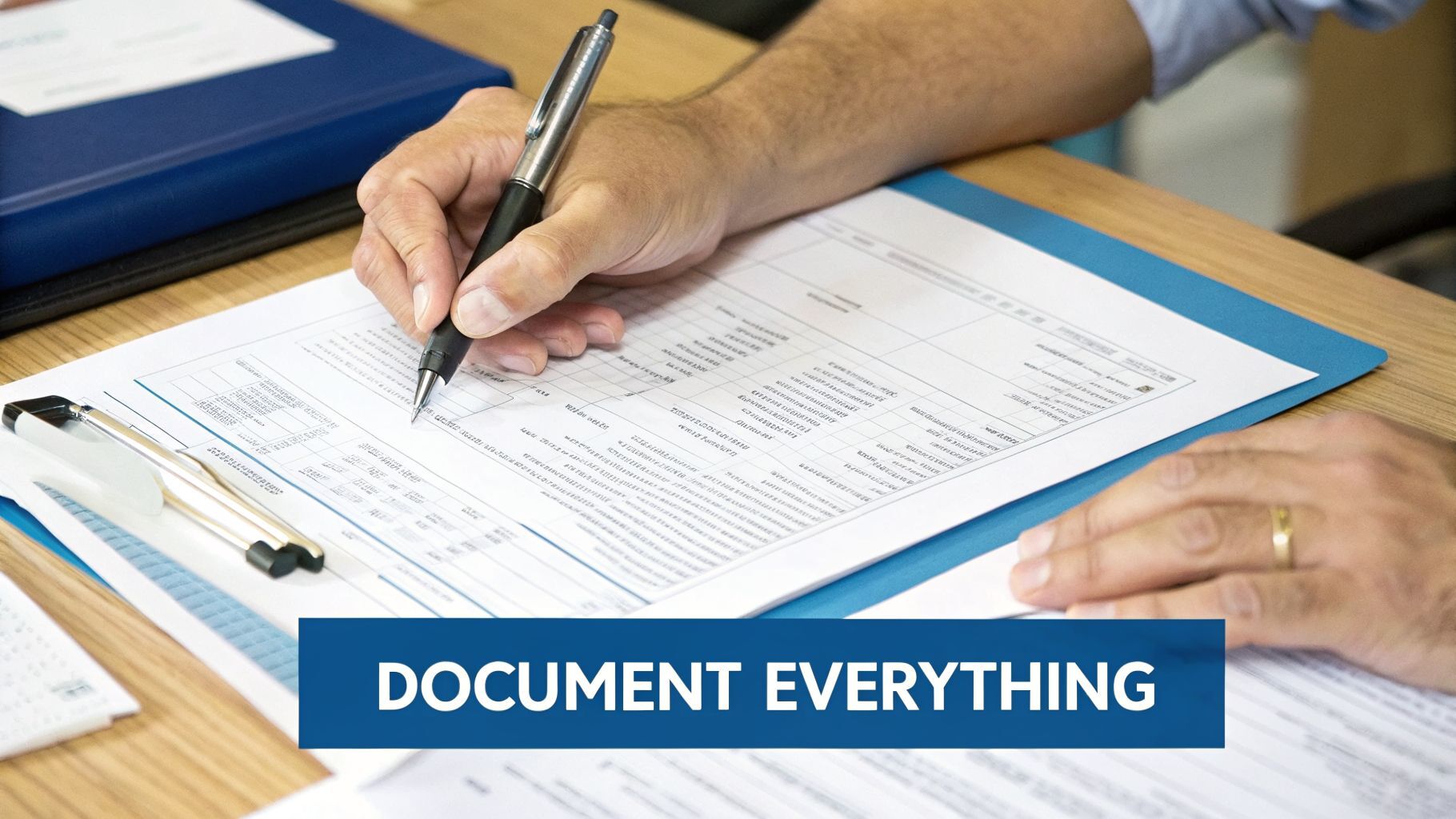
When an employee dispute heads toward legal action, the winner is almost always the one with the better paperwork. This simple truth highlights why consistent, thorough documentation is non-negotiable for every disciplinary action you take.
A casual or inconsistent approach to employee discipline can quickly turn into a massive liability. It’s a risk that most businesses simply can’t afford to take.
Think of your documentation like the black box on an airplane. When everything is running smoothly, it’s easy to forget it’s there. But if something goes wrong, that detailed, objective record is the only thing that can show exactly what happened, when it happened, and why.
Demystifying At-Will Employment
We see a common—and dangerous—misconception among employers. Many believe that “at-will” employment is an impenetrable shield against wrongful termination claims.
While it’s true that the at-will doctrine (the default in every state except Montana) allows either the employer or the employee to end the relationship for almost any reason, the key word here is almost.
You can’t terminate someone for an illegal reason. This includes discrimination against a protected class (like age, race, gender, religion, or disability), retaliation for engaging in a protected activity (like filing a workplace safety complaint or reporting harassment), or reasons that violate public policy.
Without clear documentation, an employee who is let go for poor performance could argue they were actually fired for one of these illegal reasons. If that happens, your best defense is a file full of objective, fact-based records that show a legitimate, performance-related history.
Crucial Insight: Your documentation isn’t just for your internal files; it’s your primary evidence in a potential legal battle. It proves your decisions were based on legitimate business needs, not discriminatory intent.
The Checklist for Bulletproof Documentation
Creating legally defensible documentation isn’t about writing a novel—it’s about being precise and factual. Your notes should always focus on behavior, not personality. Vague entries like “bad attitude” are useless and can even be used against you.
Stick to this simple checklist for every documented disciplinary conversation:
- Be Objective: Stick to the facts. Describe observable behaviors and specific actions, not your feelings or interpretations of their intent.
- Be Specific: Instead of writing “poor attendance,” document “Arrived at 9:15 AM on Monday, October 16, and 9:22 AM on Wednesday, October 18, violating the 9:00 AM start time policy.”
- Be Timely: Document conversations and incidents as soon as possible after they occur. Details are freshest in your mind right after the event.
- Be Consistent: Apply your documentation standards evenly to all employees in all similar situations. This helps you avoid any appearance of favoritism or discrimination.
Our comprehensive employer recordkeeping guide offers even more best practices for maintaining legally sound employee files.
From Verbal Warning Notes to Formal Letters
Even a “verbal” warning needs a paper trail. After you have a verbal coaching session with an employee, you should create a private note for their file. It doesn’t need to be complicated.
Example Phrases for Documenting a Verbal Warning
- Date and Time: “October 18, 2026, 11:00 AM”
- Issue: “Discussed repeated interruptions during team meetings, referencing specific instances from the 10/16 and 10/17 morning huddles.”
- Employee Response: “Employee acknowledged the behavior and stated they would be more mindful going forward.”
- Expectation: “Clarified that future meetings must be free of disruptions. Stated that the next step would be a written warning if the behavior continues.”
When an issue escalates to a formal written warning, the document itself has to be more detailed. It must clearly outline the problem, reference any previous conversations, set clear and measurable goals for improvement, and state the consequences if those goals aren’t met. This creates an undeniable record that you gave the employee every opportunity to succeed.
For many small businesses, the administrative burden of staying compliant can feel overwhelming. For instance, in 2023, U.S. private employers reported 2.8 million nonfatal workplace injuries and illnesses, a figure that shows the constant pressure to manage safety and risk. For companies in the Intermountain West, where PEOs like Helpside often serve businesses with 20-150 employees, meticulous HR practices around safety and discipline are absolutely essential. By partnering with an expert, these businesses can focus on growth while their PEO handles the complexities of things like workers’ comp claims and safety-related disciplinary actions. You can find additional health and safety statistics on Protex.ai.
Common Disciplinary Mistakes and How to Avoid Them
Even the most well-intentioned employers can trip up when it comes to disciplinary action. These aren’t just minor procedural errors; they’re the kinds of mistakes that can erode team morale, spark claims of unfair treatment, and put your business on the wrong side of a lawsuit.
Knowing the common pitfalls is the best way to steer clear of them.
One of the most damaging mistakes is applying rules inconsistently. Picture this: two employees are regularly late. One is a top performer, so you just have a friendly chat with them. The other gets a formal written warning. Even if your intentions were good, you’ve just created a situation that looks a lot like favoritism—or worse, discrimination.
Another critical error is waiting too long to act. The moment you learn about a policy violation, the clock starts ticking. Delaying action for days or weeks suggests the rule isn’t a priority and makes gathering accurate facts much harder.
Failing to Investigate Properly
Before you take any disciplinary action, you have to do your homework. Simply taking one person’s word over another’s without digging in is a recipe for disaster. A proper investigation is about gathering facts, not just collecting opinions.
A rushed or one-sided review almost guarantees a bad outcome. If one employee accuses another of misconduct, you must:
- Interview all relevant parties: This means talking to the accuser, the accused, and anyone who may have witnessed the event.
- Gather physical evidence: Check security footage, emails, time logs, or any other documentation that could confirm or deny the claims.
- Document every single step: Keep detailed, dated notes on who you spoke with, what they said, and what evidence you reviewed.
This process protects everyone involved. It ensures that any disciplinary measures are based on a solid foundation of fact, not hearsay or bias.
A critical part of applying discipline is making sure the process is fair and consistent. As seen in recent regulatory cases involving off-channel communications, inconsistent enforcement of rules—even for similar violations—can lead to major complications and perceptions of unfairness.
Making Emotional Decisions
Let’s be honest—dealing with employee issues can be incredibly frustrating. It’s natural to feel angry or disappointed when someone breaks the rules or underperforms. But making disciplinary decisions based on emotion is a huge mistake.
When you react in the heat of the moment, you’re far more likely to say something you regret or take action that is completely out of proportion. The best move is to always take a step back. Wait until you can approach the situation calmly, with your policies and documentation in front of you.
This is especially true for serious issues that could lead to termination. Firing someone should never be a split-second decision made out of anger.
Today’s workplace can easily trigger these mistakes. With rising concerns around issues like workplace violence and mental health, even small problems can escalate. For example, U.S. rates of serious workplace violence injuries have risen, and with 84% of workers reporting that issues like micromanagement or unclear expectations cause them stress, the fuse is often short. This is why having a clear, fairly-enforced policy isn’t just a best practice—it’s essential for keeping things from spiraling. You can read more about the data behind workplace safety trends in the AFL-CIO’s latest report.
When to Partner with an HR Expert
Navigating employee discipline can sometimes feel like you’re walking through a legal minefield. While you can often handle minor issues internally, some situations carry enough risk that going it alone is a major gamble for your business.
Knowing when to call for backup is key. These aren’t your everyday problems—they are high-stakes events where one wrong move could have serious and lasting consequences.
Key Moments to Seek Professional HR Guidance
Certain scenarios should be an immediate red flag that you need an expert in your corner. These situations are legally complex, and the potential for a misstep is just too high.
-
Your First Potential Termination: Firing an employee is one of the most legally sensitive actions you can take as an employer. An HR expert makes sure your documentation is solid and the process is handled fairly and legally, which is your best defense against a wrongful termination claim.
-
Managing a Multi-State Workforce: If you have employees in different states—like many businesses in the Intermountain West with teams in Utah, Arizona, Idaho, and Wyoming—you’re juggling a complicated web of state-specific employment laws. An expert helps ensure your disciplinary actions comply with the rules in every single location.
-
Receiving a Discrimination Complaint: Any claim involving discrimination or harassment requires an immediate, unbiased, and thorough investigation. Mishandling the investigation can create even more liability than the original complaint itself.
A Professional Employer Organization (PEO) is a strategic partner that can manage these high-stakes situations. A PEO provides a dedicated team of HR experts to handle investigations, documentation, and compliance, allowing you to focus on your business instead of HR complexities.
As your business grows, just keeping up with the day-to-day HR paperwork can become a full-time job. If you find yourself spending more time on employee issues than on growing your company, it’s a clear signal you need support. Consulting an HR expert is especially vital for navigating complex situations and staying updated on advancements like digital transformation in HR.
The PEO Partnership Advantage
Partnering with a PEO like Helpside is about more than just outsourcing tasks; it’s about sharing risk and gaining a true strategic ally. PEOs co-employ your workforce, which means they have a vested interest—skin in the game—in making sure your HR practices are compliant and sound.
This shared responsibility gives you an extra layer of protection. For many small business owners, it’s all about peace of mind. Knowing a team of certified professionals is guiding your disciplinary process allows you to handle difficult employee situations with confidence.
Learn more about the benefits of outsourcing HR functions and see how it can help safeguard your business.
Frequently Asked Questions About Disciplinary Action
Even with a well-defined process, business owners often have questions about how disciplinary action works in the real world. Let’s walk through some of the most common situations we see.
Can I Fire an Employee for a First Offense?
Legally, you often can—especially in an at-will state—but that doesn’t mean you should. Firing someone on the spot is a high-risk move.
Immediate termination is usually reserved for instances of gross misconduct, like theft, violence in the workplace, or a serious safety breach. For anything less severe, firing for a first offense without any warning can open your business up to a wrongful termination or discrimination claim. Before making that call, you need to have ironclad documentation of the offense and, ideally, consult with your PEO or an HR expert to make sure you’re on solid legal ground.
What Is the Difference Between Discipline and a PIP?
This is a great question, and the two are often confused. Disciplinary action is a direct response to an employee breaking a specific rule. Think of things like unexcused absences, insubordination, or violating a clear company policy. It’s a reaction to something that already happened.
A Performance Improvement Plan (PIP), on the other hand, is a forward-looking coaching tool. It’s designed to help a struggling employee get back on track. While a PIP might be part of your discipline process, its main purpose is corrective, not punitive. It sets clear goals, provides support, and establishes a timeline for improvement. If the employee doesn’t meet the PIP’s goals, then further disciplinary action—including termination—may follow.
Think of it this way: disciplinary action addresses what an employee did wrong, while a PIP addresses how an employee can do their job right. Both are essential management tools, but they solve different problems.
Do I Have to Follow My Progressive Discipline Policy Exactly?
Consistency is your best friend when it comes to legal protection. The goal should always be to follow your written policy as closely as you can, every single time. This protects you from claims of favoritism or discrimination.
However, a smart policy will also give you flexibility. It should include language stating that the company reserves the right to skip steps—or move straight to termination—depending on how severe the offense is. If you do decide to deviate from the standard process, you’d better have a clear, objective, and well-documented business reason for it. This is a legally tricky area where an HR expert can be a lifesaver.
Not sure if your disciplinary process is protecting your business—or putting it at risk?
Helpside’s HR experts can help you build compliant policies, handle employee issues, and reduce legal exposure.
📞 Call Helpside today for your Free 15-Minute HR Consultation: 1-800-748-5102 and get the guidance you need to move forward with confidence.
Further Readings:
Why Small Businesses Are Rethinking HR, Payroll, and Benefits
Stop Doing Your Payroll Twice: The Hidden Costs of DIY Payroll
Why Onboarding with a PEO Can Make or Break Your Business Growth
Navigating these complexities is exactly why businesses partner with Helpside. We provide the expert guidance and risk management you need to handle disciplinary situations with confidence. Learn how Helpside can protect and support your business as it grows.