
You hire a third employee, hand off a few more client projects, and then someone asks a simple question that turns into an afternoon of legal research: "Do we need workers' comp now?"
That moment catches a lot of growing employers. You're no longer a solo operator, but you're not a large company with in-house risk management either. You're in the messy middle where payroll is expanding, job duties are getting blurrier, and state rules suddenly matter in a very real way.
For a business with roughly 10 to 150 employees, workers' comp for small business isn't just another policy on the renewal checklist. It affects hiring, budgeting, classification, claims handling, and even how you structure leadership compensation. It also gets more complicated once owners, officers, LLC members, remote workers, and subcontractors enter the picture.
Your Guide to Workers' Compensation Insurance
A common pattern looks like this. A founder starts with one or two employees, runs payroll through basic software, buys general liability, and assumes workers' compensation can wait until the business is "bigger." Then growth happens faster than expected. Suddenly the business is sitting near a state threshold — or has already crossed it without realizing it.
That's where mistakes start. Not because owners don't care, but because workers' comp rules are fragmented. The trigger for required coverage may depend on headcount, payroll, role type, ownership structure, or state-specific exemptions. The answer also changes if the person in question is a spouse on payroll, a corporate officer, an LLC member, or a contractor who functions like an employee.
For growing companies, the practical issue isn't only "Do we need a policy?" It's also:
- Who must be included: employees, officers, owners, and sometimes people the business assumed were outside the policy
- How cost is shaped: payroll, role classification, and claims history
- Which buying path fits: direct purchase, broker placement, or a PEO arrangement
- What happens after an injury: reporting, claim management, and return-to-work decisions
Practical rule: Treat workers' comp as an operating system issue, not a one-time insurance purchase.
What Is Workers' Compensation and Why It Matters
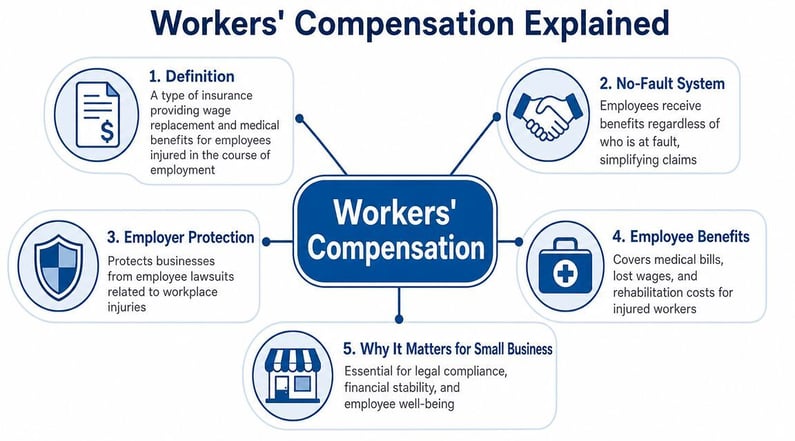
Workers' compensation is best understood as no-fault insurance for the workplace. If an employee suffers a work-related injury or illness, the policy is designed to respond without first turning the situation into a negligence fight between employer and employee. Employees may receive help with medical care, wage replacement, and related support tied to a covered workplace injury. Employers get a structured claim process and, in many situations, protection from direct employee lawsuits over that same injury.
Why small businesses feel this fast
For a growing employer, workers' comp becomes important earlier than many owners expect. Coverage rules often begin at the first employee in many U.S. states, and noncompliance can trigger penalties or stop-work orders. That's one reason the issue creates frustration — employers often don't object to protecting employees. They object to a patchwork system where timing, thresholds, and administration vary by state.
What the policy is really doing
A useful way to think about workers' comp is that it sits at the intersection of three business functions:
| Business function | What workers' comp affects |
|---|---|
| People | Employee protection after a work-related injury or illness |
| Finance | Premium cost, audit exposure, and claim-related budget pressure |
| Legal compliance | State mandates, notices, reporting, and exemption elections |
A workers' comp policy doesn't just pay claims. It forces a business to define who works for it, how those people are classified, and how fast the company responds when something goes wrong. For a small business, that discipline is valuable even before the first claim ever happens.
State Requirements and Common Exemptions
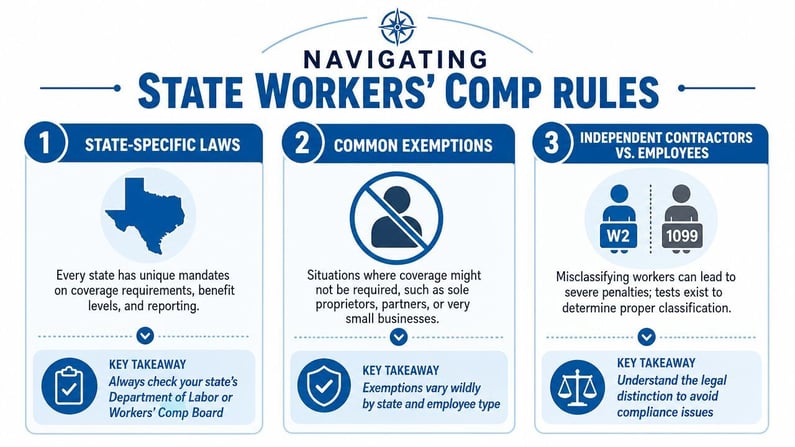
The hardest part of workers' comp for small business is that there isn't one national rulebook. Every state sets its own framework for when coverage is required, who counts toward the threshold, which roles are exempt, and how elections must be documented.
The variables that change by state
In practice, most state analysis starts with a few key points:
- Employee threshold: Some states require coverage very early; others use a higher headcount trigger.
- Worker type: Full-time, part-time, seasonal, domestic, agricultural, and casual labor may be treated differently.
- Entity structure: Sole proprietors, partnerships, corporations, and LLCs don't all get treated the same.
- Owner and officer elections: Some owners are automatically excluded, some are included, and some can opt in or out.
- Remote and multistate work: The state where work is performed can matter as much as the state where the company is formed.
Exemption rules for owners, partners, and LLC members vary sharply by state — and neither "automatically included" nor "automatically excluded" is a safe assumption without reviewing your specific state rules and entity documents.
What growing employers in the Intermountain West should verify
If your company operates in Utah, Arizona, Idaho, or Wyoming, don't rely on what was true in another state or at your last company. Use your current state agency rules and your current legal entity documents. Verify these items every time you hire into a new state or change ownership structure:
- Threshold rule: Confirm when coverage becomes mandatory for your employee count in that state.
- Officer treatment: Check whether corporate officers are included by default, excluded by default, or allowed to reject coverage.
- LLC member status: LLC owners often assume they follow corporate officer rules. In many states, they don't.
- Part-time counting: Some states count part-time workers toward the threshold.
- Subcontractor exposure: If a subcontractor lacks valid coverage, your business may absorb that payroll exposure in an audit or dispute.
Exemptions save money, but they also create risk
Exemptions aren't automatically good or bad. Sometimes electing coverage for an owner makes sense because that owner performs active field work or wants the protection. Sometimes keeping an owner exempt is reasonable because the business is managing cost and the owner has little operational exposure. The mistake is making that call casually.
If your ownership team changes titles, compensation structure, or day-to-day duties, revisit workers' comp elections at the same time. Keep a short exemption file with entity documents, election forms, current officer roster, and a note showing who reviewed state rules and when. That file becomes useful during audits, renewals, and leadership transitions.
How Workers' Comp Premiums Are Calculated
Workers' comp premium is usually modeled as: payroll × class rate per $100 of payroll × experience modifier (E-mod). Most premium conversations get confusing because people start with the final quote instead of the formula. The cleaner way to understand cost is to start with the inputs.
The three cost levers that matter most
Payroll is the wage base. If payroll rises, premium usually rises. That doesn't mean growth is a problem — it means labor cost and comp cost move together, so finance needs to plan for both.
Class rate reflects the type of work being done. Office administration and field work don't carry the same injury profile, so they won't share the same rate logic. This is why role design and job descriptions matter more than many companies think.
E-mod functions like a safety performance factor tied to loss history. A business with cleaner claims experience generally has a better path to controlling long-term cost than one that treats every injury as a one-off incident with no follow-up.
Where businesses lose control
Premium problems usually come from operations issues, not insurance issues alone. The recurring ones are predictable:
- Messy class coding: Employees drift into higher-risk duties, but payroll coding never gets updated.
- Unsegregated payroll: Mixed-role employees get grouped in a way that overstates exposure.
- Missing subcontractor certificates: Uninsured subcontractor costs can flow back onto your books.
- Weak incident response: A small claim gets harder and more expensive because reporting and documentation were sloppy.
| Cost driver | Useful control |
|---|---|
| Payroll growth | Forecast comp cost when headcount plans are approved |
| Classification | Audit class codes whenever jobs change materially |
| Claims history | Tie safety, reporting, and return-to-work into one process |
The businesses that control premium best usually aren't the ones chasing the cheapest quote. They're the ones running clean payroll data, accurate classifications, and disciplined claim handling.
Your Options for Getting Workers' Comp Coverage
Once you know you need coverage, the next decision is where to get it. That choice affects more than price — it affects service model, audit burden, claim coordination, and how many vendors your team has to manage.
Option 1: Through a state fund
Some employers buy coverage through a state fund. In monopolistic states, that may be the only route for workers' comp. The upside is clarity — if the state requires that route, the market choice is simple. The downside is that your broader HR, payroll, and claims workflow may still sit across separate systems and advisors. This path tends to fit employers that want a direct compliance channel and are comfortable handling more of the surrounding administration internally.
Option 2: Through a broker and private carrier
A broker can help you shop private market options, compare carrier appetite, and review terms. It works well when the company already has a reliable broker relationship, stable classifications, and enough internal discipline to support payroll reporting, audits, certificates, and claim follow-up. It works less well when HR and finance are already overloaded and every policy issue turns into a cross-functional fire drill.
Option 3: Through a PEO
For companies in the 10 to 150 employee range, a PEO can make sense when workers' comp is part of a larger operational strain. The value isn't only access to coverage — it's that payroll, HR administration, compliance support, and claims coordination can operate through a more integrated model. Helpside is one example, offering payroll, HR, benefits, and workers' compensation support within a PEO structure that reduces disconnected processes for growing employers.
| Coverage path | Usually a fit when | Usually a strain when |
|---|---|---|
| State fund | State rules point you there, or you want a direct route | You need broader HR and payroll integration |
| Broker and carrier | You have internal capacity and want market choice | Admin work is already falling through the cracks |
| PEO | Growth is exposing payroll, HR, and claims coordination gaps | You only want a stand-alone policy and nothing else |
Managing Claims and Reducing Long-Term Costs
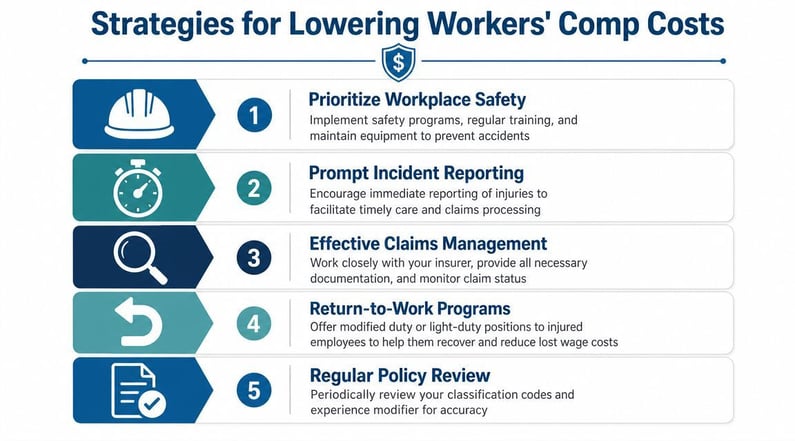
Buying the policy is the easy part. Controlling the long-term cost is what separates disciplined employers from frustrated ones. The strongest results come from connecting two things that are often managed separately: prevention and claims management. If you improve safety but mishandle claims, costs stay sticky. If you manage claims well but tolerate poor training and weak reporting, the same problems keep returning.
Prevention that actually changes outcomes
A lot of safety programs are too generic. The handbook says employees should work safely, but job-specific expectations are vague, supervisor accountability is light, and near misses never turn into process changes. Better systems are more concrete:
- Train to actual tasks: Don't stop at orientation. Refresh the tasks that create the highest injury exposure in your environment.
- Review changing roles: When an employee starts splitting time across office and field work, classification and safety procedures both need review.
- Keep equipment and work areas in order: Disorder creates small incidents that later become claims.
- Build reporting into management habits: Supervisors should know exactly what to do the same day an incident occurs.
The cheapest claim is the one prevented by better training, cleaner reporting lines, and a supervisor who acts immediately.
Claims management that protects your future premium
When an injury happens, the employer's first response matters. A workable claim process usually includes:
- Immediate incident intake: Capture the who, what, when, and where while facts are still fresh.
- Prompt carrier or administrator notice: Don't let uncertainty stall reporting. Late notice rarely helps.
- Consistent employee communication: Employees need to know what happens next, who to contact, and what paperwork is required.
- Return-to-work planning: Modified duty can matter if the employee can safely perform it under applicable restrictions.
- Post-claim review: Ask what failed operationally. If no one can answer that, the same claim pattern often repeats.
For businesses that want a more structured workflow, Helpside's workers' compensation claims management resource outlines the core moving parts.
Frequently Asked Questions About Workers' Comp for Small Business
Do 1099 contractors need to be covered?
Sometimes yes, sometimes no — and the main issue is usually classification. If a person is a genuine independent contractor under the applicable legal standard, they may not fall into your workers' comp requirement the way an employee would. But if the person is labeled 1099 while functioning like an employee, that label won't protect the business. Misclassification can affect workers' comp, wage and hour compliance, taxes, and audit exposure at the same time. Review contractor relationships before an injury happens, not after. Also keep current certificates of coverage for subcontractors when applicable. Don't use a 1099 form as a risk strategy — it's an administrative label, not a compliance shield.
What changes when we hire in multiple states?
Complexity rises quickly. The state where the employee works may control workers' comp requirements even if your company is formed elsewhere and runs payroll from a home office in another state. A multistate employer needs to verify state-specific coverage obligations, notices, classification issues, and exemption rules each time it enters a new jurisdiction. The ownership question becomes more important too — an officer exemption that works one way in one state may not carry over into another. Treat each new state hire as a compliance event that triggers review across payroll, tax setup, handbook language, and workers' comp coverage.
What does a PEO actually do for workers' comp?
A PEO can simplify workers' comp by bringing several moving parts into one operating model. Instead of having payroll in one system, HR questions with one advisor, and claims issues with another party, the employer works through a more connected structure. In practical terms, that can include support around coverage placement, payroll coordination, class code review, claims administration workflow, and compliance processes tied to onboarding and multistate employment. It doesn't eliminate the employer's responsibility to run a safe workplace or report incidents promptly. It does reduce the handoff risk that often causes delays and mistakes.
How do I keep workers' comp costs from rising at renewal?
Long-term cost control starts with operations, not negotiation. The three most impactful levers are payroll accuracy (making sure wage growth is planned and class codes stay current), classification discipline (auditing job duties when roles change materially), and claims history management (improving first-response quality, return-to-work coordination, and post-claim review). Businesses that run clean payroll data, accurate classifications, and disciplined incident response consistently outperform those that focus primarily on finding a cheaper quote at renewal.
Are owners and officers required to be covered by workers' comp?
It depends entirely on the state and entity structure. Corporate officers may be included by default, excluded by default, or eligible to file an election to opt in or out. LLC members often follow different rules than corporate officers, even in the same state. Sole proprietors and partners are frequently excluded by default but may be able to elect coverage. The safest approach is to verify your specific state rules, update elections whenever ownership structure or job duties change, and keep documentation showing who reviewed those rules and when.
If your company is growing and you need help sorting through coverage requirements, owner exemptions, payroll classification, or claims workflow, Helpside can help you evaluate your options and build a workers' comp process that fits how your business actually operates.