
When a workplace injury happens, how you respond in the first few hours—and the days that follow—makes all the difference. Having a solid plan for workers compensation claims management isn’t just about filling out forms; it’s a clear, step-by-step process designed to support your employee while keeping costs and compliance under control.
For small and midsize businesses, a reactive approach can be incredibly costly. A well-defined framework is your best defense against soaring premiums and legal headaches.
Building Your Proactive Claims Management Framework
Without a plan, a workplace injury can quickly spiral into confusion. Employers find themselves putting out fires instead of guiding the process, leading to delayed reporting, higher insurance costs, and prolonged employee absences. Proactive claims management flips that script, turning chaos into a predictable and controlled system.
The idea is to create a supportive path that prioritizes your employee’s well-being while protecting the business. It’s a coordinated effort that starts the moment an injury is reported and continues through medical care, claims processing, and a safe return to work.
The Workers’ Compensation Claims Management Lifecycle
To get a handle on the process, it helps to see it as a lifecycle with distinct phases. This high-level overview shows the three main stages you’ll navigate from the moment an injury occurs to the employee’s full recovery.
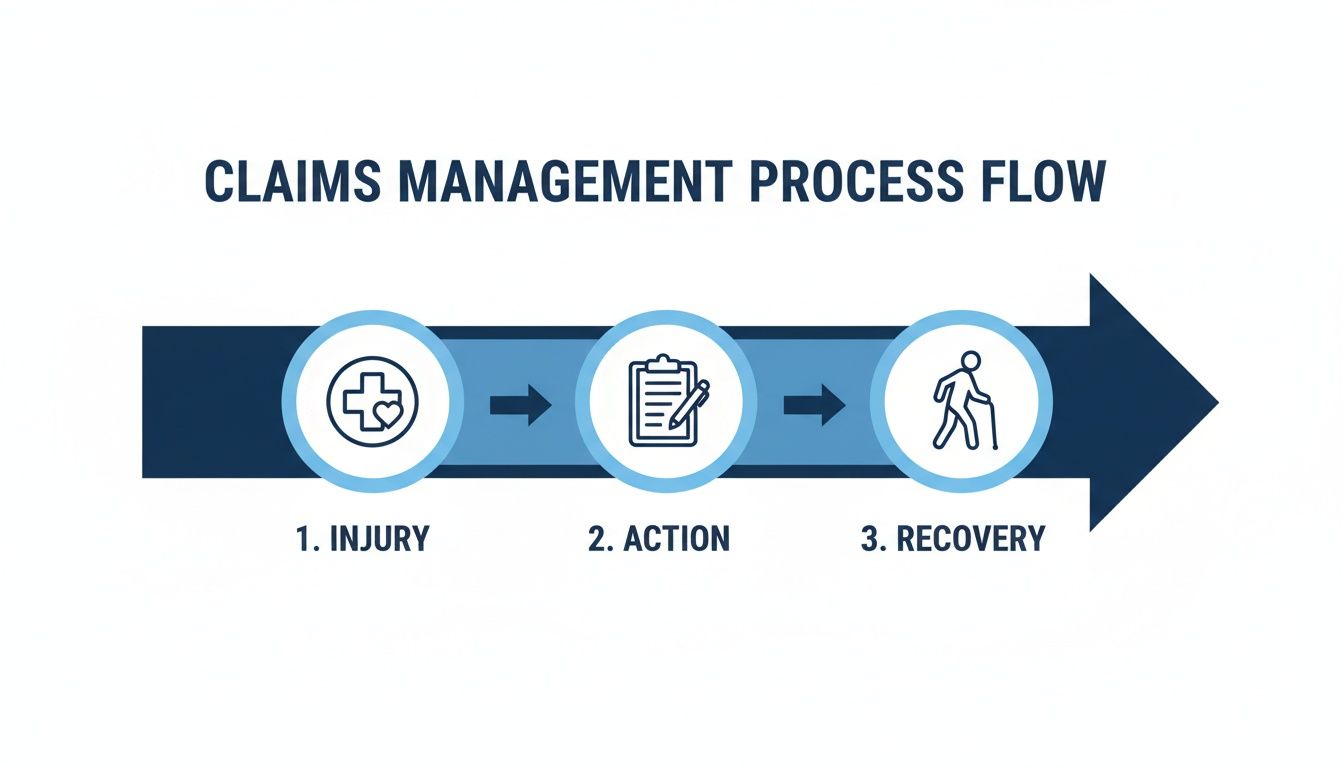
This visual makes it clear: your actions, like providing immediate first aid and documenting the incident, are just as crucial as the employee’s physical recovery.
Let’s break down what this lifecycle looks like in practice. Each phase comes with its own set of priorities and actions for the employer.
| The Workers’ Compensation Claims Management Lifecycle | ||
|---|---|---|
| Phase | Employer’s Key Actions | Primary Goal |
| 1. Injury & Immediate Response | Provide medical care, secure the area, gather initial details from the employee and witnesses. | Ensure employee safety and stabilize the situation. |
| 2. Investigation & Reporting | Conduct a thorough incident investigation, complete all required forms, and report the claim to the insurer/TPA within state-mandated deadlines. | Document facts accurately and meet all compliance deadlines. |
| 3. Claim & Medical Management | Maintain regular communication with the employee, insurer, and medical provider. Coordinate care and discuss potential modified duty. | Facilitate appropriate medical treatment and a safe recovery. |
| 4. Return-to-Work & Closure | Develop a formal return-to-work plan (modified or full duty). Monitor progress and manage the claim until it officially closes. | Bring the employee back to work safely and control claim costs. |
Understanding these stages helps you anticipate what’s next, communicate more effectively, and manage the process with confidence. This isn’t a rigid checklist but a flexible playbook you can adapt to each unique situation, keeping state-specific laws in mind.
A common mistake is treating claims management like just another administrative task. It’s much more than that—it’s a core part of your risk management and a reflection of your company culture. How you handle a claim tells your team everything about how much you value them.
Ultimately, a strong framework helps you achieve three critical goals:
- Ensure Compliance: State regulations are complex and non-negotiable. Reporting deadlines can vary dramatically by state, and missing one can lead to serious fines.
- Control Costs: Proactive management has a direct impact on your Experience Modification Rate (E-Mod), the number insurance carriers use to set your premiums. A well-managed claim is almost always a less expensive one.
- Support Employees: A clear and empathetic process reduces anxiety for an injured employee. That trust goes a long way toward encouraging a faster, safer return to their job.
Of course, the best way to manage a claim is to prevent it from ever happening. You can learn more about how to create an effective workplace safety program to get ahead of potential incidents.
The First Critical Hours After A Workplace Injury
How you handle the first few hours after an employee gets hurt on the job can make or break the entire claim. Your immediate actions don’t just affect the claim’s cost; they influence the employee’s recovery, their trust in the company, and even team morale. Before a single piece of paperwork is filled out, your absolute first priority is one thing: getting the injured employee proper medical care.
Everything else can wait. Ensuring the employee is safe and looked after must come before any calls to an insurer or internal reports. That’s why having a clear, established plan before an incident happens is the cornerstone of effective workers compensation claims management.
Prioritizing Immediate Medical Care
For any serious or life-threatening injury, the protocol is straightforward: call 911 immediately. There should never be a moment’s hesitation from a manager or coworker when emergency services are needed.
For non-emergency situations, being prepared is just as critical. Many proactive employers build relationships with local occupational health clinics. These facilities are experts in work-related injuries and know the ins and outs of the workers’ comp system, which can make the entire process smoother for everyone.
Your response plan should spell out a few key things:
- Designated Medical Facilities: A list of approved occupational clinics or doctors, where permitted by state law.
- Transportation Procedures: A clear plan for how an employee will get to the clinic. Will a supervisor drive them? Will you use a ride-share service?
- Necessary Paperwork: Any forms the employee needs to bring, like a medical authorization form that tells the clinic to treat them and bill the company’s workers’ comp carrier.
It is critical to remember that state laws differ significantly on this. Some states allow an employer to direct an employee to a specific medical provider, at least for the initial visit, while others give the employee the right to choose their own doctor from the outset. Ensure your procedures align with your state’s specific regulations.
An organized, empathetic response shows an injured employee they’re a valued member of the team. When a manager stays calm and helps facilitate immediate care, it builds a foundation of trust that is priceless throughout the rest of the claims process.
Securing The Scene and Gathering Information
Once the employee is on their way to receive medical care, your focus can shift to the incident scene. The goal here is twofold: prevent anyone else from getting injured and preserve the scene for the investigation.
This might mean roping off the area, especially if machinery or a hazardous material was involved. The key is not to clean up or move anything until you’ve had a chance to document the environment. This is crucial for understanding what went wrong and making sure it doesn’t happen again.
Now is also the time to start on the First Report of Injury (FROI) form. This document officially kicks off the workers’ compensation claim, so getting the details right and submitting it quickly is essential.
Real-World Scenario: The Retail Slip-And-Fall
Picture this: an employee in a retail store slips on a small, unseen puddle near the stockroom and injures their wrist during the fall.
- Medical Care: The manager immediately checks on the employee. It’s clearly not life-threatening, so they follow the non-emergency plan and drive the employee to the company’s designated occupational health clinic a few miles away (assuming state law allows this).
- Securing the Scene: While they’re gone, another team member puts up “Wet Floor” signs and mops the spill to keep others safe, but only after the manager quickly snapped a few photos of the scene with their phone.
- Reporting: As soon as they return, the manager fills out the FROI form, noting the time, location, and the employee’s account of what happened. They send it to their insurance carrier that same day, well within the state’s deadline.
This kind of swift, organized response gets the employee taken care of, eliminates further risk, and starts the claims process on the right foot. For a closer look at the immediate steps, you can check out our guide on what to do when an employee is injured at work. Remember, timely reporting isn’t just a good idea—it’s a legal requirement, and missing deadlines can result in penalties from the state.
How To Conduct An Effective Incident Investigation
A thorough incident investigation is one of the most powerful tools in your workers compensation claims management playbook. It’s not about assigning blame. It’s about digging into the “why” behind an incident so you can keep it from happening again. A prompt, fact-finding investigation also gives your insurance carrier credible documentation and shows your people you’re serious about workplace safety.
This is about more than just filling out a form. A real investigation pieces together the sequence of events with objectivity and detail. This process has to start the moment the employee has received medical care and the scene is secured. The goal is to collect information while memories are fresh and the environment hasn’t been disturbed.

This proactive approach helps you find the root cause, which is often completely different from the immediate cause. For example, an employee slipping on a wet floor is the immediate cause. But the root causes could be a leaky pipe that hasn’t been fixed, a lack of “Wet Floor” signs, or poor training on spill cleanup. That’s what you’re trying to find.
Gathering Information From People
The human element is everything. Your approach should be empathetic and focused on gathering facts, not interrogating people. You’ll want to speak with three key groups—always separately and in a private setting to get the most honest information.
The Injured Employee:
As soon as it’s appropriate, talk with them. Make sure they’re comfortable and not under the influence of any pain medication that could affect their memory. The key here is to listen way more than you talk.
- Ask them to walk you through what happened in their own words, from start to finish.
- Find out what they were doing right before the incident.
- Ask if they’ve done this task before and if anything was different this time.
Witnesses:
Coworkers who saw or heard something can offer an invaluable third-party perspective.
- Interview them one-on-one. This prevents their stories from bleeding into each other.
- Use open-ended questions like, “Tell me what you saw,” instead of leading ones like, “Did you see them slip?”
- Make a note of where they were standing in relation to the incident to understand their vantage point.
The Supervisor:
The direct supervisor provides crucial context about the job, training protocols, and equipment status.
- Ask about the employee’s training records for that specific task.
- Inquire about any known issues with the equipment or work area.
- Find out if the employee was working under normal conditions or if something unusual was going on (like rushing to hit a deadline).
An effective investigation is a blame-free process. The moment employees feel they or their coworkers will be punished, they become reluctant to share the candid details needed to uncover root causes and improve workplace safety for everyone.
Documenting The Scene and Evidence
While conversations build the narrative, physical evidence provides the hard facts. This part of your workers compensation claims management process creates a tangible record for the insurance adjuster and your own safety team.
You should be collecting and documenting several types of evidence right away:
- Photographs and Videos: Use your smartphone. Get the scene from multiple angles—wide shots of the whole area, then close-ups of specific details like the equipment involved, the floor condition, or the specific hazard.
- Physical Objects: If it’s relevant, collect it. This could be a broken tool, a frayed cord, or even the footwear the employee was wearing. Place everything in a labeled bag to preserve it.
- Records and Logs: Gather important paperwork like equipment maintenance logs, the employee’s training records, or safety inspection reports from the days leading up to the incident.
This detailed information isn’t just for handling the current claim. It’s the foundation for making real, meaningful changes—like repairing faulty equipment or updating safety training—that stop future injuries before they happen. It turns a reactive claims event into a proactive safety improvement. And remember, while each state’s laws vary, a well-documented, good-faith investigation is a universally valuable practice.
Implementing A Successful Return-To-Work Program
Getting an injured employee back on the job safely and quickly is one of the biggest wins in workers compensation claims management. A structured return-to-work (RTW) program isn’t just a nice thing to do—it’s a powerful strategy for controlling claim costs, boosting morale, and actually helping your employee recover faster. The longer someone is out of work, the less likely they are to ever come back. That makes a proactive RTW program a must-have for both your employee and your business.
This process doesn’t start the moment an employee gets cleared for light duty. It starts long before an injury ever happens. The best programs are built on a solid foundation of pre-identified tasks that can accommodate common medical restrictions.

Creating a Bank of Modified-Duty Tasks
Thinking you’ll just “find something” for an injured employee to do when the time comes is a recipe for failure. Instead, you need to proactively build a “task bank” of meaningful jobs that can work around physical limitations. This takes a bit of creativity, especially if your business is not in an industrial or manual labor setting.
Think about all those valuable but non-urgent tasks that always get pushed to the back burner:
- Administrative Support: Organizing digital files, entering data, answering phones, or helping prepare training materials.
- Safety and Compliance: Reviewing safety manuals, watching training videos, or doing facility safety walkthroughs (if their mobility allows).
- Inventory Management: Performing cycle counts from a seated position, organizing small parts, or updating inventory records.
- Customer Outreach: Making follow-up calls to clients or helping with light marketing projects.
When you identify these roles ahead of time, you can confidently offer a productive alternative as soon as an employee is released to light duty. It shows you value their contribution and want to keep them engaged.
Collaborating with Medical Providers
Open and clear communication with the treating physician is absolutely essential. Your goal isn’t just to get a list of what the employee can’t do; you need a clear, functional description of what they can do. A vague note that just says “light duty” doesn’t help anyone.
To get the specifics you need, send the doctor a detailed description of the employee’s regular job and your list of pre-identified modified-duty tasks. This gives the physician real, concrete options to evaluate against the employee’s current condition.
Taking this step often results in a work status report with specific, actionable restrictions, like:
- No lifting over 10 pounds.
- Seated work for 90% of the shift.
- No repetitive grasping with the right hand.
Armed with this information, you can make a formal, appropriate offer of modified duty. It’s also important to understand key medical benchmarks, like when an employee reaches Maximum Medical Improvement (MMI) in workers’ comp. This milestone helps shape the timeline and expectations for both temporary accommodations and the entire return-to-work plan.
Making a Formal Offer and Navigating Challenges
Once you have the doctor’s restrictions and a suitable task lined up, you need to make a formal, written offer of modified duty to the employee. This letter needs to be crystal clear.
- A Clear Job Description: Detail the specific modified tasks they’ll be doing.
- Physical Requirements: Spell out exactly how the role complies with the doctor’s restrictions.
- Logistical Details: Include the work schedule, pay rate (which should generally match their pre-injury rate), and a start date.
- A Point of Contact: Name the supervisor they will report to.
Send this letter via a method that provides proof of delivery, such as certified mail. This creates a legal record that you made a suitable offer. In many states, if an employee refuses a suitable offer of modified work, it can impact their eligibility for wage replacement benefits, so this documentation is critical.
A well-documented, formal offer of modified duty is a cornerstone of effective claims management. It protects the employer and provides the employee with a clear, unambiguous path back to productive work, removing uncertainty from the process.
Of course, you might hit some bumps. An employee could be hesitant to return, worried about getting hurt again or feeling like they aren’t ready. This is where empathy and good communication come in. Reassure them that their safety is the top priority and that the doctor has approved these specific tasks. A supportive, understanding tone can make all the difference.
Mastering Documentation and State-Specific Compliance
When it comes to workers compensation claims management, there’s an old saying that rings true: if it wasn’t documented, it never happened. Meticulous, real-time record-keeping is your single best defense for managing a claim, controlling costs, and meeting your legal obligations. It becomes the official story of the claim, from the moment an incident occurs to its final resolution.
This is about much more than just filing the initial injury report. A comprehensive claim file should serve as the single source of truth for you, your insurance adjuster, and any legal counsel who might get involved. Good documentation proves you’re making a good-faith effort to manage the claim properly—something that can be invaluable if a dispute ever arises.

Building Your Claim File The Right Way
Think of each claim file as a story told in chronological order. It needs to be organized and contain every relevant detail, allowing anyone to pick it up and understand the claim’s history at a glance.
Here’s what every solid claim file should include:
- The First Report of Injury (FROI): This is the official starting point.
- Incident Investigation Notes: Get everything in here—witness statements, photos from the scene, supervisor reports, and any findings from your root cause analysis.
- Medical Records: Every doctor’s note, work status report, and medical bill tied to the injury.
- Communication Log: Keep a detailed record of every single conversation with the employee, their doctor, and the insurance adjuster. Note the date, time, and a quick summary of what was discussed.
- Modified Duty Offers: Keep copies of all formal, written return-to-work offers, along with proof of delivery to prove they were sent.
- Wage Statements: You’ll need clear documentation of the employee’s pre-injury earnings to calculate their benefits correctly.
This level of detail isn’t optional in modern claims management. It provides the clarity you need to make informed decisions and protects your business from unnecessary disputes.
Navigating State-Specific Compliance Nuances
While the principles of good documentation are universal, the rules of workers’ comp are intensely local. Every state has its own unique set of laws, reporting deadlines, and required forms. What works perfectly in one state might result in penalties in another.
For instance, the deadline to report an injury to your insurance carrier can vary dramatically between states. Missing these deadlines can lead to hefty fines and might even strip you of your ability to direct medical care. This is a complex area, and it’s important to state that this article is for informational purposes and does not constitute legal advice. Employers should always consult with qualified legal counsel to ensure they’re fully compliant with their specific state’s regulations.
Failing to report injuries on time can have serious consequences. As one legal analysis points out, an employee might be able to sue my employer for not reporting my injury in Pennsylvania. This example highlights how critical it is to know and follow your state’s laws to the letter.
The core principle here is simple: know the rules in every state you operate in and follow them without exception. Pleading ignorance of a state-specific deadline or form is never a valid defense.
The Growing Complexity of Mental Health Claims
The workers’ compensation landscape is also shifting to put a greater focus on mental health. While these claims are still less common, their impact can be significant.
Different states have widely varying standards for when a mental health condition is compensable under workers’ compensation. Some require a physical injury to accompany the mental stress, while others have specific rules for psychological claims. As these complex cases become more frequent, the need for precise and thorough documentation becomes even more critical for managing outcomes and keeping costs in check.
Staying on top of these evolving requirements demands real diligence. For small and midsize businesses, navigating this intricate web of documentation and multi-state compliance can be a massive burden—and it often highlights the value of partnering with an expert who specializes in HR and risk management.
Strategic Cost Control For Your Business
Smart workers compensation claims management is so much more than just pushing paperwork after someone gets hurt. It’s really about protecting your company’s bottom line without ever cutting corners on employee care. The only way to do that well is to get out of a reactive mindset and start paying attention to the numbers that tell you how healthy your safety and claims programs really are.
Getting a handle on your data is the first step. Three numbers, in particular, paint a powerful picture of your company’s risk and where you have room to improve.
Key Performance Indicators To Monitor
Watching these KPIs helps you catch bad trends before they snowball into painful premium hikes. Each one gives you a different piece of the puzzle.
- Experience Modification Rate (E-Mod): This is a huge one. Your insurance carrier assigns you an E-Mod that compares your claims history to other businesses in your industry. If it’s over 1.0, you’re paying more for insurance because your claims are worse than average. Below 1.0, and you get a credit.
- Claim Frequency: This just tracks how often claims are happening, often measured as the number of claims per a standard unit, like hours worked or payroll. If this number starts creeping up, it’s a red flag that you probably have a systemic safety issue that needs fixing—fast.
- Claim Severity: This tells you the average cost of each claim. A high severity rate might mean you’re dealing with more serious injuries, or it could point to delays in getting employees back on their feet with a solid modified-duty program.
When you track these metrics, you can finally shift from just reacting to claims to proactively managing your risk. See claim frequency ticking up? Time to audit your safety training. Is severity the problem? Let’s double down on that return-to-work process.
The goal is to turn your workers’ comp program from a volatile, unpredictable expense into a manageable part of your business operations. This is how you protect your bottom line and stay focused on growth.
The Shifting Landscape Of Claim Costs
Recent industry data highlights a trend every business owner should be watching. While claim frequency has generally been declining over the past several years, the average cost per claim (severity) has been rising.
This increase in severity is driven by factors like medical inflation and increasingly complex medical care. You can dig into more of these workplace injury trends yourself.
This dynamic—fewer claims, but much more expensive ones—leaves small businesses incredibly vulnerable. One serious incident can trigger a massive, unpredictable premium hike. It makes rock-solid safety programs, careful claims oversight, and expert partnerships more critical than ever.
By focusing on prevention and smart cost-containment strategies, you can insulate your business from these rising costs. For a deeper dive, check out our guide on how to calculate workers comp premiums and how to save.
Your Top Workers’ Comp Questions, Answered
When you’re dealing with workers’ compensation, a lot of questions come up. We see employers grapple with the same uncertainties all the time. Below are a few of the most common ones we hear, along with some straightforward, practical advice. Just remember, these are general guidelines, as specific state laws will always govern the requirements.
What’s the Absolute First Thing I Should Do When an Employee Gets Hurt?
Your first and only immediate priority is the employee’s well-being. Get them the right medical care, right away.
This could mean calling 911 for a serious injury or arranging transportation to a designated occupational health clinic for something less urgent. Everything else—filling out the First Report of Injury, investigating what happened—is secondary. Medical care always comes first.
Can I Fire an Employee While They’re on Workers’ Comp?
This is a minefield. While receiving workers’ comp benefits does not provide an employee with absolute protection from termination, it is illegal in every state to fire someone as retaliation for filing a workers’ compensation claim.
You must tread very carefully here. Other laws, like the Americans with Disabilities Act (ADA) and the Family and Medical Leave Act (FMLA), often come into play, adding more layers of compliance you need to navigate. Before considering termination of an employee on workers’ compensation leave, you should consult with legal counsel.
Firing an employee who has filed a claim, even for a legitimate reason, can easily be seen as retaliation. That can spark a wrongful termination lawsuit, which is almost always a bigger, more expensive headache than the original workers’ comp claim.
Do I Have to Offer an Injured Employee Light Duty?
While most states do not explicitly mandate that an employer create a light-duty position, offering a modified return-to-work program is one of the smartest things you can do in workers’ compensation claims management.
Choosing not to is a huge missed opportunity to get a handle on your claim costs. A good program keeps your employee engaged and connected to the company, helps them recover faster, and can dramatically lower the financial drain from lost-time wage benefits.
Juggling multi-state compliance, return-to-work programs, and all the claim paperwork can be a real burden, especially for a growing business. At Helpside, we step in with expert HR, payroll, and risk management support. We help you turn a complex, reactive headache into a predictable, well-managed part of your operations.