This article was written by Josh Hancey, Safety Director at Helpside. Joshua has been with Helpside for over seven years. Connect with him on LinkedIn here
When you hear the term “workplace safety training program,” it’s easy to think of thick binders and compliance checklists. But at its core, a safety program is much more than that. It’s a structured way to teach your team how to spot hazards, prevent injuries, and know exactly what to do in an emergency.
Think of it as a fundamental investment in both your people and your company’s financial health. It’s one of those rare business expenses with a clear, proven return.
The Real Cost of Workplace Incidents

For a small business owner, a workplace injury is never just a statistic. Imagine a key team member in your small warehouse slips and falls, suffering a serious back injury. In an instant, your entire operation feels the ripple effect. Productivity tanks as the rest of the team scrambles to pick up the slack, which often leads to burnout and mistakes.
That single incident sets off a chain reaction of hidden costs. You’re suddenly drowning in complex workers’ compensation paperwork and spending hours on the phone with insurance adjusters. Team morale sinks as everyone worries about their own safety and the well-being of their injured coworker. This is the reality behind the numbers—one accident can disrupt operations, drain your resources, and poison the culture you’ve worked so hard to build.
Beyond the Initial Accident Report
The true financial hit from a workplace incident goes far beyond the obvious medical bills. Those are just the tip of the iceberg. The less visible, indirect costs are what can really damage a small business’s bottom line.
- Direct Costs: These are the immediate, tangible expenses you see, typically covered by workers’ compensation insurance. They include medical payments for the injured employee and wage replacement benefits.
- Indirect Costs: These are the uninsured, out-of-pocket expenses that can truly cripple a business. We’re talking about lost productivity, the cost to hire and train a replacement, damage to equipment or products, and all the time spent on incident investigation and reporting.
The National Safety Council estimates that these indirect costs can be 1 to 4.5 times higher than the direct costs of an incident. For a small business, this means a $10,000 medical claim could actually end up costing you as much as $45,000 when all is said and done.
The Strong Financial Case for Prevention
This is where proactive workplace safety training programs flip the script, turning a perceived cost into a powerful strategic investment. It’s about getting out of reactive crisis mode and building a proactive culture of prevention. The data is clear.
According to the U.S. Bureau of Labor Statistics, private industry employers reported 2.8 million nonfatal workplace injuries and illnesses in 2022. But there’s good news. Federal data shows that effective workplace safety training can slash these incidents significantly.
The financial argument for safety is just as compelling, as this table illustrates:
The Business Case for Safety Training
This table breaks down the tangible benefits your business can see from a strong safety program.
| Metric | Impact of Effective Training |
|---|---|
| Return on Investment (ROI) | Studies show a return of $4-$6 saved for every $1 invested in safety. |
| Workers’ Comp Premiums | Fewer claims and a lower experience modification rate (EMR) lead to reduced premiums. |
| Productivity | A safer workplace means fewer disruptions, less downtime, and more consistent output. |
| Employee Turnover | Employees who feel safe and valued are more loyal and less likely to leave. |
| Operational Costs | Reduced costs from equipment damage, incident investigations, and hiring temporary staff. |
This translates directly into more predictable operating costs and fewer disruptive workers’ compensation claims. You can explore more health and safety statistics to understand the broader impact of prevention.
Ultimately, investing in safety is investing in stability. It protects your most valuable asset—your people—while safeguarding your company’s financial health and ensuring its long-term success. It’s not just about avoiding fines; it’s about building a resilient and profitable business.
Navigating Your OSHA Compliance Duties
Most business owners know the Occupational Safety and Health Administration (OSHA) exists, but what it actually requires of them can feel a little murky. Getting clear on those responsibilities is the first step toward building a workplace that’s not just compliant, but genuinely safe. And it all starts with one core principle.
At the heart of OSHA compliance is the General Duty Clause. This is a catch-all requirement that says every employer has to provide a workplace “free from recognized hazards that are causing or are likely to cause death or serious physical harm.” Think of it as the foundational promise you make to your employees—that you will actively look for and fix foreseeable dangers.
This isn’t about reacting after an accident happens. It’s a proactive duty. You have to assess your environment—whether it’s an office, a construction site, or a warehouse—and deal with the risks that come with the work you do. A solid workplace safety training program is the main way you live up to that obligation.
Understanding OSHA’s Specific Training Standards
Beyond the broad General Duty Clause, OSHA has a long list of specific standards that demand training for particular hazards. These aren’t just suggestions; they are legal requirements. Falling short on them is one of the quickest ways to face significant penalties.
For instance, some of the most common citations are tied directly to a failure to train. These include:
-
Hazard Communication (HazCom): Your employees must be trained on the dangers of any chemicals they work with or around. Getting a handle on OSHA SDS requirements is a non-negotiable part of this, as Safety Data Sheets are the blueprint for communicating chemical risks.
-
Fall Protection: Anyone working at heights of four feet or more in general industry (or six feet in construction) needs training on how to spot and minimize fall hazards.
-
Lockout/Tagout (LOTO): This standard is all about controlling hazardous energy. Workers who service machinery must be trained on procedures to prevent it from starting up unexpectedly, which is a common cause of serious injuries.
OSHA’s preliminary data for fiscal year 2023 shows a familiar pattern in violations. Failures in fall protection were the most cited standard, with 7,271 violations. Other top areas with required training components included hazard communication with 3,213 violations, ladders with 2,978, and lockout/tagout with 2,554. These aren’t just numbers; they represent huge compliance gaps where businesses are putting their people at risk.
Key Takeaway: OSHA compliance isn’t about having a safety manual collecting dust on a shelf. It requires active, documented training that gives your team the real-world knowledge they need to do their jobs safely and handle the specific hazards in your workplace.
Federal Floor, Not the Ceiling
It’s crucial for every business owner to understand that federal OSHA standards are just the minimum requirement—they’re the floor, not the ceiling. Twenty-two states and territories run their own OSHA-approved safety programs covering both private and public sector employees, and these programs often have stricter or different rules.
These “State Plan” states, like California, Arizona, or Utah, have the authority to set their own standards that go beyond the federal baseline. For example, a state might have lower exposure limits for certain chemicals or require specific training on topics federal OSHA doesn’t cover.
This means you absolutely have to know the rules where you operate. If your business is in a State Plan state, their rules are the ones you follow. If you have locations in multiple states, you have to comply with the regulations at each specific worksite. For more guidance on this, you can check out our guide on how small businesses can stay informed using OSHA resources.
Ultimately, navigating your OSHA duties comes down to proactive risk management. By understanding both the General Duty Clause and the specific, location-based training standards that apply to you, you can build a safety program that acts as your best defense against accidents, fines, and legal headaches.
Building an Effective Safety Training Program
A truly effective workplace safety program isn’t a dusty binder on a shelf or a one-and-done meeting. It’s a living system built on continuous improvement, and creating one that actually works requires a thoughtful blueprint, not a generic template. The whole process starts with one foundational step: understanding the unique risks your employees face every single day.
The first building block is a thorough needs assessment. Think of it as a diagnostic exam for your workplace. You need to walk the floor, talk to your team, and review past incident reports to pinpoint the specific hazards tied to each job. After all, an office worker’s safety needs are worlds away from a warehouse employee operating a forklift—your training has to reflect that reality.
Designing a Relevant Curriculum
Once you know what hazards you’re dealing with, you can design a curriculum that addresses them head-on. A generic safety video just won’t cut it. The content has to be tailored to the daily tasks and environments of your employees, making every module relevant and practical.
A strong curriculum does more than list rules; it explains the “why” behind them. When your team understands the real-world consequences of cutting corners, they are far more likely to buy into the procedures. This often means developing a robust strategy like the one outlined in this guide for building an effective trucking company safety program, which emphasizes comprehensive training components.
The need for this tailored approach is significant. A 2021 global risk poll by Lloyd’s Register Foundation found that 19% of workers reported suffering a serious work-related injury, and 61% said they had never received any work-related safety training. This data points to a massive opportunity for businesses to protect their people. Effective training can dramatically increase adherence to safety protocols.
Choosing the Right Delivery Methods
How you deliver the training is just as important as what you teach. For small businesses, a blended approach often works best, striking a balance between effectiveness, engagement, and cost.
Consider these common methods:
- Hands-On Training: For tasks involving machinery or specific physical skills, there’s simply no substitute for in-person demonstration and practice.
- Classroom-Style Sessions: This format is excellent for sparking interactive discussions and Q&A, creating a collaborative learning environment.
- eLearning Modules: Online courses offer flexibility and consistency, allowing employees to learn at their own pace. They’re perfect for foundational knowledge and annual refreshers.
- Simulations: For high-risk tasks, virtual reality (VR) or computer-based simulations provide a safe space to practice emergency responses without real-world danger.
The goal is to engage your employees, not just lecture at them. Adults learn best when they are actively involved, so aim for a mix that includes discussions, demonstrations, and practical activities.
Establishing a Consistent Schedule and Documentation
Safety training is never a one-and-done task. A successful program runs on a consistent and predictable schedule that covers every stage of the employee lifecycle.
Crucial Insight: An effective safety program must be woven into your company’s operational fabric. It should be a continuous cycle of assessment, training, documentation, and improvement, not a reactive measure taken only after an incident occurs.
Your training calendar should include:
- New Hire Orientation: All new employees must receive comprehensive safety training before they start their jobs.
- Annual Refresher Training: Regular refreshers keep safety principles top-of-mind and ensure everyone is current on procedures.
- Task-Specific Training: When an employee changes roles, new equipment is introduced, or a new hazard is identified, targeted training is essential.
Finally, diligent documentation is your best friend for both compliance and improvement. Keep detailed records of who was trained, on what topics, and when. These records are more than just proof for OSHA—they’re valuable data for tracking progress, spotting knowledge gaps, and showing your commitment to a safe workplace. For more ideas on what to cover, check out our guide on five essential safety training topics for your program.
Your Training Needs to Fit Your Industry and Location
A generic, one-size-fits-all approach to workplace safety training programs isn’t just ineffective—it can create a dangerous false sense of security. Asking a software engineer to sit through hours of training on lockout/tagout procedures for heavy machinery is a waste of everyone’s time. On the flip side, giving a warehouse worker a brief memo on desk ergonomics completely misses the real hazards they face every single day.
For safety training to actually work, it has to be laser-focused on the specific risks tied to your industry and the jobs your people do.
Think about two different small businesses. A software development company’s biggest risks are probably things like ergonomics, electrical safety in the server room, and having a solid emergency evacuation plan. Their training needs to be all about preventing repetitive strain injuries and making sure everyone knows how to get out of the building safely.
Now, picture a small manufacturing business with its own warehouse. Their risk profile is completely different. Their safety plan has to cover forklift operation, proper lifting techniques, machine guarding, handling chemicals, and using Personal Protective Equipment (PPE). Generic training would leave both teams unprepared for the incidents most likely to happen in their own environment.
High-Risk Industries Demand a Deeper Dive
For certain industries, the need for customized training is even more critical because the risks are so much higher. Just checking the basic OSHA boxes isn’t nearly enough. The training has to get into the nitty-gritty of the specific activities that pose the biggest threats.
Take a look at these high-risk sectors:
- Construction: General fall protection is a start, but a truly effective program will have hands-on modules for specific jobs like scaffolding safety, trenching protocols, and spotting electrical hazards on a constantly changing job site.
- Healthcare: These workers face a unique mix of dangers. Training has to go beyond the basics to cover bloodborne pathogens, safe patient handling to prevent back injuries, and clear protocols for preventing workplace violence.
A safety program is only as strong as its relevance. If your employees can’t see a direct line between the training and what they do every day, the information won’t stick, and unsafe habits will continue. Customization is what turns compliance into real risk reduction.
The Challenge of Staying Compliant Across State Lines
For companies growing beyond their home state, things get even more complicated. It’s a common mistake to think federal OSHA regulations are the final word everywhere. In reality, federal rules are just the starting point—the floor, not the ceiling.
Many states, known as “State Plan” states, run their own OSHA-approved safety programs. This gives them the power to create and enforce standards that are even stricter than the federal ones.
This means a business with locations in different states has to navigate a patchwork of regulations. For example:
- Utah (UT-OSHA): Has its own set of rules and enforcement priorities that can be different from federal standards. You can learn more about them on the official UT-OSHA website.
- Arizona (ICA): The Industrial Commission of Arizona has its own specific state standards, which you can find on the ICA site.
- Idaho: While Idaho is a federal OSHA state, employers there must still be aware of any local emphasis programs or specific enforcement priorities that may affect their industry.
A company with offices in multiple states can’t just roll out a single safety training program and call it a day. The training you give to employees in Salt Lake City might need to cover specific Utah requirements that don’t apply to the team in Boise. This kind of geographic customization isn’t optional—it’s essential for staying compliant and truly protecting your people, no matter where they work.
A Step-By-Step Implementation Roadmap
Turning a safety strategy into a practical, functioning program can feel like a huge undertaking. The key is to break it down into manageable steps. This roadmap provides a clear, systematic process for implementing your workplace safety training program from the ground up, making the entire initiative achievable and less overwhelming.
The whole process really boils down to three core phases: first, assessing your unique environment, then tailoring the training to fit those specific needs, and finally, delivering that training to your team consistently.
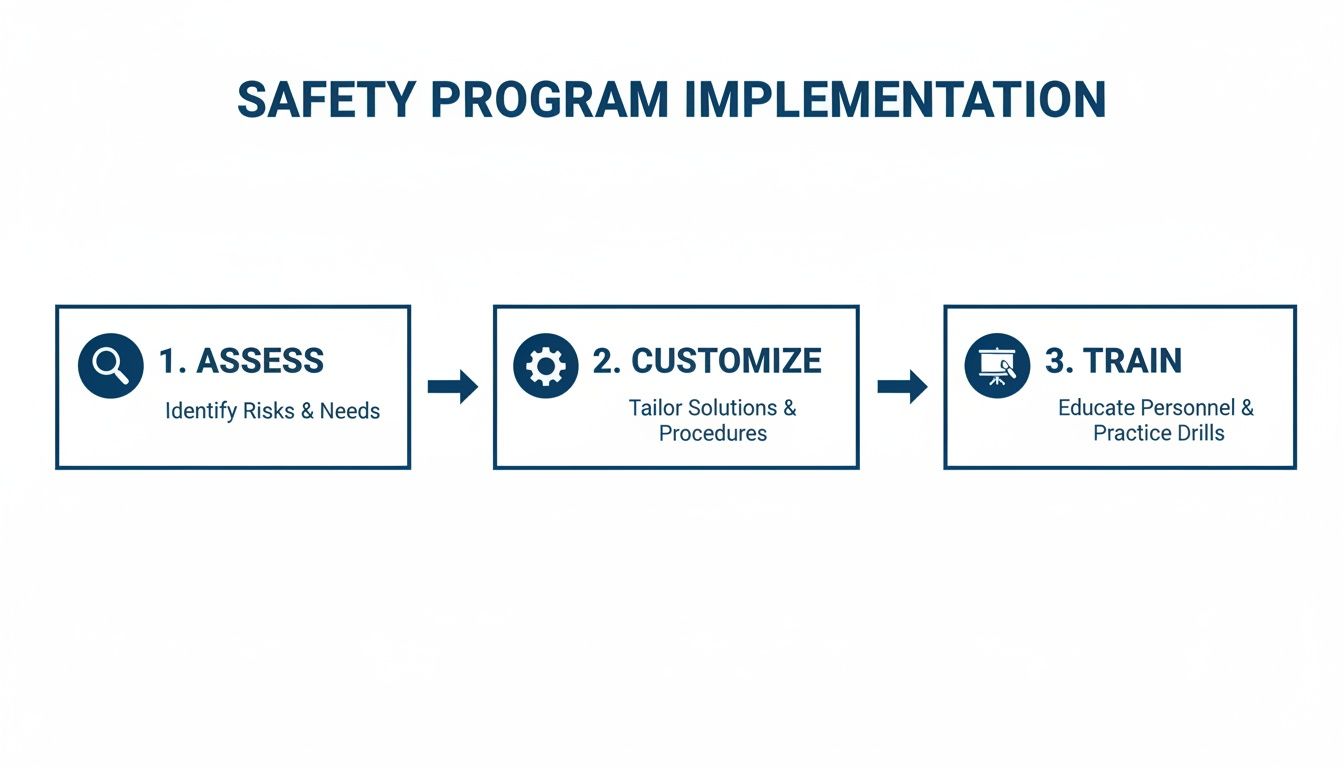
This flow shows that a successful program always starts with a deep understanding of your specific hazards. You have to know what you’re protecting people from before you ever create a single training slide.
Step 1: Assign a Safety Coordinator
Every program needs a champion—someone to own the process. For a small business, this doesn’t have to be a full-time safety manager with a fancy title. It can be a dedicated manager, an HR professional, or even a motivated employee who is given the time and authority to lead the charge.
This person becomes the go-to for all things safety. They’ll be responsible for scheduling training, keeping records, and spearheading hazard assessments. Giving one person clear ownership is critical; it prevents safety from becoming an abstract idea that nobody feels personally accountable for.
Step 2: Conduct a Thorough Hazard Assessment
Before you can train, you have to know what you’re training for. A job hazard assessment (JHA) is simply a formal process for identifying and evaluating the risks that come with each role in your company. This means watching tasks being done, talking to the people who do the work every day, and writing down potential dangers.
- Review past incidents: Look at any previous injuries or even near-misses. They often point to recurring problems you need to fix.
- Walk the floor: Get out there and look around. Regularly inspect the work environment for obvious hazards like blocked fire exits, unsafe machine operation, or simple tripping dangers.
- Involve your team: Your employees are the real experts on the ground. They know the hidden risks of their jobs better than anyone, so ask for their input.
This assessment becomes the foundation of your entire training curriculum. It ensures the content you develop is directly relevant to preventing the most likely incidents in your specific workplace.
Step 3: Develop or Source Your Curriculum
With your hazard assessment complete, it’s time to build your training content. The goal is to create materials that are specific, engaging, and easy for everyone to understand. You can either develop this content in-house or source it from a reputable provider.
Your curriculum should have clear learning objectives for each topic. For instance, after a session on ladder safety, an employee should be able to identify three common ladder hazards and demonstrate the proper three-point-of-contact climbing technique. This makes the training’s success measurable, not just a box to check.
Step 4: Schedule and Deliver the Training
Implementation is all about consistency. Your schedule should include training for new hires before they even start their first shift, annual refreshers for all staff, and special sessions whenever a new process or piece of equipment is introduced.
To keep people engaged, mix up your delivery methods. Combine classroom-style discussions with hands-on demonstrations and maybe some interactive online modules. Adults learn best when they’re actively involved, so try to limit long lectures and maximize participation.
Step 5: Establish Clear Record-Keeping Protocols
Meticulous documentation isn’t just a good idea—it’s non-negotiable. It serves as your proof of compliance for OSHA and is a vital tool for managing your program effectively. Your records should track who was trained, on what topics, when it happened, and how you verified they understood it.
A common mistake is treating documentation as an afterthought. From day one, implement a simple, organized system—whether it’s a shared spreadsheet or dedicated software—to log all training activities. This simple habit is your best defense during an audit and helps you easily see who might need a refresher.
Step 6: Measure, Review, and Improve
A safety program is a living system, not a one-and-done project. You must continuously measure its effectiveness to ensure it’s actually reducing risk. Tracking key metrics is the only way to gauge your progress.
- Leading Indicators: These are proactive measures. Think of things like the number of safety observations completed, employee participation in safety meetings, or the percentage of hazards corrected on time.
- Lagging Indicators: These are reactive measures that look backward, such as incident rates, the number of near-miss reports, and workers’ compensation claims data.
Regularly review these metrics with your team to celebrate what’s working and pinpoint areas for improvement. This constant feedback loop is what drives real, continuous improvement and helps you create a safety and health management system that truly protects your people and your business.
To help you stay organized, we’ve put together a simple checklist you can use to track your progress as you build out your program.
Safety Program Implementation Checklist
| Phase | Action Item | Status (To Do / In Progress / Complete) |
|---|---|---|
| Foundation | Assign a dedicated Safety Coordinator | |
| Define roles and responsibilities | ||
| Assessment | Conduct a job hazard assessment (JHA) for all roles | |
| Review past incident and near-miss reports | ||
| Solicit safety feedback from employees | ||
| Development | Develop or source training curriculum based on JHA findings | |
| Set clear, measurable learning objectives for each module | ||
| Choose a mix of training delivery methods | ||
| Implementation | Create a master training schedule (new hire, annual, etc.) | |
| Deliver initial training to all current employees | ||
| Implement a simple and consistent record-keeping system | ||
| Maintenance | Establish a process for regular program review | |
| Track leading and lagging safety indicators | ||
| Schedule annual refresher training for all staff |
This checklist isn’t exhaustive, but it provides a solid framework to ensure you cover all the essential bases. Following these steps methodically will help you launch a program that is both compliant and effective.
How a PEO Partner Simplifies Safety Management
Building and maintaining an effective workplace safety training program is a heavy lift, especially for a growing business. It’s easy to get bogged down in the details—conducting hazard assessments, creating training materials, and making sense of state-specific OSHA rules. This is exactly where a Professional Employer Organization (PEO) can make a huge difference.
A PEO like Helpside doesn’t just add another service to your plate; we provide a fully integrated safety and risk management system. Instead of juggling separate vendors for safety training, workers’ compensation insurance, and claims processing, you get a single, expert team that handles it all. It’s a connected approach designed to simplify your life and actively reduce your risk.
An Integrated Approach to Risk and Safety
For a small business, a single workplace incident can set off a chain reaction of administrative headaches. With a PEO, the entire life of a claim is managed under one roof. When an injury happens, your PEO partner steps in immediately to manage the claim, making sure all the right procedures are followed and the paperwork is handled correctly.
But the real value is how that information is used. Our safety experts use claims data to spot risk patterns in your business. This allows us to provide targeted workplace safety training programs that address your most pressing hazards. It becomes a proactive cycle where risk management, training, and claims administration all work together to create a safer environment and keep costs under control.
Partnering with a PEO transforms safety from a disjointed administrative chore into a cohesive, expertly managed function. You can offload the burden of compliance and risk management, freeing you up to concentrate on growing your business.
Gaining Scale and Expertise
One of the biggest perks of a PEO partnership is gaining access to resources that are usually out of reach for smaller companies. Because a PEO represents thousands of employees across hundreds of businesses, it has the scale to negotiate much better workers’ compensation insurance rates than a small business could ever get on its own.
You also get a dedicated team of safety and HR professionals in your corner. These experts are always tracking the complex web of federal and state regulations, including the specific requirements in states like Utah, Arizona, and Idaho. They bring the expertise needed to keep your safety program compliant and effective, acting as a single point of contact for all your safety, HR, and risk-related questions.
Ultimately, working with a PEO is a strategic move that delivers peace of mind. It ensures your safety management is not only compliant but also optimized to protect your employees and your bottom line, giving you the expert support you need to grow with confidence.
Common Questions About Safety Training
Figuring out the requirements and best practices for a workplace safety training program can bring up a lot of questions. Here are some clear, direct answers to the things we hear most often from business owners.
What Is the Most Important Part of a Safety Program?
Every piece of your safety program matters, but the single most critical factor is consistency. A program that you apply, review, and update consistently is far more effective than a perfect plan that only gets dusted off once in a while.
This means consistent training for everyone, from new hires to your most seasoned veterans. It also means enforcing safety rules fairly and having a reliable process for spotting and fixing new hazards as they pop up. Consistency is what turns a set of rules into a true safety culture.
How Much Should a Small Business Budget for Safety Training?
There’s no magic number here, since the cost really depends on your industry and its specific risks. The key is to focus on the return on investment (ROI), not just the upfront expense.
It’s been shown time and again that businesses see a return of $4 to $6 for every $1 invested in safety, mostly from preventing accidents and lowering insurance costs. The best approach is to figure out exactly what training you need first, then look for cost-effective ways to deliver it—like the integrated services a PEO can offer.
Can I Just Use Online Videos for OSHA Training?
Online videos and courses are great tools—they’re efficient and cover a lot of ground. But on their own, they often aren’t enough to meet OSHA’s requirements. Many standards demand that training be interactive, specific to your worksite, and give employees a chance to ask questions to a qualified person.
A blended approach is usually the most effective and compliant strategy. You can combine online courses for foundational knowledge with in-person, hands-on instruction for the tasks and hazards your team deals with every single day.
Workplace safety isn’t just about compliance, it’s about protecting your people and your bottom line. If you’re ready to build a safety program that reduces risk, lowers workers’ comp costs, and keeps you compliant across states, Helpside can help. Connect with our team to get started.
Call Helpside today for your Free 15-Minute Benefits Audit: 1-800-748-5102
Further Readings:
The Importance of Safety Orientations during Onboarding
Five Safety Training Topics for your Employee Training Program
Why Employee Safety Training is Important
Ready to build a safety program that protects your team and your bottom line—without all the administrative headaches? Helpside offers integrated safety training, workers’ compensation, and claims support to keep your business compliant and your costs predictable. Discover how our PEO services can simplify your safety management at helpside.com.