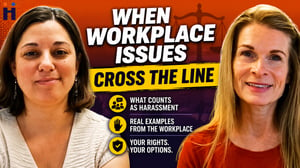
Most workplace situations that feel wrong don't start with bad intentions. They start with poor judgment, a misunderstanding, or someone thinking "this probably isn't that big of a deal" — until it is.
In this episode of It's Personnel, HR Manager Rachelle Beers and HR Business Partner Amanda Rojas tackle one of the most misunderstood topics in the workplace: harassment and discrimination. They break it down from two angles — what employees need to know, and what employers absolutely must get right.
Whether you're an employee wondering if you should say something, or an employer hoping you're probably fine — this episode is for you.
🎧 Listen to the Episode
▶ Watch on YouTube
What Actually Counts as Harassment — and What Doesn't
Most people's mental image of workplace harassment skips straight to extremes — either something totally benign or something egregious. The reality is far more nuanced, and that's exactly where confusion (and risk) lives.
Harassment is any unwelcome behavior tied to or motivated by a person's legally protected characteristics — race, gender, religion, age, disability, military status, pregnancy, and others. Discrimination occurs when those characteristics become the basis for employment decisions: who gets hired, promoted, or paid fairly.
The key, as Rachelle explains, is that protected characteristics must actually be the basis of what happened for it to cross the legal line. That distinction matters enormously when it comes to what kind of response you can expect from your employer — and what they're legally obligated to do.
"Protected classes or protected characteristics must be the basis of an action for true harassment or discrimination to have taken place."
— Rachelle Beers, HR Manager
The "Equal Opportunity Jerk" — Why a Bad Manager Isn't Always Breaking the Law
One of the most clarifying ideas in this episode is what Rachelle and Amanda call the equal opportunity jerk. Picture a manager who yells at everyone, calls people names, and makes the whole team miserable — but does it uniformly, without targeting anyone based on race, gender, age, or other protected characteristics.
That behavior is awful and almost certainly violates company policy. But it might not constitute illegal harassment.
Now change one variable: that same manager specifically targets employees of a particular protected class — yells at them more, passes them over for promotions, makes their work environment hostile while treating others normally. Now you have a much bigger problem. That's a potential legal violation, and the employer must take immediate action.
Policy / Culture Violation
Manager treats everyone badly — equal-opportunity bad behavior. Terrible culture, but may not be illegal harassment.
Potential Legal Violation
Manager targets individuals based on protected characteristics. Employer must act immediately.
Am I Overreacting? How to Use the Reasonable Person Standard
This is the question HR hears most often — usually followed by "it wasn't that bad" or "I don't want to make it a bigger deal than it is." Rachelle and Amanda offer a straightforward way to work through it.
Write it down. Put the facts on paper. When you see it in black and white, it's easier to ask: would a reasonable person in my position find this behavior offensive, threatening, or hostile? That's the "reasonable person standard" — the lens HR and courts use to evaluate these situations.
One odd comment may be easy to brush off, and usually it is. But patterns of behavior — especially after you've asked someone to stop — are a different matter entirely.
The hosts use two contrasting scenarios to bring this to life:
Scenario A — The Intimidating Coworker
A large, quiet coworker makes you nervous simply by his presence. He hasn't said or done anything wrong. That discomfort is real — but it may not be reasonable to expect your employer to restructure schedules or shifts over it, because there's no actual behavior to address.
Scenario B — The Hugger / Jump-Scarer
A coworker keeps hugging you despite your discomfort, or sneaks up behind you to scare you repeatedly. This person has full control over that behavior. You have every right to ask them to stop — and if they don't, to escalate it. Their intent doesn't override your experience.
"The impact is what matters — not the intent. Someone saying 'I was just joking' doesn't undo the impact their behavior had."
— Amanda Rojas, HR Business Partner
What to Do When Something Happens: The STOP Method
If you feel safe enough to address the behavior directly, that's almost always the best first step. Rachelle and Amanda walk through a practical framework called the STOP method:
State the behavior
Be specific about what you find offensive or uncomfortable.
Tell them the impact
Explain how it affects you — or others around you.
Offer a replacement behavior
Suggest an alternative. ("Let's high-five instead of hug.")
Preview consequences
Make clear what you'll do if the behavior doesn't stop.
If you don't feel safe addressing it directly — or the behavior escalates into a pattern — go up the chain. Follow your company's complaint process and document everything: dates, times, witnesses, emails, messages. Don't delete anything. That paper trail is your protection.
And remember: you don't have to be the direct target to say something. Bystanders have every right — and arguably a responsibility — to report behavior that violates policy or culture, as long as they do so in good faith, through proper channels, with the intent to actually resolve the issue.
Retaliation: What It Is — and What It Isn't
Fear of retaliation is the number one reason employees delay reporting — or never report at all. That fear is understandable. But understanding the legal definition of retaliation can make a real difference.
Retaliation IS
- Demoting or transferring someone to a worse role after they file a complaint
- Increased harassment after the accused learns who filed
- Any adverse employment action taken because of the complaint
Retaliation IS NOT
- Holding an employee accountable for pre-existing performance issues
- Disciplining an employee for policy violations that predate the complaint
- Normal performance management that was already underway
"Even if you're dealing with something really difficult at work, your behavior still needs to be in line with company policies. That way, the focus stays where it needs to — on your complaint."
— Rachelle Beers, HR Manager
Filing a good-faith complaint is your legal right and is protected. But it doesn't create a performance immunity shield. Maintain your professionalism throughout, keep documenting, and let the complaint process do its job.
What Employers Must Get Right
The second half of the conversation shifts to the employer side — and the stakes are just as high.
The moment a complaint is filed, the clock starts. Doing nothing is never an option — legally or culturally. Employers are required to investigate promptly, thoroughly, and impartially. Every step of that process needs to be documented.
Consistency is everything. Employment decisions — discipline, promotions, performance management — need to be applied evenly across your workforce. When they aren't, even legitimate decisions can look retaliatory, and that's a liability you don't want.
Employer Obligations When a Complaint Is Filed
- Investigate immediately — delay signals indifference and increases legal exposure
- Take steps to stop the harassing behavior while the investigation is active
- Document the complaint, the investigation process, and the outcome
- Apply policies and discipline consistently across all employees
- Never take adverse action against an employee for filing a good-faith complaint — that's illegal retaliation
- Build a culture where the baseline is respect — not just legal compliance
That last point is worth pausing on. Rachelle puts it plainly: if all you're trying to do is avoid the legal line, that is an extremely low bar. The goal should be a workplace where people feel genuinely safe, where problems get addressed before they become complaints, and where culture comes from real leadership — not HR policy minimums.
Common Misconceptions — Cleared Up
Amanda wraps the episode with a reality check on the ideas she encounters most often:
"Everything uncomfortable is illegal harassment."
It isn't. There's a wide gray zone between a perfectly safe workplace and illegal harassment, and a lot of real-life situations fall squarely in it. Evaluate using the reasonable person standard before deciding how to proceed.
"If it's not illegal, it's acceptable."
Also wrong. Not illegal doesn't mean it's okay. Employers and employees should be aiming for a culture that rises well above what the law technically requires.
"Filing a complaint protects me from everything."
It protects you from retaliation. It doesn't shield you from pre-existing accountability. Keep your performance and professionalism solid throughout the process.
"Culture is leadership's job, not mine."
Culture does flow from the top — but without employees willing to do the right thing, speak up, and engage honestly, it can fall apart quickly. Everyone has a role.
The Bottom Line
Most workplace problems don't start with bad intentions. They start with someone not knowing where the line is — or being too uncomfortable to say anything. Understanding the difference between a policy violation and a legal one, knowing how to evaluate your own situation, and acting in good faith can make all the difference.
For employees: you have more rights than you realize, and speaking up protects more than just yourself. For employers: the standard isn't avoiding the legal minimum. It's building something better.
It's Personnel is a podcast hosted by HR Manager Rachelle Beers and HR Business Partner Amanda Rojas, exploring the real issues shaping today's workplaces. New episodes available on Spotify and YouTube. Subscribe so you never miss one.