When you’re weighing a PEO vs. ASO, the most important difference comes down to a single concept: co-employment. A Professional Employer Organization (PEO) enters into a formal co-employment relationship with your business. An Administrative Services Organization (ASO), on the other hand, acts strictly as a third-party vendor you hire for specific HR tasks.
That one distinction changes just about everything—from how employment liabilities are shared to the caliber of benefits you can offer and how the service is priced.
Understanding The Core HR Models
Choosing an HR outsourcing partner is a major decision. It directly impacts your company’s risk, day-to-day efficiency, and your power to attract and keep great people. The lines between a PEO and an ASO can seem blurry at first because they often offer similar services, like payroll processing. But the way they deliver those services couldn’t be more different.
Think of a PEO as a comprehensive HR partner. Through the co-employment model, the PEO becomes the employer of record for payroll tax and insurance purposes. This means it files payroll taxes under its own Employer Identification Number (EIN), not yours. This structure allows the PEO to share and assume a significant portion of employment-related liabilities.
An ASO, in contrast, is more like an à la carte HR service. Your company remains the sole employer of record and retains all the legal responsibilities that come with it. The ASO is simply an administrator, processing transactions or offering advice under your company’s EIN while you retain 100% of the employer liability.
PEO vs. ASO At a Glance
To make the practical differences crystal clear, let’s look at how each model handles key business functions. This side-by-side view cuts through the noise. And if you want to dive even deeper into the PEO relationship, check out our guide on what is a PEO.
Core Differences Between PEO and ASO Models
This table provides a quick, high-level summary of the core differences between the PEO and ASO models.
| Feature | Professional Employer Organization (PEO) | Administrative Services Organization (ASO) |
|---|---|---|
| Employment Model | Co-employment; PEO is employer of record for specific purposes. | No co-employment; you remain the sole employer of record. |
| Liability & Risk | Employer liability is shared, with PEO assuming significant risk. | All employer liability and risk remain with your company. |
| Employee Benefits | Access to PEO’s large-group health and retirement plans. | Administers the benefit plans that you secure on your own. |
| Workers’ Comp | Provided and managed by the PEO under its master policy. | You must secure and manage your own policy. |
| Tax Filing | Payroll taxes are filed under the PEO’s EIN. | Payroll taxes are filed under your company’s EIN. |
As you can see, the co-employment relationship is the engine driving all the other differences. It’s what allows a PEO to share risk and offer Fortune 500-level benefits, while an ASO operates more like a traditional service provider.
How Co-Employment Defines Your HR Partnership
The entire PEO vs. ASO conversation really comes down to a single, powerful concept: co-employment. This isn’t just an industry buzzword; it’s a formal legal and contractual arrangement that changes the fundamental relationship between your business, your employees, and your HR partner. Getting a handle on this model is the first and most important step in deciding which path is right for you.
With a Professional Employer Organization (PEO), you enter into a co-employment relationship. The PEO becomes the employer of record for your team, but only for specific administrative purposes like payroll taxes and employee benefits. This means they handle things like payroll tax filings under their own Employer Identification Number (EIN), not yours. This shift in structure is precisely what allows a PEO to take on a huge chunk of your employment-related administrative burdens and share certain liabilities.
An Administrative Services Organization (ASO) works from a completely different playbook. There is no co-employment. Your business is—and always remains—the sole employer of record. You keep 100% of the employer liability and the final say on everything from tax filings under your EIN to managing workers’ compensation claims.
The Impact on Liability and Risk
The co-employment model directly changes your company’s risk profile. When a PEO contractually shares certain legal roles of an employer, it also shares the burdens that come with them. This includes navigating workers’ compensation claims under its own master policy and keeping up with the tangled web of state and federal employment laws, which can vary significantly from one state to another.
For instance, if an employee gets hurt on the job and files a workers’ compensation claim, the PEO manages the entire process. They handle the paperwork, deal with the insurance carriers, and even help implement safety programs to prevent it from happening again. The financial and administrative weight of that claim hits the PEO’s policy, shielding your business from the kinds of premium spikes that can cripple a small company.
With an ASO, your business bears the full weight of compliance and liability. The ASO can provide guidance and software, but the ultimate responsibility—and the consequences of any errors—rests squarely on your shoulders.
A Real-World Scenario: Multi-State Payroll
Let’s make this practical. Imagine you hire your first remote employee in California, opening up a whole new world of tax and labor law headaches. State employment laws are complex and vary widely.
-
With a PEO: The PEO is typically already registered to do business in California. They have the necessary tax registrations and legal framework in place. They’ll correctly calculate and withhold state and local taxes, manage state unemployment insurance (SUI) filings under their own accounts, and help ensure your new hire is paid in compliance with California’s strict wage and hour rules. Your administrative lift is minimal.
-
With an ASO: The ASO’s software might help with the tax calculations, but your business is responsible for compliance. You have to register your business in the new state, get a new SUI number, set up state withholding accounts, and make sure you’re following every single detail of that state’s labor laws. If you slip up, the penalties are all yours.
This single example gets to the heart of the matter. A PEO takes on the actual administrative and compliance work. An ASO gives you the tools to do the work yourself. That distinction shapes everything from your legal exposure to how much time your team spends on HR paperwork instead of growing the business.
Analyzing the True Cost of PEO vs ASO Services
When you’re weighing a PEO against an ASO, the initial price tag only tells you a small part of the story. To really understand the financial impact, you have to look beyond the monthly admin fee and see the complete cost picture. Let’s break down how each model is priced and where the hidden expenses really are.
A Professional Employer Organization (PEO) generally uses one of two pricing models. The first is based on a percentage of total payroll, which typically falls between 2% to 8%. The second is a straightforward per-employee-per-month (PEPM) fee. Both bundle most of your HR services into a single, predictable cost.
An Administrative Services Organization (ASO) also uses a PEPM model, but its initial quote often looks much lower. Don’t let that fool you. That lower cost is a reflection of its à la carte nature—you’re hiring a vendor for specific tasks, not a comprehensive HR partner.
PEO Pricing: The Bundled Value Proposition
The key to PEO pricing is seeing everything that’s included in that one fee. It’s not just for payroll. That single cost typically covers payroll administration, federal and state tax compliance, State Unemployment Insurance (SUI) management, and access to an entire team of HR and legal experts.
But here’s the most critical part: it also includes access to the PEO’s master workers’ compensation policy and its large-group health benefits. By pooling thousands of employees from all its client companies, a PEO can get enterprise-level benefits at rates that most small businesses could never qualify for on their own. This bundled value is huge and often gets overlooked in a simple price comparison.
A common mistake is comparing a PEO’s all-inclusive fee directly against an ASO’s admin-only fee. The real comparison must account for the total cost of all your HR functions, including the benefits and insurance premiums you’d have to buy separately.
ASO Pricing: The True Cost of À La Carte
An ASO’s lower PEPM fee looks tempting, but it’s just the starting point. That fee usually covers basic payroll processing and some HR software. Everything else is on you. Your business is responsible for finding, negotiating, and paying for its own workers’ compensation policy and health insurance plans on the open market.
This is where the costs can quickly climb past a PEO. Data shows that ASOs often cost $50-$250 PEPM for just the administrative tasks, which seems like a bargain. But because small businesses can’t get the same leverage as a large group, they typically pay 15-25% more for health plans. In contrast, PEO clients tap into those large-group rates, often seeing their premiums drop by 20% while saving a ton of administrative time. To dive deeper into this, you can learn more about the hidden costs and true value of a PEO.
Sample Annual Cost Analysis PEO vs ASO (50 Employees)
To make this crystal clear, let’s run the numbers for a hypothetical 50-employee company. This scenario shows how an ASO’s lower admin fee can end up costing you a lot more annually once you add in all the other necessary vendor costs.
| Cost Item | PEO (All-Inclusive) | ASO + Separate Vendors |
|---|---|---|
| HR/Payroll Admin Fee | $72,000 | $36,000 |
| Health Insurance Premiums | $450,000 | $562,500 (25% higher) |
| Workers’ Comp Premium | $30,000 | $37,500 (25% higher) |
| HR Tech/Compliance Tools | Included | $5,000 |
| Total Annual Cost | $552,000 | $641,000 |
Note: Figures are estimates for illustrative purposes. Actual costs vary by state, industry, and provider.
In this example, the PEO model could deliver $89,000 in annual savings. The difference comes almost entirely from the PEO’s scale and its ability to secure better rates on benefits and insurance. It’s a powerful reminder of why you have to look at the whole picture, not just the sticker price.
Comparing Benefits and Workers Compensation Management
For most small and growing businesses, offering competitive benefits and managing workers’ compensation are two of the biggest hurdles. The way a PEO versus an ASO handles these critical functions is often the deciding factor for business owners. The difference isn’t just about paperwork; it directly impacts your ability to attract top talent, control costs, and protect your company.
The power of a Professional Employer Organization (PEO) comes from its co-employment model. By becoming the employer of record for thousands of employees across all its client companies, a PEO creates a massive employee pool. This scale gives it the buying power of a Fortune 500 company when it’s time to negotiate for health, dental, vision, and retirement plans.
For a small business, this is a game-changer. Instead of shopping for benefits on the small-group market where options are limited and premiums are high, you get access to top-tier plans at significantly lower costs. This isn’t just a perk; it’s a strategic advantage in the war for talent.
The PEO Advantage in Health and Retirement Benefits
An Administrative Services Organization (ASO) operates very differently. It provides the software and administrative support to manage the benefits you find and secure on your own. Your company remains a small fish in a big pond, stuck with the higher premiums and less robust plan designs typical of the small-group market.
A PEO doesn’t just administer benefits; it provides them. By aggregating thousands of worksite employees, PEOs unlock enterprise-level health, dental, and retirement options at reduced rates—a benefit that businesses consistently report as a primary reason for partnership.
This pooling effect is a well-documented driver of success. The PEO industry serves over 4 million worksite employees nationwide, enabling its members to offer Fortune 500-caliber benefits. Businesses that partner with a PEO grow faster, have lower employee turnover, and are significantly less likely to go out of business.
Navigating Workers Compensation Insurance
The same logic applies to workers’ compensation. This legally required insurance protects your business and employees from workplace accidents, but managing it can be complex and expensive—especially in high-risk industries. State laws vary dramatically, and a single large claim can cause your premiums to skyrocket for years.
A PEO fundamentally changes your relationship with workers’ comp by providing coverage for your employees under its own master insurance policy. This offers several key advantages:
-
No Down Payment: PEOs often eliminate the need for a large upfront deposit on a new policy.
-
Pay-As-You-Go Premiums: Your premium is calculated and paid with each payroll run, which is great for cash flow.
-
Claims Management: The PEO’s risk management experts handle the entire claims process, from the initial filing to return-to-work programs.
-
Safety Programs: PEOs provide proactive safety training and resources to help prevent accidents before they happen.
This comprehensive approach leads to more stable, predictable premiums. If you want to better understand what influences your costs, check out our guide on how to calculate workers comp premiums and how to save.
An ASO, on the other hand, simply administers the policy you already have. You are responsible for securing coverage, managing claims, and bearing the full financial impact of any incidents. While the ASO can process payroll deductions for your premiums, the risk, liability, and administrative burden remain entirely yours. This highlights the core difference in the PEO vs. ASO debate: one is a partner that shares risk, while the other is a vendor that processes tasks.
Which HR Model Aligns with Your Business Goals?
Deciding between a Professional Employer Organization (PEO) and an Administrative Services Organization (ASO) really comes down to one question: What does your business actually need to grow? The right HR partner isn’t just another vendor—it’s a strategic choice that can either fuel your momentum or bog you down in administrative headaches. Your company’s size, industry, and long-term goals will ultimately point you in the right direction.
The decision often hinges on your priorities. This flowchart is a great place to start when you’re weighing the PEO vs ASO options.
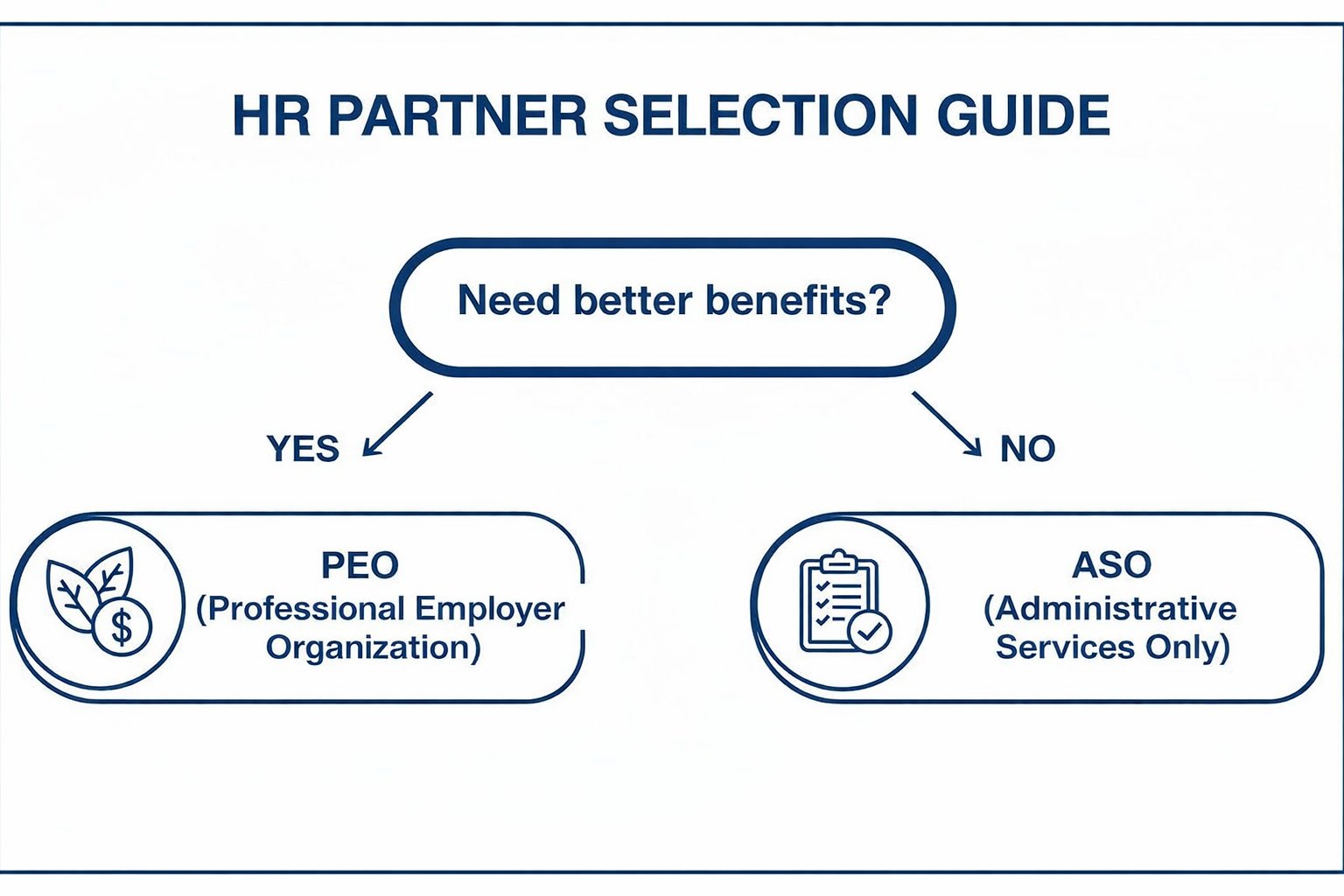
As you can see, the need for competitive benefits is one of the biggest factors that steers growing businesses toward a PEO.
The Ideal PEO Client Profile
A PEO is typically the perfect fit for small and mid-sized businesses, usually with 10 to 150 employees, that are hitting very specific growing pains. These are companies at a tipping point, where handling HR internally has gone from challenging to unsustainable.
You should seriously consider a PEO if your business:
-
Needs to attract and retain top talent. To compete with bigger companies, you have to offer enterprise-level health benefits, retirement plans, and other perks. A PEO gives you access to these plans at costs you could never get on your own.
-
Is expanding across state lines. Navigating multi-state compliance is a minefield of different tax laws, wage regulations, and leave policies. PEOs are already registered in those states and manage all that complexity for you.
-
Wants to offload administrative burdens. If your leadership team is sinking too much time into payroll, compliance paperwork, and HR fires, a PEO takes those tasks completely off your plate so you can focus on running the business.
A PEO’s real value is its ability to share risk and absorb administrative complexity. By becoming the employer of record for specific purposes, a PEO shields your business from many of the compliance burdens that can distract a growing company.
The Best-Fit Scenarios for an ASO
An ASO model, on the other hand, works best for companies at either end of the spectrum. These organizations either already have the internal resources to manage key HR functions or have very minimal needs to begin with.
An ASO is a better fit for:
-
Larger companies with established HR teams. If you have a skilled internal HR department but just want to outsource a specific, time-consuming task like payroll processing, an ASO gives you the tools you need without the comprehensive partnership of a PEO.
-
Very small businesses with simple needs. A startup with a handful of local employees and no immediate plans to offer complex benefits might find an ASO’s à la carte services are enough for basic payroll.
A Decision-Making Checklist
To make a confident choice, sit down with your team and ask these critical questions. Your answers will make it clear whether the shared-liability model of a PEO or the task-based approach of an ASO is a better match for your strategic vision.
-
How much compliance risk are we truly prepared to own and manage internally?
-
Is offering competitive benefits a core part of our strategy to hire and keep the best people?
-
Do we have the in-house expertise to handle multi-state employment laws as we expand?
-
Is our main goal to offload administrative tasks, or do we just need better payroll software?
Ultimately, the choice in the PEO vs ASO debate comes down to whether you need a service provider to handle tasks or a strategic partner to manage risk and enable growth.
Frequently Asked Questions About PEOs and ASOs
When you start digging into the details of a PEO vs ASO, a few key questions almost always come up. As you weigh which HR partnership makes the most sense for your business, getting clear answers is the first step toward making a confident decision. Here are our answers to some of the most common questions we hear from business owners.
Do I Lose Control of My Employees with a PEO?
This is probably the biggest myth we run into, but the answer is a firm no. Even though a Professional Employer Organization (PEO) becomes the employer of record for administrative purposes, you retain full control over your business operations and your team.
You’re still the one calling all the shots. You direct day-to-day operations and make every critical decision, including:
-
Hiring and firing employees
-
Setting pay and managing performance
-
Defining and shaping your company culture
-
Guiding your overall business strategy
The PEO’s job is to handle the backend HR—payroll, benefits, and compliance. This frees you up to lead your team without getting tangled in paperwork.
Is It Difficult to Switch from an ASO to a PEO?
Not at all. In fact, it’s a natural and very common step for a growing business. The switch from an Administrative Services Organization (ASO) to a PEO is usually a smooth one, and it’s typically triggered by specific growth milestones.
Companies usually make the change when they hit challenges the ASO model can’t quite solve anymore. This often happens when a business needs to offer more competitive benefits to attract talent, starts expanding into states with complex labor laws, or faces compliance issues that demand a higher level of expertise and shared risk.
The move from an ASO to a PEO isn’t a sign of a bad initial choice. Instead, it’s a strategic step that reflects a company’s success and its evolving need for a more comprehensive HR and compliance partner.
Is a PEO More Expensive Than an In-House HR Manager?
When you’re comparing costs, it’s easy to get stuck on salary figures—but that doesn’t tell the whole story. With a PEO, you get access to an entire team of certified specialists in payroll, benefits, risk management, and employment law. The bundled cost for all of that expertise is often significantly less than the salary and benefits package for a single, experienced HR manager.
Beyond the cost, a PEO brings a depth of knowledge and risk mitigation that one person can rarely match. You get a full bench of experts ready to handle everything from tricky multi-state compliance to workers’ compensation claims, giving you a much stronger support system that protects your business. That shared liability and expertise is a major differentiator in the PEO vs ASO conversation.
How Helpside Delivers the PEO Advantage
Understanding the nuts and bolts of the PEO model is one thing. Seeing how the right partner turns those concepts into real-world results for your business is another. When you’re weighing PEO vs ASO options, the provider’s experience and regional expertise can make all the difference—and this is where Helpside really stands apart.
For over 35+ years, we’ve been the strategic HR partner for more than 800 businesses, primarily here in the Intermountain West. Our deep roots mean we get the specific compliance hurdles and talent markets that companies in Utah, Arizona, Wyoming, and Idaho face every single day. We built our PEO services to address these local needs head-on.
A People-First Approach—No Ticket Queues
We just don’t believe that when you have a critical HR question, you should have to submit a ticket and wait. Our people-first approach is simple: you get direct access to a dedicated team of experts who know your business. No call centers. No generic email queues.
This direct relationship is crucial. When you partner with us, you’re not just buying a service; you’re gaining an extension of your own team. Your dedicated HR consultant and payroll specialist are just a phone call or email away, ready to provide the specific, actionable guidance you need to make confident decisions.
At Helpside, our goal is to empower business owners, finance leaders, and HR managers to stop worrying about compliance and start focusing on growth. We achieve this by taking on the full weight of HR administration with a personal, responsive touch.
Differentiators That Drive Growth
Our commitment to our clients goes beyond just excellent service. We’ve structured our entire PEO model to be transparent, flexible, and genuinely valuable. We don’t believe in locking clients into long-term contracts, which is why we offer flexible terms that grow right alongside your business.
We also have transparent pricing, so you know exactly what you’re paying for without any hidden fees. Plus, we’re proudly broker-friendly, working alongside your trusted benefits advisor to ensure you have the best possible solutions. It’s a collaborative approach that really sets us apart.
Ultimately, our comprehensive management of HR, payroll, benefits, and risk provides the peace of mind needed to scale. For businesses with 20-150 employees facing the challenges of attracting talent, managing multi-state compliance, or controlling costs, Helpside delivers the true PEO advantage. We handle the complexities so you can focus on what you do best—building your business.
Ready to stop juggling vendors and start focusing on growth? Helpside provides the expert support and Fortune 500-level benefits you need to succeed. Schedule a discovery call to learn how we can help your business thrive. Visit us at https://helpside.com.