
At its core, the difference is simple. A payroll service is a specialized vendor you hire to handle paychecks and file payroll taxes. A Professional Employer Organization (PEO), on the other hand, is a full-fledged HR partner that legally shares employer responsibilities with your business through a formal co-employment relationship.
It’s like the difference between hiring someone to just mow your lawn versus partnering with a comprehensive landscaping firm that manages the lawn, garden, sprinklers, and seasonal care.
Defining the Core Difference: PEO vs. Payroll Service
Deciding between a PEO and a payroll service is a pivotal choice that shapes your company’s risk, operational load, and even its potential for growth. While both get your employees paid, their service models, scope, and legal foundations are worlds apart. Nailing down this distinction is the first step to making the right call.
A payroll service is a straightforward vendor relationship. You provide them with employee hours and wage details, and they handle the calculations, tax withholdings, and payments. That’s where their involvement ends. Your business remains the sole employer, retaining 100% of the liability for everything else—HR compliance, benefits administration, workers’ compensation, and employment law adherence.
A PEO works under a completely different framework: co-employment. Through this legal agreement, the PEO becomes the “employer of record” for tax and, in many cases, compliance purposes. This means they formally share and take on a significant portion of the employment-related risks, integrating a complete HR infrastructure into your business that goes far beyond just cutting checks.
Key Takeaway: A payroll service performs a task for you. A PEO becomes a co-employer, sharing legal responsibilities and managing your entire HR function from top to bottom.
Key Differences at a Glance
This table gives you a quick, high-level snapshot of how these two models stack up. Think of it as a starting point. As we dig deeper in the next sections, these core differences will really come into focus.
For a more detailed breakdown, you can learn more about the differences between a PEO and a payroll company right here on our blog.
| Attribute | Payroll Service | Professional Employer Organization (PEO) |
|---|---|---|
| Employment Model | You are the sole employer. | Co-employment model; PEO shares specific employer liabilities. |
| Primary Function | Transactional payroll & tax filing. | Strategic, comprehensive HR outsourcing partner. |
| Scope of Services | Narrow: wage calculation, tax processing. | Broad: payroll, HR, benefits, risk management, compliance. |
| Liability | Your business retains all employment liability. | PEO contractually assumes and shares key employer risks. |
As you can see, one is a transaction, and the other is a partnership. Understanding which one fits your business depends on where you are now and where you plan to go.
Comparing the Scope of Services
When you’re weighing a PEO vs. a payroll service, the biggest question comes down to scope. While both make sure your team gets paid correctly and on time, their roles in your business couldn’t be more different. One is a specific tool you use for a single task; the other is a comprehensive partner that integrates into your operations.
A payroll service is built to execute one precise, transactional function. Its scope is intentionally narrow, focusing only on the mechanics of paying your people. This laser focus is both its main strength and its key limitation.
What Payroll Services Handle
A standard payroll provider’s duties are straightforward and strictly limited to the payroll cycle. Think of them as a highly specialized calculator and payment processor for your company.
Their core tasks usually cover:
- Wage Calculation: Accurately figuring gross pay from hours, salaries, overtime, and commissions based on data you provide.
- Tax Withholding and Filing: Deducting federal, state, and local taxes from paychecks and remitting them to the appropriate agencies.
- Payment Processing: Distributing funds to employees through direct deposit or paper checks.
- Basic Reporting: Generating standard payroll registers and tax reports for your records.
Basically, you feed them the data, and their system processes it. The strategic HR work, benefits management, and compliance oversight are all still on your plate. You can get a closer look at their functions in our guide on how payroll companies work.
The Integrated PEO Partnership
A Professional Employer Organization (PEO), on the other hand, offers a comprehensive suite of services that covers the entire employee lifecycle. Payroll is just one piece of a much bigger partnership designed to manage your whole HR infrastructure.
A PEO’s scope goes far beyond just cutting checks. It takes on the operational weight of a full-fledged HR department, which allows your leadership to offload administrative headaches and focus on growing the business.
The Critical Distinction: A payroll service is a vendor that processes transactions. A PEO becomes a co-employer that manages your entire HR function, sharing risk and offering strategic guidance on your most important asset—your people.
This partnership model delivers real, measurable results. Research from the National Association of Professional Employer Organizations (NAPEO) shows that businesses partnering with a PEO are 50% less likely to go out of business and experience 7-9% faster growth than other similar small businesses. It really highlights the value of having a holistic HR strategy in place.
A Side-by-Side Scope Comparison
To see the difference clearly, let’s break down what each solution typically offers in key HR areas. The table below shows the functional gap between a transactional service and a strategic partnership.
| HR Function | Payroll Service Scope | PEO Scope |
|---|---|---|
| Payroll & Taxes | ✅ Core function | ✅ Full payroll, tax, and W-2 management |
| Employee Benefits | ❌ Not included | ✅ Access to and administration of Fortune 500-level health, dental, vision, and 401(k) plans |
| Workers’ Comp | ❌ Not included | ✅ Policy management, claims administration, and safety program support |
| HR Compliance | ❌ No support | ✅ Guidance on federal, state, and local employment laws; handbook development; and risk mitigation |
| HR Support | ❌ No support | ✅ Access to certified HR professionals for strategic advice and employee relations issues |
The difference is stark. A payroll service handles one critical task efficiently. A PEO provides the entire framework for managing your team, reducing risk, and offering the kind of competitive benefits that attract and keep top talent.
Analyzing the True Cost and ROI
It’s easy to get fixated on the sticker price when comparing a PEO to a payroll service. But while one might seem cheaper on the surface, the total financial impact—the true ROI—often tells a very different story. It’s not just about what you pay; it’s about what you get back in efficiency, risk reduction, and strategic focus.
Payroll service pricing is usually straightforward. Most providers charge a simple base fee plus a small per-employee fee for each payroll run. This model is predictable and works well for businesses that just need a transactional service to cut checks.
PEOs, on the other hand, typically use one of two models: a percentage of total payroll or a flat per-employee-per-month (PEPM) fee. This number will almost always look higher at first glance, but that’s because it bundles an entire HR infrastructure into one cost. That bundled value is where the real savings start to show up.
The Hidden Costs of an In-House Approach
Comparing a PEO’s fee directly to a payroll service subscription is like comparing apples to oranges. To get a real sense of the costs, you have to account for all the hidden expenses of managing HR in-house—the very things a simple payroll service leaves for you to handle. And those costs add up fast.
Think about what it takes to hire an internal HR manager to do what a PEO does. The financial case for a PEO becomes crystal clear for growing businesses. According to the Bureau of Labor Statistics, the median HR manager salary in May 2024 was $140,030. Once you factor in payroll taxes, unemployment insurance, workers’ comp, health benefits, and retirement contributions, the total cost for that single hire can easily exceed $170,000 annually.
In contrast, PEO pricing is often a fraction of that cost, typically averaging around $1,395 per employee annually, depending on the scope of services. The math speaks for itself.
Beyond salary, there are other significant costs to consider:
- Leadership Time: How many hours are your CEO, COO, or other key leaders spending on administrative HR tasks instead of growing the business? Their time has a real dollar value.
- Compliance Penalties: One slip-up with employment law can trigger fines and legal fees that easily dwarf the annual cost of a PEO.
- Benefits Premiums: Small businesses almost always pay more for health insurance. A major factor in the PEO vs. payroll decision is managing small business health insurance costs, which PEOs are uniquely positioned to help lower.
ROI in Focus: The true cost of a payroll service is its subscription fee plus the salary, time, and risk you absorb by managing everything else yourself. The value of a PEO is measured in hard cost savings, mitigated risk, and reclaimed time.
How a PEO Delivers Tangible ROI
It helps to think of a PEO as a strategic investment, not just another line-item expense. The return on that investment comes from several key areas that a payroll service simply can’t touch.
First, PEOs give you access to Fortune 500-level benefits at small business prices. By pooling employees from all their clients, they create massive buying power. This allows you to offer competitive health, dental, vision, and 401(k) plans that help you attract and keep great people—a direct contributor to your bottom line.
Second, a PEO actively reduces your risk. Through the co-employment model, they share liability and work to keep you compliant with the tangled web of federal, state, and local labor laws, which vary significantly from one jurisdiction to the next. This protection from costly fines and lawsuits is a huge, often underestimated, part of a PEO’s value. To see how this breaks down, check out our guide on the real cost of PEO services.
Finally, the operational lift is immense. When you offload time-draining HR administration, your leadership team gets to focus 100% on core business functions like product innovation, sales, and client relationships. This reclaimed time is one of the most significant drivers of growth and profitability.
Understanding Liability and Compliance Risk

Beyond features and cost, the biggest difference between a PEO and a payroll service comes down to risk. For any growing business, navigating the maze of employment law is a high-stakes game. One mistake can trigger audits, fines, or even lawsuits.
How liability is handled isn’t just a minor detail—it’s a core part of your business’s defense strategy. This is where the two models diverge completely.
The Payroll Service Liability Model
When you work with a payroll service, the relationship is transactional. You send them employee data—hours, wages, new hire details—and they process it. They make sure payroll taxes are calculated and filed based on the information you provide.
But that’s where their responsibility ends. Your business remains the sole employer and holds 100% of the liability for everything else. This includes wage and hour laws, proper employee classification, lawful hiring and firing practices, and workplace safety.
You’re on your own for HR compliance. If you misclassify a worker as an independent contractor or miss a state-specific meal break law, the payroll service has no obligation to catch it. The consequences fall squarely on your shoulders.
Your company is solely responsible for:
- Wage and Hour Laws: Following the Fair Labor Standards Act (FLSA) and complex state/local rules on minimum wage, overtime, and breaks.
- Employee Classification: Correctly identifying workers as employees versus contractors to avoid major tax penalties.
- Termination and Hiring Practices: Using legally sound procedures for hiring, discipline, and termination to prevent wrongful termination claims.
- Workplace Safety: Meeting OSHA standards and managing workers’ compensation claims internally.
This model puts the full weight of compliance on your leadership team, who may not have the expertise to keep up with ever-changing regulations.
The PEO Shared Liability Model
A PEO changes this entire equation through its co-employment model. The PEO contractually assumes and shares a significant portion of employment-related liabilities with your business. It becomes the employer of record for tax and certain compliance purposes, giving it a vested financial interest in keeping you compliant.
This shared risk is a game-changer, especially for businesses in highly regulated industries or those operating in multiple states. While payroll services focus narrowly on processing paychecks and tax forms, they offer no real protection against broader employment law violations.
In contrast, a PEO’s co-employment model means they share legal responsibility for functions like payroll tax administration, benefits administration, and often, workers’ compensation. You can learn more about how this creates a safer HR environment by exploring a breakdown of PEO vs. Payroll Services.
The Bottom Line on Risk: With a payroll service, you buy a tool and own all the risk. With a PEO, you gain a partner that shares the risk, providing a powerful layer of protection against costly compliance errors.
This partnership means the PEO takes an active role in managing your HR risks. They help you develop compliant employee handbooks, offer guidance on tricky employee relations issues, manage workers’ comp policies and claims, and help ensure your practices align with federal, state, and local laws. It’s a proactive approach designed to stop problems before they start—a level of security a simple payroll processor just can’t match.
Accessing Better Employee Benefits
Attracting and keeping great people often comes down to one thing: your employee benefits. When comparing a PEO vs. payroll service, the way each one handles benefits is probably the biggest difference you’ll find. For most growing companies, this is the factor that matters most.
A payroll service is a transactional partner. Its job is to cut paychecks and handle taxes, and that’s usually where the relationship ends. This means payroll providers don’t get involved in offering, finding, or managing employee benefits.
If you’re only using a payroll service, securing benefits is all on you. You have to go out into the small-group market yourself to find health insurance, a retirement plan, and anything else you want to offer. Not only is this a huge time sink, but you’ll almost always end up with higher premiums and less attractive plans.
The PEO Advantage in Benefits Administration
This is where a Professional Employer Organization (PEO) completely changes the game for small and mid-sized businesses. Through the co-employment relationship, a PEO pools all the employees from its client companies into one large group. This collective buying power is the secret to unlocking enterprise-level benefits.
Instead of shopping for insurance as a company with 30 employees, you’re suddenly part of a group with thousands. This scale gives PEOs the leverage to negotiate for far more robust and affordable benefits packages—the kind typically only available to huge corporations.
The types of benefits you can access through a PEO often include:
- Medical, Dental, and Vision Insurance: Access to top-tier health plans from major carriers at much more competitive rates.
- 401(k) Retirement Plans: The ability to offer a professionally managed 401(k) without the crushing administrative costs and fiduciary risk.
- Life and Disability Insurance: Group term life, short-term disability (STD), and long-term disability (LTD) coverage.
- Ancillary Benefits: Options like Health Savings Accounts (HSAs), Flexible Spending Accounts (FSAs), and employee assistance programs (EAPs).
But it’s not just about access. The PEO handles the entire benefits administration process. That means everything from running your annual open enrollment and getting new hires set up to answering employee questions and helping with claims. It’s a massive administrative burden lifted right off your shoulders.
A Critical Look at Workers’ Compensation
Workers’ compensation is another area where the two models couldn’t be more different. With a payroll service, you’re on your own to find and manage your workers’ comp policy. That means shopping for a carrier, dealing with audits, making premium payments, and handling the entire claims process if someone gets hurt.
A PEO, on the other hand, bakes workers’ comp management right into its service. They don’t just give you access to a policy—often at a better rate because of their large employee pool—they manage it for you proactively.
The Benefits Bottom Line: A payroll service leaves you to fend for yourself in the complex and expensive small-group benefits market. A PEO gives you immediate access to Fortune 500-level benefits and expert administration, turning a major challenge into a competitive advantage.
PEOs actively work to keep your workplace safe and your premiums down. This often includes providing safety training, conducting on-site risk assessments, and managing injury claims from beginning to end. This hands-on approach minimizes risk, controls costs, and helps keep you compliant with state regulations—a level of support a payroll provider just isn’t built to give. For a growing business, this integrated risk management can be just as valuable as the health benefits themselves.
How to Choose the Right Solution for Your Business
Deciding between a Professional Employer Organization (PEO) and a basic payroll service isn’t just a budget line item. It’s a strategic choice that says a lot about how you plan to manage your company’s growth, risk, and talent.
The right answer depends entirely on your business’s current size, its complexity, and where you’re headed. Let’s break down the ideal fit for each.
A payroll service is often the best starting point for very small or early-stage businesses. These companies usually have simple payroll needs, fewer compliance headaches, and aren’t quite ready to build out a big benefits package to attract talent.
But once a business starts growing, the administrative strain of HR becomes real. If you’re getting bogged down in paperwork, losing sleep over changing employment laws, or realizing you need better benefits to compete, a PEO becomes a powerful partner.
The Ideal Profile for a Payroll Service
A payroll service is a no-nonsense, practical tool for companies with specific traits. It works best when your own team can confidently handle the bigger HR picture.
You’re likely a good fit for a payroll service if your company:
- Has Fewer Than 10 Employees: At this stage, HR is usually straightforward. The main goal is just getting paychecks right and on time.
- Operates in a Single State: Managing compliance is much simpler when you only have one set of state and local labor laws to worry about.
- Has In-House HR Knowledge: You have a founder or manager who is comfortable handling employee relations, compliance questions, and sourcing benefits on their own.
- Isn’t Focused on Benefits Yet: Your immediate priority isn’t offering comprehensive health insurance or retirement plans to attract new hires.
When a PEO Becomes the Right Choice
A PEO is built for businesses hitting that critical point where managing people, risk, and benefits starts to feel like a barrier to growth. It’s a partnership designed for companies ready to offload HR burdens so they can get back to their core mission.
A PEO is almost always the better option when your business:
- Has Between 10-150 Employees: This is the sweet spot where HR complexity explodes, but hiring a full, in-house HR department isn’t practical yet.
- Wants to Offer Competitive Benefits: You know that attracting top talent means offering the kind of enterprise-level health insurance and 401(k) plans that big companies do.
- Faces Real Compliance and Liability Risks: You operate in multiple states or a heavily regulated industry and need an expert in your corner to mitigate risk.
- Needs to Free Up Leadership’s Time: Your executive team is spending far too many hours on administrative HR instead of on strategy and growth.
This decision tree shows how benefits often become the deciding factor. A payroll service provides none, while a PEO delivers comprehensive plans.
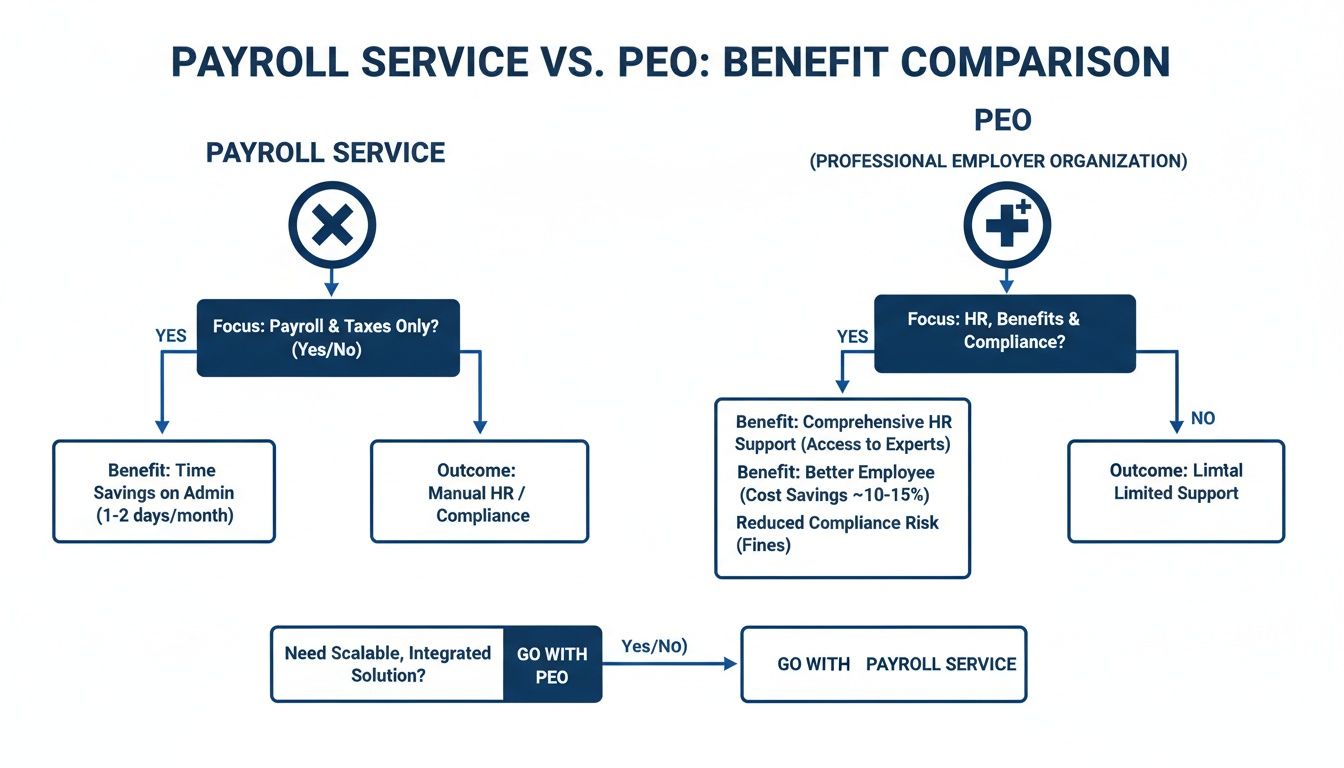
As you can see, if offering robust health and wellness benefits is a strategic priority for you, a PEO provides the infrastructure and access you need to make it happen.
The choice between a PEO and a payroll service really comes down to your strategic goals. If you just need a transaction processed, a payroll service will do. If you need a partner to help you manage risk, attract talent, and support growth, a PEO is the clear answer.
To dig deeper into this, check out these key factors for how to select an HR partner that genuinely fits your company’s needs. Making the right choice now puts your business on a much stronger path for the future.
Frequently Asked Questions
Even with a detailed comparison, a few practical questions almost always come up when businesses weigh a PEO against a standard payroll service. Let’s clear up some of the most common points of confusion.
What Exactly Is Co-Employment?
At its core, co-employment is the legal partnership that makes a PEO possible. It’s a formal agreement where your business and the PEO divvy up the responsibilities of being an employer.
Here’s how it works in practice:
- You (the business owner) keep full control over your business. That means you’re still in charge of day-to-day operations, management decisions, hiring and firing, and your company’s unique culture and mission.
- The PEO steps in as the official employer of record for specific administrative tasks. They handle things like payroll processing, filing payroll taxes under their own tax ID number, administering benefits, and ensuring you’re compliant with all those tricky employment laws.
This shared responsibility is the real game-changer. It legally transfers a huge chunk of employment-related liability from your plate to the PEO’s—a layer of protection a payroll service simply can’t provide.
What Does the Transition to a PEO Look Like?
Switching from a payroll provider or an in-house system to a PEO is a well-managed onboarding process. You’ll typically work with a dedicated implementation team that walks you through every step, making sure the move is seamless for you and your employees.
The process usually breaks down like this:
- Data Collection: The PEO will gather all the necessary company info, employee census data, and your current payroll and benefits details.
- System Setup: They’ll get their HR platform configured with all your company’s information, setting up the framework for payroll, benefits, and compliance.
- Employee Onboarding: Your team will complete their new-hire paperwork online through the PEO’s system, where they can also select their benefits and acknowledge company policies.
A good PEO has this process down to a science. They can often get you fully transitioned in just a few weeks with very little disruption to your daily workflow.
Key Insight: Co-employment doesn’t mean you give up control of your team. Think of it as a strategic partnership where you offload the administrative headaches of being an employer so you can get back to leading your business.
How Does a PEO Work with Our Existing HR Person?
A PEO is built to support your internal HR staff, not replace them. If you already have an HR manager or generalist on your team, the PEO becomes their strategic partner and administrative engine.
This partnership frees your HR professional from getting bogged down in time-consuming tasks like running payroll, managing benefits enrollment, or chasing down compliance paperwork. Instead, they can focus their energy on high-impact initiatives like employee development, performance management, recruiting top talent, and nurturing your company culture. The PEO gives them the tools, expertise, and administrative backup to make their role even more effective.
Ready to stop juggling vendors and start focusing on growth? Helpside provides a single, dedicated team for payroll, HR, benefits, and risk management, giving you the peace of mind to run your business. Learn how Helpside can support your company.