
So, what exactly is HR outsourcing? In simple terms, it’s when you bring in an external partner to manage some—or all—of your company’s human resources functions.
It’s about more than just offloading tasks. For small and midsize businesses especially, it’s a strategic way to tap into specialized expertise in areas like payroll, employee benefits, and the ever-changing world of compliance.
Understanding HR Outsourcing for Business Growth

Think about it this way: you wouldn’t try to be your own lawyer, accountant, and IT specialist while also running your business. The risk and sheer complexity would be overwhelming. Human resources is no different. It’s a field governed by intricate federal, state, and local employment laws, benefits administration rules, and payroll tax regulations that are constantly being updated.
This is where understanding what is HR outsourcing becomes a real competitive advantage. It’s not about giving up control. It’s about forming a partnership with a dedicated team of HR pros, giving you access to knowledge and resources that are often out of reach for smaller companies.
Moving Beyond Administrative Tasks
Many business owners view HR as a purely administrative function. While processing payroll and managing paperwork are certainly parts of the job, strategic HR management goes much deeper. An external partner can handle both the routine tasks and the complex challenges, freeing up your team to focus on what they do best: growing the business.
Here are some of the key functions an HR outsourcing partner typically manages:
-
Payroll Management: Ensuring everyone gets paid accurately and on time, while handling all tax withholding and filings in compliance with federal, state, and local laws.
-
Benefits Administration: Managing everything from health insurance enrollment and carrier relationships to maintaining compliance for retirement plans like a 401(k).
-
Compliance and Risk Management: Navigating the complex web of federal, state, and local employment laws (such as FMLA, FLSA, and ADA) to minimize legal risk.
-
Employee Relations: Offering expert guidance on performance management, conflict resolution, and legally compliant termination procedures.
A strong HR outsourcing relationship acts like an extension of your own leadership team. It gives you the strategic support needed to build a great workforce, reduce risk, and create a positive employee experience—freeing you up to focus on your core business goals.
Why It Matters for Small Businesses
For a small business, a single compliance mistake can be devastating. Misclassifying an employee as an independent contractor or mismanaging a leave request under the Family and Medical Leave Act (FMLA) can lead to significant fines and costly legal battles. On the other side of the coin, not being able to offer competitive health benefits can make it nearly impossible to attract and retain top talent.
We see this all the time. HR outsourcing tackles these pain points head-on. By partnering with experts, you get a vital support system that handles these critical functions with precision. It’s a strategic move that helps level the playing field, allowing you to offer robust benefits and maintain compliance without the overhead of a full-time, in-house HR department.
You can learn more about how outsourcing HR benefits small businesses and helps them overcome these exact challenges. Ultimately, it’s an investment in stability and sustainable growth.
Comparing the Three Main HR Outsourcing Models
Once you start looking into HR outsourcing, you’ll quickly encounter a variety of acronyms. It can feel like learning a new language. But once you understand the models, you’ll see that each offers a different level of service, liability, and benefits.
Figuring out these core differences is the key to choosing a partner that actually fits your company’s size, your comfort level with risk, and your growth trajectory. The three main models you’ll hear about most are the PEO, the ASO, and the more general HRO.
PEO: The Co-Employment Partnership
A Professional Employer Organization (PEO) is built on a co-employment model. This is the most comprehensive and integrated form of HR outsourcing, and it’s often an ideal match for small to midsize businesses that want to offer competitive benefits and minimize compliance risks.
Think of it as a formal business partnership. When you team up with a PEO, your company and the PEO become co-employers of your workforce. You retain control over day-to-day operations, business decisions, hiring and firing, and your company culture. The PEO, meanwhile, becomes the “employer of record” for specific administrative and legal purposes, like payroll taxes and benefits administration.
This legal structure is what allows the PEO to:
-
File payroll taxes under its own Federal Employer Identification Number (FEIN).
-
Provide your employees access to its large-group benefits plans, which often means better health insurance options at more competitive rates than a small business could secure on its own.
-
Share certain employer-related liabilities, such as those related to workers’ compensation and unemployment claims administration.
That last point about shared responsibility is a significant advantage. A PEO’s experts help ensure your employee handbook, policies, and practices are aligned with the complex web of federal, state, and local employment laws.
ASO: The A La Carte Service Model
Next up is the Administrative Services Organization (ASO). The best way to think of an ASO is an ‘a la carte’ menu for HR tasks. Unlike a PEO, there’s no co-employment relationship. You remain the sole legal employer, and you retain all the associated liabilities.
With an ASO, you select the specific administrative functions you want to outsource, such as payroll processing or benefits administration. The ASO executes those tasks on your behalf, but everything—including tax filings—is done under your company’s FEIN.
The key distinction is liability. In an ASO model, the service provider acts as a vendor. They execute tasks you assign, but your company alone is ultimately responsible for all legal and compliance obligations as the employer.
Because you are not part of a larger co-employment pool, you are also responsible for sourcing and negotiating benefits plans for your team. This model can work well for businesses that already have some in-house HR expertise but need to offload time-consuming administrative work. If you want to dig deeper into these differences, you can learn more about PEO services vs. human resources outsourcing.
HRO: The Broad Outsourcing Umbrella
Finally, there’s Human Resources Outsourcing (HRO), which is the broadest category of all. In fact, both PEOs and ASOs are types of HRO. The term HRO can be used to describe any kind of third-party HR service, from a firm that handles a single function to a high-level strategic consultant.
You might hire an HRO provider to manage just one area, like recruiting (often called Recruitment Process Outsourcing or RPO), or to help you develop a comprehensive workforce strategy. It’s a completely customizable, function-specific approach.
To make it a bit clearer, here’s a quick breakdown of how these three models stack up against each other.
PEO vs. ASO vs. HRO: A Quick Comparison
This table highlights the fundamental differences between the three main HR outsourcing models, helping you see which approach might be the best fit for your business.
| Feature | PEO (Professional Employer Organization) | ASO (Administrative Services Organization) | HRO (Human Resources Outsourcing) |
|---|---|---|---|
| Employment Model | Co-employment; PEO is employer of record for tax purposes. | No co-employment; you remain the sole employer. | No co-employment; functions as a third-party vendor. |
| Liability | Certain employer liabilities are shared between your company and the PEO. | All employer liabilities remain solely with your company. | Varies by service, but you typically retain most liability. |
| Benefits Access | Access to PEO’s large-group health insurance and retirement plans. | You source and manage your own separate benefits plans. | Typically does not include access to master benefits plans. |
| Service Scope | Comprehensive, bundled services (payroll, benefits, risk, compliance). | A la carte; you select specific services like payroll processing. | Can range from single-function (e.g., recruiting) to strategic consulting. |
| Best For | Small to midsize businesses seeking comprehensive support, better benefits, and risk mitigation. | Companies needing help with specific administrative tasks while retaining full control and liability. | Businesses needing specialized support for a single HR function or project-based work. |
As you can see, the right choice really depends on how much support you need, the benefits you want to offer, and how you want to manage employment risk.
The Strategic Benefits of an HR Partnership
Beyond the definitions and models, the real question is: what’s in it for your business? When you shift from handling HR in-house to bringing on a partner, you unlock some serious advantages that can fundamentally change how you operate and grow.
This isn’t just about delegating tasks. It’s about turning a cost center into a source of competitive strength, empowering your business to compete on a larger scale, protect itself from risk, and free you up to focus on what actually matters.
Unlocking Enterprise-Level Benefits and Cost Savings
One of the first and most powerful perks of partnering with a PEO is gaining access to enterprise-level employee benefits. For a small business, trying to negotiate competitive health insurance or a robust 401(k) plan is often difficult. Premiums can be high and options limited, making it tough to attract and retain great people.
A PEO changes the game by pooling employees from all its client companies into one large group for benefits purposes. This collective buying power gives them the leverage to negotiate more favorable rates and plans with insurance carriers. Suddenly, your small team can offer the kind of high-quality, affordable health, dental, and vision insurance that was once only available to large corporations.
This is more than just a nice-to-have; it’s a critical tool for growth. Offering fantastic benefits makes your company a place where top talent wants to work, helping you build a stronger, more dedicated team.
Navigating Complex Compliance and Mitigating Risk
Federal, state, and even local employment laws create a constantly shifting landscape. From FMLA leave and overtime rules under the FLSA to workers’ compensation and proper employee classification, one misstep can trigger audits, significant fines, or legal battles that could cripple a small business.
An HR partner acts as your dedicated compliance resource. Their team of experts lives and breathes these regulations. They help ensure your employee handbook is current, payroll withholdings are accurate for employees in different states, and your workplace practices are aligned with the latest legal requirements.
This proactive approach to risk management is where an HR partnership truly shines. Instead of reacting to problems after they happen, you have specialists working to prevent them in the first place. That kind of peace of mind is invaluable.
This is where the different HR outsourcing models really come into play. A comprehensive strategy branches into specialized models like PEOs and ASOs, each designed to manage different aspects of your HR.
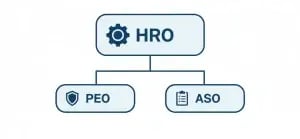
As the diagram shows, while HRO is the umbrella term, a PEO provides the deepest level of support by sharing certain risks and compliance burdens with you.
Gaining Administrative Freedom and Strategic Focus
How many hours a week do you or your key leaders spend on administrative HR? Processing payroll, managing benefits enrollment, handling onboarding paperwork—it’s all essential, but it doesn’t directly generate revenue. These tasks are distractions from your core business.
Outsourcing these functions gives you back your most valuable asset: time. By offloading the administrative weight, you and your managers can finally concentrate on the work that actually grows the business, like product development, customer service, and strategic planning. This isn’t just about being more efficient; it’s about putting your energy where it has the greatest impact.
And the data backs this up. Businesses that use a PEO grow 7-9% faster, have 10-14% lower employee turnover, and are 50% less likely to go out of business. You can dig into more of the numbers by exploring these outsourcing statistics.
Enhancing the Employee Experience
Finally, a great HR partner helps you create a better overall experience for your team. Think about it: a smooth onboarding process, an easy-to-use benefits portal, and a reliable person to call with HR questions. These things add up to a professional and positive work environment.
When employees feel supported and their administrative needs are handled seamlessly, they’re more engaged, productive, and likely to stick around. Better retention not only saves you a fortune in recruiting and training costs but also helps you build a stable, experienced team and a stronger company culture.
How to Calculate the Real Cost and ROI
When business owners start looking at HR outsourcing, their eyes often go straight to one number: the per-employee-per-month (PEPM) fee. It’s an important figure, but it’s only a small piece of a much larger financial puzzle.
To really understand the value, you have to stop thinking about it as just another business expense. Instead, see it for what it is—a strategic investment with a measurable return.
The first step is getting an honest look at what you’re truly spending on HR right now. This means digging deeper than the obvious line items to uncover the hidden costs buried in your day-to-day operations.
Identifying Your In-House HR Costs
Before you can figure out the ROI of bringing on an HR partner, you need a clear baseline. The real cost of managing HR yourself is almost always higher than you think. Start by adding up these often-overlooked expenses to get your “all-in” number.
Here’s what to track:
-
Leadership and Staff Time: How many hours a week do you, an office manager, or other leaders spend on HR tasks? Consider the time spent running payroll, answering employee questions, navigating benefits renewals, or researching compliance laws. Multiply those hours by their wage or salary rate to get a real dollar amount.
-
Direct Vendor Costs: Add up all the monthly or annual fees you pay for separate services. This includes your payroll software, benefits broker fees, and subscriptions for HR tools or legal advice hotlines.
-
Compliance and Risk Exposure: This one is harder to quantify but critically important. A single compliance mistake—like misclassifying an employee or mismanaging a leave request—can easily lead to fines and legal fees that can cost tens of thousands of dollars. While you can’t predict a lawsuit, you have to acknowledge the financial risk your business is carrying.
-
Turnover and Recruiting Expenses: High employee turnover is expensive. Factor in the cost of job postings, the time spent interviewing candidates, and the lost productivity during hiring and training. Inadequate benefits or a poor employee experience are often major drivers of turnover.
By tallying these expenses, you begin to see the full financial weight of your current HR model. This comprehensive figure—not just your payroll software fee—is the true number to compare against a potential partner’s proposal.
Calculating the ROI of a Partnership
Once you have a handle on your current costs, you can actually measure the ROI of partnering with an HR provider. The calculation goes way beyond a simple cost comparison and starts to focus on the value and savings you gain.
The formula is pretty straightforward: you compare your “all-in” in-house HR cost against the partner’s single, transparent fee. For many businesses, the direct cost savings are obvious right away. If you’re currently spending $4,000 per month on payroll software, staff time, and broker fees, a PEO proposal for $3,500 per month already shows a positive return.
But the real value often comes from cost avoidance and other strategic gains. For example, a PEO can often secure more competitive rates on health insurance and workers’ compensation, leading to significant premium savings that can more than cover the PEPM fee itself. You can learn more about how HR outsourcing can reduce costs in our detailed guide.
This process changes the conversation from, “How much does this cost?” to, “How much value will this create?” It helps you see an HR partnership not as an expenditure, but as a strategic investment that frees up capital, reduces risk, and helps your business grow sustainably.
Common Risks and How to Avoid Them
Outsourcing your HR is a big step, and while the benefits are clear, a successful partnership means going in with your eyes open. You’re placing a huge amount of trust in an external provider—their people, their systems, and their technology. The best way to build a strong foundation is to tackle the common worries head-on before you sign anything.
Most business owners we talk to have the same three anxieties: losing control, finding the right cultural fit, and keeping their employee data secure. The good news is that these are all completely manageable with the right questions and a solid vetting process.
Maintaining Control and Leadership
A common myth is that outsourcing HR means giving up control over your people and culture. In reality, the best HR partners act as an extension of your team, not a replacement for your leadership. You always keep full authority over who you hire, who you let go, your day-to-day operations, and the kind of workplace you want to build.
Think of it this way: your HR provider handles the administrative headaches and compliance burdens that pull you away from what you do best—leading your company. They offer expert advice on tricky employee situations, but the final decision is always yours.
Finding the Right Cultural and Service Fit
Not all HR providers are the same. Some operate like giant, impersonal call centers where you get a different person every time you call with a question. For you and your employees, that kind of transactional experience can be incredibly frustrating.
To avoid this, you have to find a partner whose service style actually matches your company’s culture. Look for providers who offer dedicated, one-on-one support.
-
Ask Direct Questions: During your initial conversations, ask them point-blank: “Will I have a dedicated HR professional who knows my business, or will I be routed through a call center queue?”
-
Understand Their Process: Find out what their typical response times are and how they handle complex issues, like compliance questions for an employee in another state.
-
Check References: Don’t just take their word for it. Talk to their current clients to get a real feel for what the day-to-day relationship is actually like.
Choosing a partner with a responsive, people-first service model is the key to getting strategic guidance without losing the personal touch your team deserves.
Ensuring Data Security and Confidentiality
Handing over sensitive employee information—like Social Security numbers, salaries, and health data—is a massive responsibility. Data security must be a top priority when choosing a provider. A breach doesn’t just damage your reputation; it opens you up to serious legal and financial consequences.
Your HR partner should act as a fortress for your company’s most sensitive information. Vetting their security protocols isn’t just a suggestion; it’s a non-negotiable step in protecting your business and your employees.
To manage this risk, you need to be a discerning buyer. Look for providers who can show you they take security seriously.
-
Ask for Proof: Inquire about their security protocols, data encryption methods, and their disaster recovery plans.
-
Look for Certifications: Ask if they have certifications like SOC (Service Organization Control) reports. These are third-party audits that validate a provider’s internal controls for handling financial and sensitive data.
-
Verify Compliance: Make sure they are fully compliant with regulations like HIPAA that govern how protected health information is handled.
By thoroughly vetting a potential partner’s approach to control, service, and security, you can confidently find an ally who will be a reliable and trustworthy part of your business journey.
How to Choose the Right HR Outsourcing Partner

Choosing an HR partner is one of the most important decisions you’ll make for your business. This isn’t just about hiring a vendor; it’s about finding a team you trust with your people, your compliance, and your company’s future. With the right roadmap, you can confidently vet potential partners and find one that truly aligns with your growth goals.
The market for these services has grown significantly for a reason. The global HR outsourcing market was valued at $44.3 billion in 2023 and is projected to hit $65.3 billion by 2030. Nearly 80% of companies now outsource some HR functions, making it a mainstream strategy for smart businesses. You can explore more of these global HR outsourcing trends to see the full picture.
This growth means you have more options than ever, which makes a structured evaluation process absolutely essential.
Evaluate Expertise and Compliance Capabilities
Not all HR providers are created equal, especially when it comes to the complexities of multi-state employment law. As you grow and hire employees in new states, you’ll face a maze of different payroll tax requirements, workers’ compensation rules, and leave laws. One mistake can be incredibly costly.
Your first step should be to vet potential partners on their compliance knowledge. Ask specific, state-related questions: “How would you handle an employee’s paid sick leave request in Colorado versus a similar one in Utah?” or “What are the final paycheck requirements in California?” A true partner doesn’t just process payroll; they proactively guide you through these challenges, and their answers will reveal the depth of their expertise.
Analyze the Client Service Model
The way a provider supports its clients is a huge differentiator. For a business with 20 to 150 employees, an anonymous 1-800 number just won’t cut it. The wrong service model can lead to frustrating delays, leaving both you and your employees without answers.
When you have an urgent compliance question or a sensitive employee issue, the last thing you want is to submit a ticket and wait. A dedicated support model ensures you get timely, expert guidance from someone who actually knows your business.
Before you sign anything, dig into their service structure with these questions:
-
Dedicated Representative vs. Call Center: Will you get a single point of contact who knows your business, or will you be routed through a generic help desk every time you call?
-
Expertise and Accessibility: Is your representative a certified HR professional? What are their guaranteed response times for critical issues?
-
Employee Support: How will your employees get help with their benefits or payroll questions? Is the process simple and helpful, or a bureaucratic nightmare?
Scrutinize Benefits and Pricing Transparency
For many small businesses, a primary motivation to consider a PEO is to gain access to high-quality, affordable health benefits. A great partner should offer enterprise-level plans that help you attract and retain top talent. Don’t just look at the premium cost—analyze the plan quality, provider network size, and deductible levels. A cheap plan with a massive deductible isn’t a real benefit.
Just as important is pricing transparency. The PEO industry can sometimes involve hidden fees buried in complex contracts. A trustworthy partner will provide a clear, easy-to-understand proposal with no surprises. Demand a breakdown of all administrative fees, setup costs, and any other potential charges. If a provider is evasive about their pricing, consider it a major red flag. By following this checklist, you can move from simply understanding what is HR outsourcing to confidently picking a partner that will help you scale.
Answering Your Key HR Outsourcing Questions
Even after you understand the different models and benefits, the practical questions are what really matter. Business owners want to know what this partnership actually looks like day-to-day. Let’s tackle the most common questions we hear to help you figure out if this move is right for your business.
Thinking through these real-world scenarios is the final step in understanding what HR outsourcing could mean for your company’s future.
At What Size Should My Business Consider Outsourcing?
There’s no magic number. It’s less about a specific employee count and more about hitting certain growth triggers. While many businesses in the 10-75 employee range find it’s a natural time to look for help, the real signal is growing complexity.
Are you hiring your first employee in a new state? Are your benefits costs becoming a significant budget challenge? Are you spending more time on administrative paperwork than on growing your business? These are the real signs that it’s time to explore a partnership.
How Is This Different from Just Using Payroll Software?
This is a common point of confusion. Viewing HR outsourcing as just a more advanced payroll tool misses the bigger picture. Payroll software is a transactional tool; it processes payments based on the data you enter. It’s a great piece of tech, but it can’t give you strategic advice or protect you from compliance mistakes.
An HR outsourcing partner, especially a PEO, provides a strategic relationship. You get a team of certified experts who offer guidance on complex employee issues, ensure you’re compliant with ever-changing labor laws, and help you manage risk. It’s the difference between using a calculator and hiring a CPA.
Payroll software executes a command. An HR partner helps you make the right command in the first place, ensuring your decisions are both strategic and legally sound.
Will I Lose Control of My Employees with a PEO?
This is probably the biggest myth we hear about the PEO model, and the answer is a firm no. The term “co-employment” can sound intimidating, but it’s a legal framework designed to shift specific administrative burdens—like payroll tax remittance, benefits, and certain liabilities—off your plate. It’s not about taking over your company.
You always keep 100% control over your core business operations. This includes:
-
Hiring and Firing: You decide who joins your team and when someone needs to be let go. Your PEO partner is there to advise on best practices, not to make the decision for you.
-
Daily Management: You manage your employees’ day-to-day tasks, set their schedules, and conduct performance reviews.
-
Company Culture: You are the sole architect of your workplace environment, mission, and values.
Think of an HR partner as your administrative and compliance arm. They handle the backend headaches, freeing you up to lead your team with confidence.
Ready to stop managing HR headaches and start focusing on growth? Helpside provides the expert guidance, Fortune-500 benefits, and dedicated support your business needs to thrive. Learn how Helpside can give you peace of mind.